Hello. This is Lucid Dental Clinic.
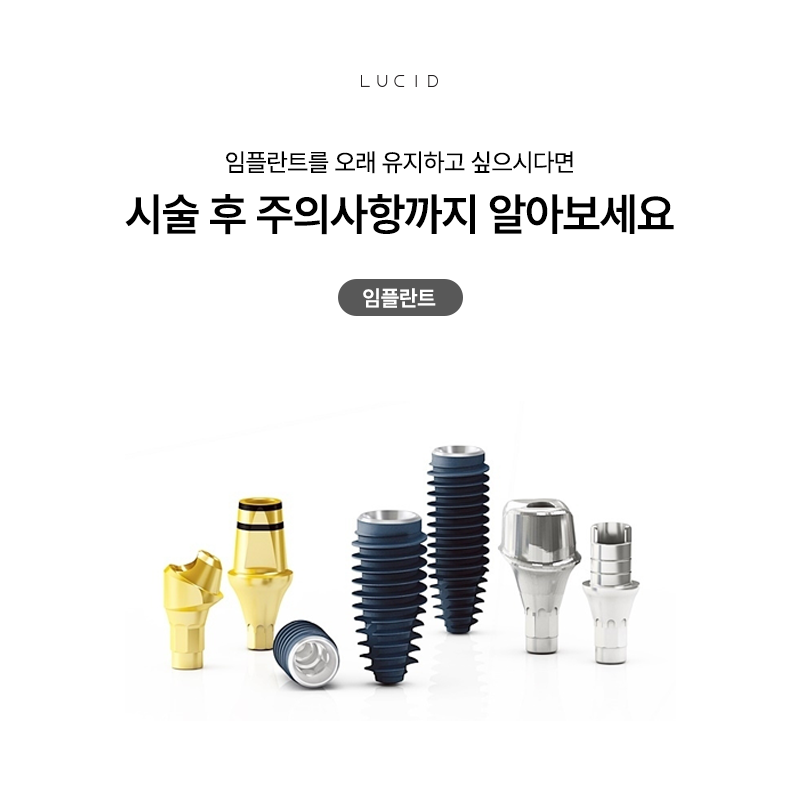
One of the most common questions from people considering implant treatment or those who have already had the procedure is: “How long can it last?” and “How should I care for it so it lasts a long time?”
Implants are not simply replacements for teeth; because they are directly bonded to the gums and bone, post-procedure care largely determines the outcome.
Today, I’ll carefully organize the precautions you need to know in order to keep your implants more stably and for a longer time.
Why is implant care important?
Unlike natural teeth, implants do not have nerves, so even if a problem occurs, it is often difficult to notice early.
Because of that, if care is lacking, by the time symptoms appear, the condition may already have progressed.
Common problems that can occur include:
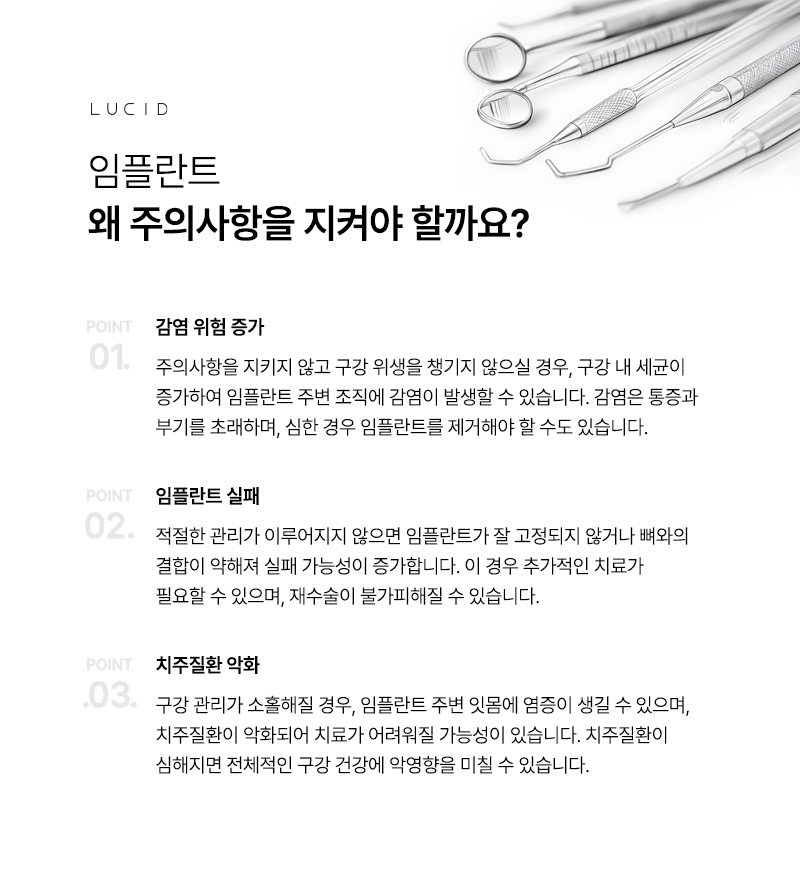
- Increased risk of infection
If oral hygiene is not properly maintained, bacteria can quickly multiply, and inflammation may develop in the gum around the implant. If this continues, swelling, bleeding, and pain can occur, and in severe cases, the implant may even need to be removed.
- Reduced implant stability and possible failure
An implant must firmly integrate with the bone to remain stable, but if care is insufficient, this bond may weaken. Then the implant may become loose or fail to function properly.
- Worsening periodontal disease
If inflammation develops in the gum around the implant, existing gum disease can worsen, and this may also affect overall oral health.
In this way, an implant at Eonju Station Dental Clinic is not a treatment that ends once it is placed; it requires ongoing care and attention.
Things to check before implant treatment
For successful results with an implant at Eonju Station Dental Clinic, preparation before the procedure is also very important.
First, if you have cavities or gum disease in your mouth, those conditions must be treated first. This is because if there are infectious factors present when proceeding with an implant, the likelihood of inflammation after the procedure can increase.
Also, during the consultation, you should fully inform the medical staff about any medications you are currently taking, whether you have any systemic diseases, whether you smoke, and whether you are pregnant.
This information is not just for reference; it is an important factor that directly affects the treatment plan and recovery process.
Precautions immediately after implant treatment
Right after the procedure at Eonju Station Dental Clinic, this is the most important period for the implant to settle in. How you manage this period can greatly affect early stability.
- Be careful with food intake
In the early stage, it is best to eat soft foods. Foods that are gentle and soft, such as porridge, soup, and steamed eggs, can be helpful.
-
Hot foods
-
Spicy foods
-
Chewy or hard foods
It is best to avoid these foods. In particular, if you bite into hard foods and strong force is applied to the implant area, it can affect the initial fixation.
- Limit smoking and drinking
Smoking reduces blood flow to the gums, which can hinder recovery and increase the likelihood of inflammation. Alcohol can also trigger inflammatory reactions, so it is best to avoid it for a certain period.
- Avoid excessive stimulation
You should avoid touching the treated area with your hand or repeatedly prodding it with your tongue. Even small stimulation can affect the recovery process.
Proper care after implants
To keep an implant at Eonju Station Dental Clinic for a long time, daily care is truly important.
- Thorough oral hygiene care
Implants do not develop cavities, but they are still affected by gum disease. So they require even more careful care than natural teeth.
-
Proper brushing 2 to 3 times a day
-
Use of interdental brushes
-
Use of dental floss
-
Use of an oral irrigator if needed
In particular, the space between the implant and the gums can easily trap food, so using auxiliary tools is important.
- Eating habits
Implants can be affected by strong impact or continuous pressure.
These habits can shorten the life of the implant, so caution is needed.
- Regular dental checkups
Regular checkups are essential for implants.
Generally, visiting every 3 to 6 months to check the implant condition, examine the gum condition, and receive scaling and care together can help maintain it more stably.
- Overall health management
Implants are connected not only to oral health but also to overall physical health. In particular, if you have diabetes, blood sugar management is very important, and the more stable your overall health is, the more positively it can affect implant maintenance.
- Managing teeth grinding and clenching habits
Unconsciously clenching your teeth or grinding them can place continuous pressure on the implant. If you have these habits, you may want to consider management methods such as a protective appliance.
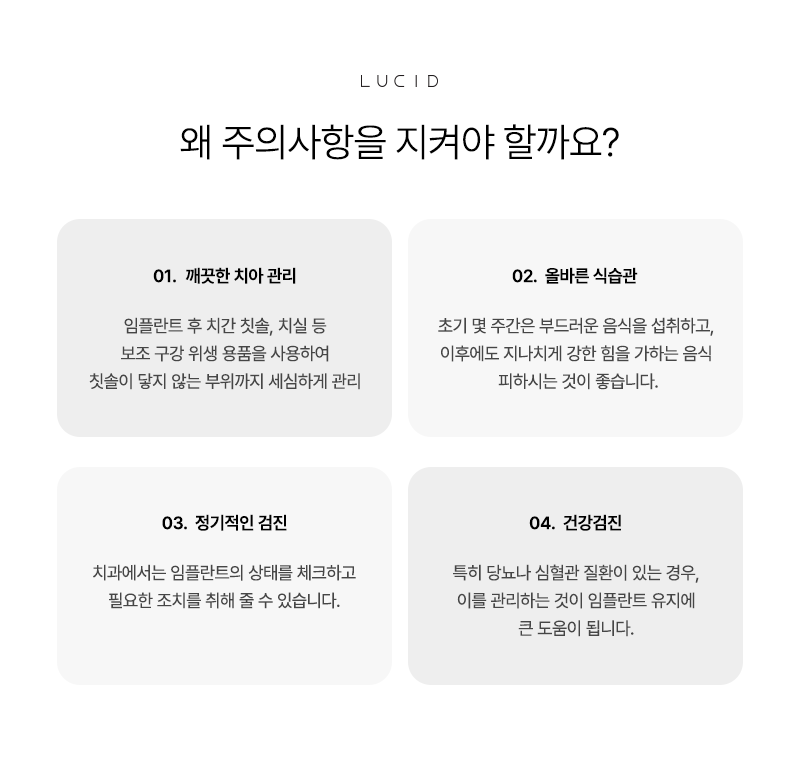
Key summary for keeping implants for a long time
To keep an implant at Eonju Station Dental Clinic for a long time, it is not just simple care, but a change in overall lifestyle that is needed.
If you consistently practice these five things, you can use your implant more stably.
Implant Q&A
Q. Can implants really be used for a long time?
A. Many people ask whether it is a semi-permanent treatment. The usage period of an implant varies greatly depending on how it is cared for. If oral hygiene is maintained consistently and regular checkups are done well, it can often remain stable for a long time. On the other hand, if care is lacking, problems can develop more quickly than expected, so post-procedure care is truly important.
Q. I heard implants don’t get cavities. Does that mean I don’t need to care for them?
A. While the implant itself does not develop cavities, peri-implantitis (gum inflammation) can occur instead. This is the more important point. If the gums weaken, even the bone supporting the implant can be affected, so it is actually better to care for it even more carefully than natural teeth.
Q. When can I resume normal meals after the procedure?
A. It varies slightly depending on each person’s recovery. In general, it is best to start with soft foods in the early stage and gradually expand your diet. If you start eating hard foods too quickly, it can affect implant fixation, so it is important to adapt slowly.
Q. How long does pain last after an implant?
A. Right after the procedure, you may have temporary discomfort or mild pain. However, it often eases over time. If the pain lasts a long time or becomes worse, it is best to get checked.
Q. Can implants become loose too?
A. A properly settled implant is generally not loose. However, looseness can occur if gum inflammation or a problem with bone integration develops. That is why it is important to check the condition through regular examinations.
Q. How often should I go for regular checkups?
A. Usually, visiting every 3 to 6 months to check the condition is recommended. The interval may vary depending on the individual, so it is best to create a customized care plan through consultation.
An implant can be seen not just as a treatment that replaces a tooth, but as a process of restoring everyday comfort and confidence as well.
However, no matter how well an implant is placed, if it is not properly cared for, it may be difficult to maintain the expected results for a long time.
So it is more accurate to think of an implant not as “the end of treatment,” but as the start from that point onward.
Brushing three times a day, one small habit, and one regular checkup at Eonju Station Dental Clinic can accumulate and determine the lifespan of the implant.
If you pay just a little more attention to care, you can eat comfortably without discomfort and maintain a daily life where you can smile naturally.
Above all, continuous attention and consistent care are the most important. Implants are a treatment whose results follow how well they are cared for.
If you have more questions about implants or want to check whether your current condition is okay, you are welcome to visit and consult with us.
Checking even small questions in advance can help maintain a healthier oral condition.
If you have questions, talk to us on Naver Talk Talk!
Lucid Dental Clinic
3rd to 4th Floors, Coway Building, 606 Nonhyeon-ro, Gangnam-gu, Seoul
Naver Reservation :: Lucid Dental Clinic
[LUCID DENTAL CLINIC 루시드치과] Lucid aims to provide dental care that designs both aesthetics and function, not just a place to treat teeth. We understand that visiting a dental clinic requires a lot of 고민 and determination. That is why Lucid’s principle is to treat only as much as needed rather than treating a lot. Preserving teeth and gums as much as possible is the best treatment. We prioritize ways to protect natural teeth and, even when treatment is necessary, provide precise care in a way that minimizes damage. [LUCINATE 루시네이트 프리미엄 라미네이트] Lucid...
m.booking.naver.com
Lucid Dental Clinic
This is Lucid Dental Clinic, bringing you happiness.
pf.kakao.com