Hello. This is Lucid Dental Clinic.
If you are considering wisdom tooth extraction, you may naturally have questions like, “When is the best time to get it removed?”, “How much will it hurt?”, and “When can I start exercising again?”
In particular, for office workers and people who exercise regularly, the recovery period and the timing of returning to daily life can feel even more important.
Today, I’ll organize everything from the basic concept of wisdom teeth, the reasons extraction may be needed, the procedure, problems that can occur if they are left untreated, and the most commonly asked questions about how long the pain lasts and when exercise is possible.
What Are Wisdom Teeth?
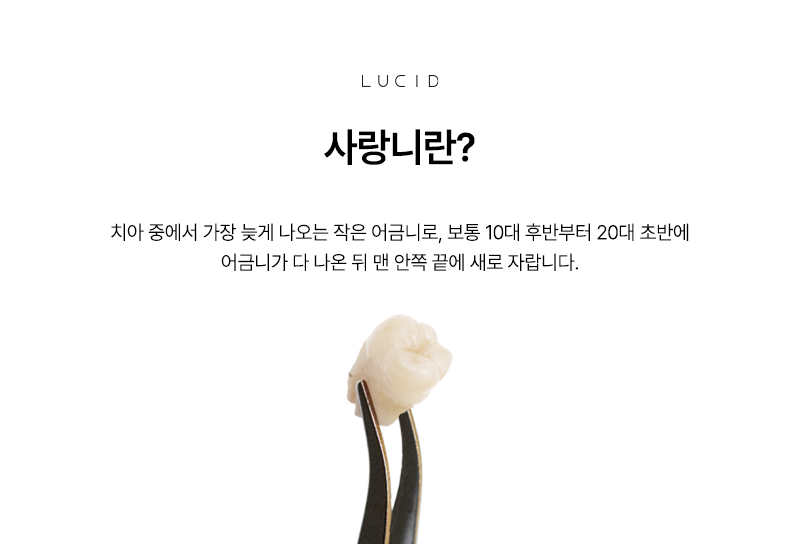
Wisdom teeth usually refer to the third molars that erupt between the ages of 17 and 25.
Because they are located at the very back of the mouth, they are harder to care for than other teeth. If there is not enough space in the dental arch, they often cannot grow in normally.
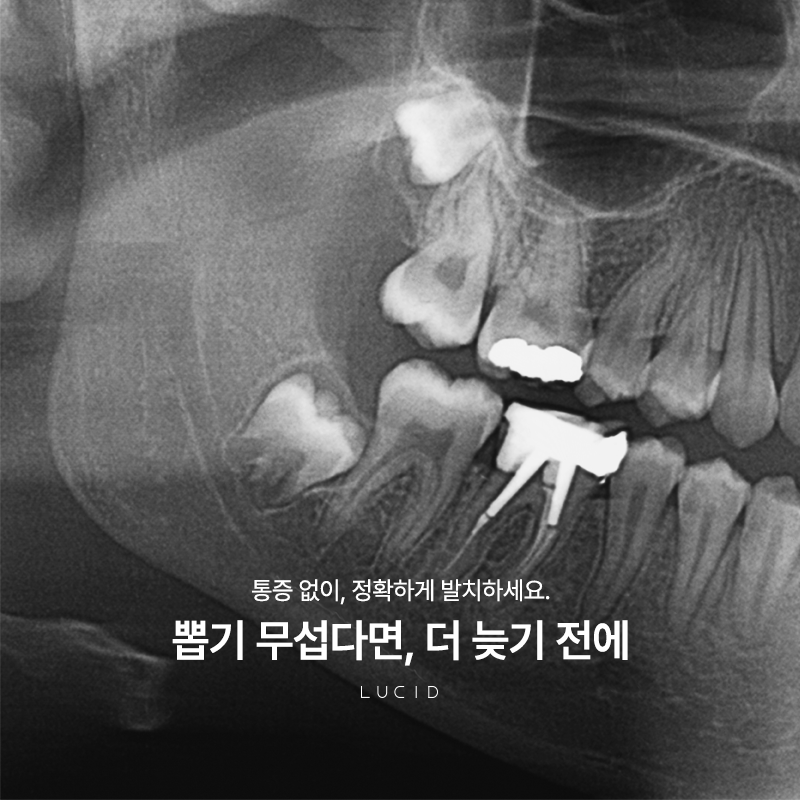
In particular, many modern people have smaller jaw sizes due to changes in diet, so it is common for wisdom teeth to grow at an angle or remain partially or completely covered by the gums.
When the location and shape are not normal like this, it can affect the overall oral environment, not just a single tooth, so an accurate examination of the condition is necessary.
Do Wisdom Teeth Always Need to Be Removed?
Many people think that wisdom teeth must always be extracted, but that is not true in every case.
If they have erupted straight, can be kept clean, and do not cause gum inflammation or pain, extraction may not necessarily be required.
However, in reality, most wisdom teeth are classified as teeth that are likely to cause problems because they grow in abnormal directions due to lack of space, are partially exposed because they are covered by the gums, or are in positions that are difficult to maintain.
In particular, the judgment that “it doesn’t hurt right now, so it’s fine” can lead to bigger problems later, so it is important to determine the direction of treatment through regular checks at a dental clinic near Gangnam Station.
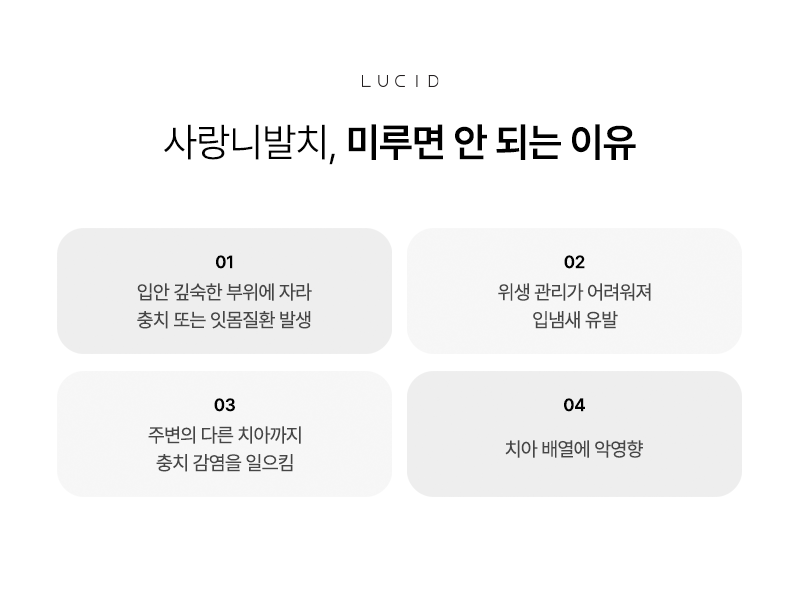
Why You Shouldn’t Delay Wisdom Tooth Extraction
The three most common reasons people delay wisdom tooth extraction are: “It seems okay for now,” “I don’t have time,” and “I’m scared.”
But if you delay it, the following problems can occur:
-
Repeated inflammation of the gum around the wisdom tooth
-
Food trapping that creates an environment where bacteria can grow easily
-
The possibility of cavities spreading to adjacent teeth
-
The teeth may be pushed, affecting the overall alignment
In particular, repeated inflammation can affect daily life not only through pain but also through swelling and limited mouth opening.
Also, as time passes, the tooth roots can become stronger, the bond with the surrounding bone can become firmer, and extraction can become more difficult.
Because this can lead to a longer recovery period, it is important to receive treatment at the appropriate time through a dental clinic near Gangnam Station.
Problems That Can Occur If Wisdom Tooth Cavities Are Left Untreated
If wisdom tooth cavities are left untreated, various problems can occur beyond simple pain.
In particular, because wisdom teeth are difficult to care for due to their location, cavities tend to progress quickly.
Even if there is little discomfort at first, the condition can worsen rapidly over time, so it is important to check early and respond promptly.
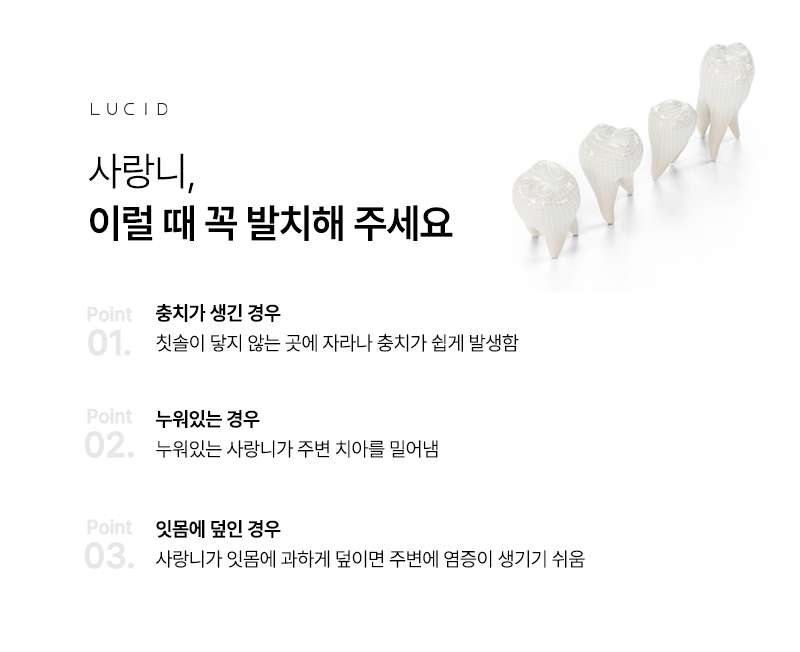
Wisdom Teeth: When Extraction Is Especially Recommended
If any of the following apply, it is a good idea to actively consider wisdom tooth extraction.
- When there is decay
Wisdom teeth are in a position that is difficult for a toothbrush to reach, so cavities can easily develop. The problem is that it can affect not only the wisdom tooth itself but also the neighboring tooth. In this case, removing the source of the problem through extraction may be considered rather than treatment.
- When the tooth is lying sideways
If a wisdom tooth is lying sideways, it continuously pushes against the tooth in front. This can cause pain, changes in dental alignment, and damage to adjacent teeth. Special care is needed for people who have had orthodontic treatment, because their teeth may shift again.
- When it is covered by the gums
If a wisdom tooth has not fully emerged and is partially covered by the gums, food can easily get trapped and an environment where bacteria can grow is created. Since this condition is difficult to improve naturally, removing the root cause through a dental clinic near Gangnam Station can be helpful.
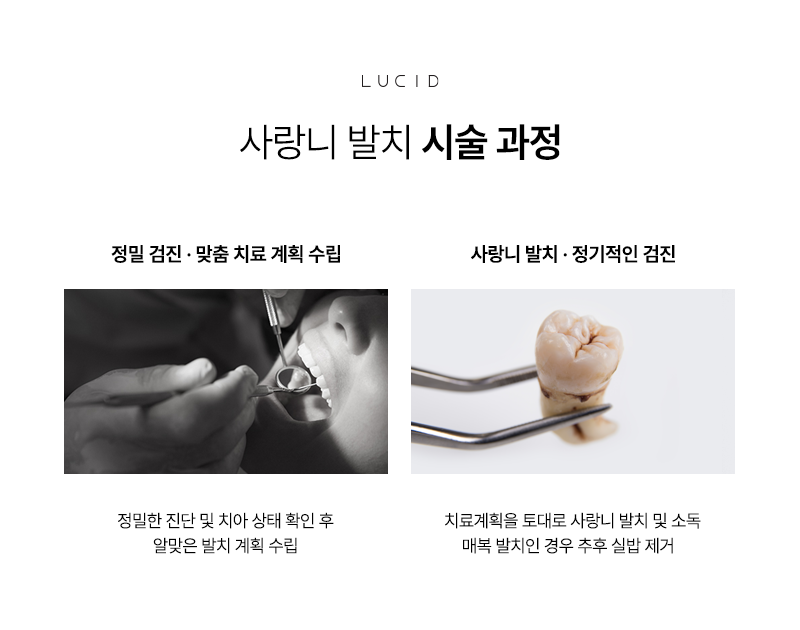
Lucid Dental Clinic Wisdom Tooth Extraction Procedure
Wisdom tooth extraction is not just a simple tooth removal process; it is a procedure in which accurate diagnosis and planning are important.
At a dental clinic near Gangnam Station, the process is carried out in the following steps.
- Detailed diagnosis
The oral condition is examined, and the wisdom tooth’s position, direction, and depth are analyzed. If necessary, imaging is performed to consider its relationship with the nerves.
- Customized extraction plan
A plan suited to the individual condition is established by determining whether a simple extraction is possible, whether the gum needs to be incised, or whether the tooth needs to be divided.
- Extraction after anesthesia
The procedure is performed after sufficient anesthesia, and if necessary, the tooth may be divided and removed. This method helps reduce stress on the surrounding tissues.
- Hemostasis and aftercare guidance
After extraction, hemostasis is achieved with gauze, and precautions are provided to support recovery. Management at this stage can have a major effect on recovery speed.
How Long Does the Pain Last After Wisdom Tooth Extraction?
Pain after wisdom tooth extraction at a dental clinic near Gangnam Station varies from person to person, but generally follows this pattern.
-
Day of extraction to day 2: This is the period when swelling and pain may feel the most severe
-
Day 3 to day 5: Pain gradually eases, and daily life becomes a little easier
-
Around 1 week: Most discomfort decreases
-
After 2 weeks or more: The gum tissue stabilizes and recovery progresses
However, in cases of impacted wisdom teeth or higher-difficulty extractions, the recovery period may be longer than this. Recovery speed can also vary depending on how well care is managed after the extraction.
When Can You Exercise After Extraction?
Exercise can have a positive effect on recovery, so it is important to adjust the timing carefully.
-
Immediately after extraction (1–2 days): Exercise should absolutely be avoided. During this period, bleeding can recur, and increased blood pressure may worsen swelling.
-
After 3–5 days: Light activities are possible, but it is better to limit them to walking or stretching.
-
After 1 week: If recovery is stable, light exercise and low-intensity gym workouts may be possible.
-
After 2 weeks: In most cases, running, weight training, and high-intensity exercise can be resumed without much difficulty.
Things to keep in mind
If you start exercising too soon, problems such as renewed bleeding, worsening pain, and delayed recovery can occur. Therefore, it is important to gradually increase exercise intensity while considering your own recovery status.
Wisdom teeth are not simply teeth that can be left alone; depending on their condition, they can affect oral health.
In particular, because recovery speed and subsequent condition can vary depending on the timing of extraction and how it is managed at a dental clinic near Gangnam Station, accurate diagnosis and planning are important.
At Lucid Dental Clinic, we take each patient’s condition into full consideration and help ensure treatment is carried out in a stable direction with unnecessary burden minimized.
If you have discomfort caused by your wisdom teeth or are 고민 about the timing of extraction, we recommend not delaying and checking your current condition.