Hello, this is Lucid Dental Clinic.
In the past, implants focused simply on placing artificial teeth in the missing area. Modern dentistry, however, aims to help patients return to daily life as accurately and quickly as possible.
Medical technology has advanced day by day, and success rates are higher than before. Still, many patients remain concerned about side effects such as pain and nerve damage.
This is because each patient’s oral structure is as unique as a fingerprint, and a high level of precision is required to avoid disturbing the complex nerves and blood vessels beneath the jawbone.
Ultimately, when considering Gangnam dental implants, the key point we should focus on is how an experienced specialist interprets and applies the data provided by digital equipment.
What is a navigation implant?
Many people are curious about what a Gangnam dental navigation implant is.
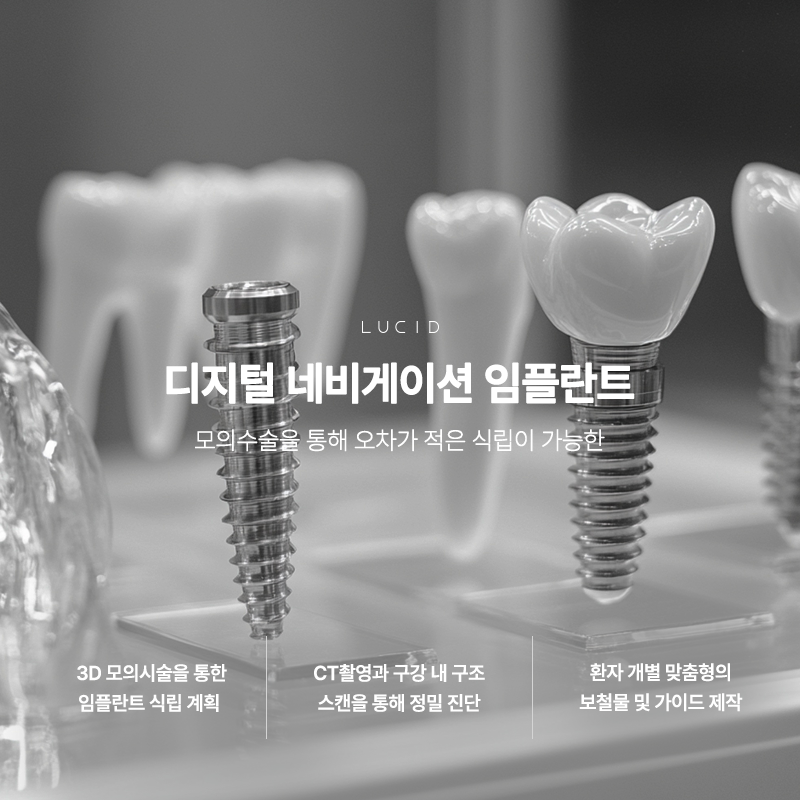
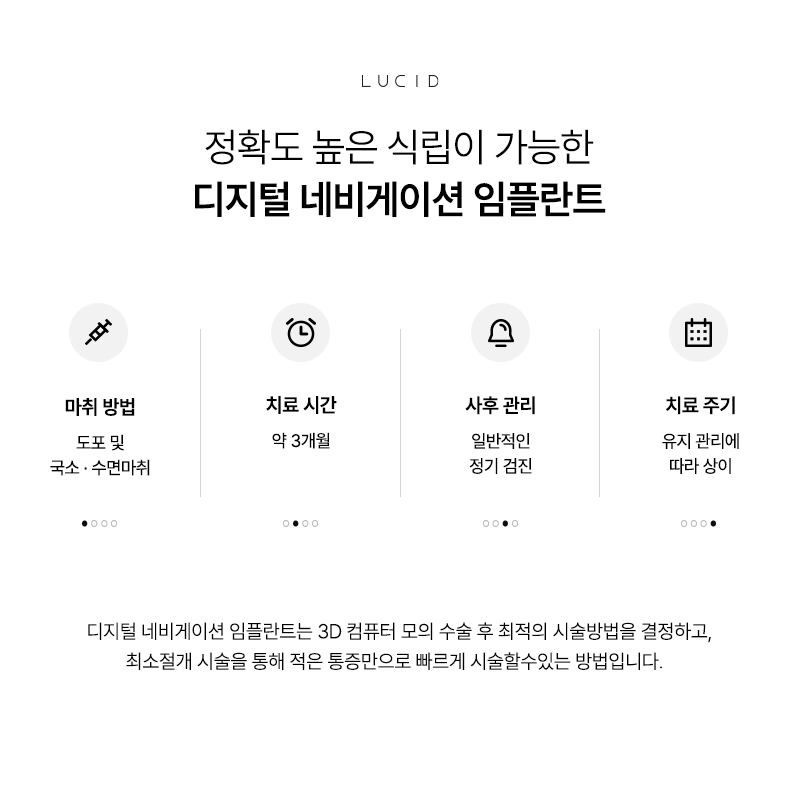
Unlike conventional surgery, navigation refers to surgery that uses computer analysis. Based on preoperative 3D CT imaging and prior data, the patient’s overall oral condition is analyzed, a mock surgery is performed using that data, and a surgical guide is created before the implant procedure is carried out. This is collectively referred to as computer-assisted implant surgery, and it is commonly called a navigation implant.
Because the procedure uses computers and data, customized implants for each patient are possible, and various side effects can also be reduced, which is why many people prefer this surgical method.
What are the advantages of navigation implants?
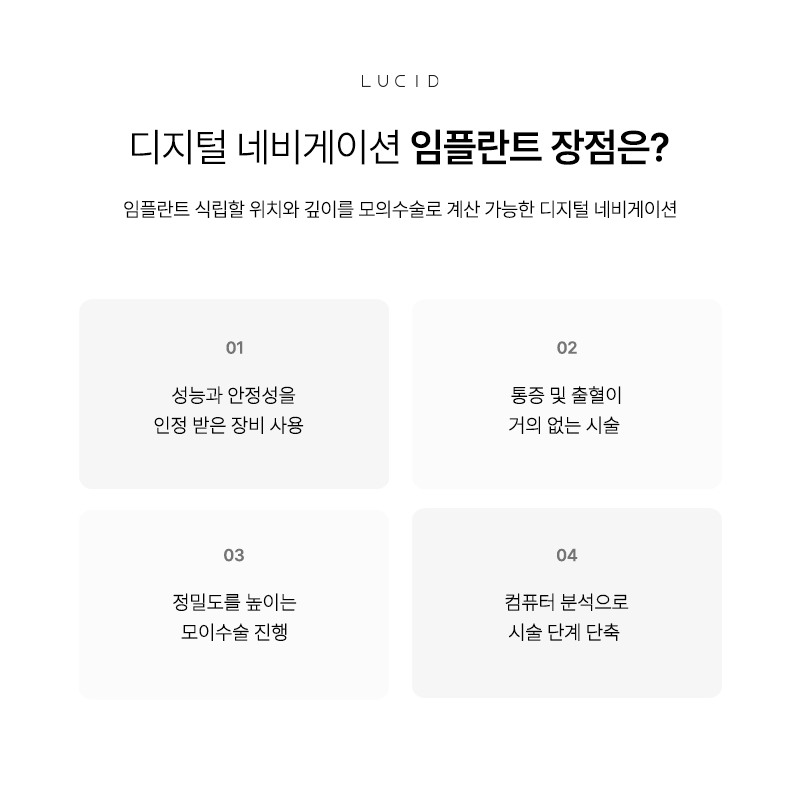
The biggest advantage is that, unlike conventional surgery, accuracy improves because mock surgery and guide fabrication are performed using personalized preoperative data.
Unlike traditional treatment, the incision area is clearly smaller, and because placement is performed with a precise guide, the implant position and angle can be set accurately, resulting in high success rates and accuracy.
Next is shorter procedure time.
In addition to the accuracy advantage mentioned above, the procedure is carried out after preoperative simulation and mock surgery, along with guide fabrication. This not only specifies the exact location where the implant will be inserted, but also takes into account in advance information such as the distance to surrounding teeth, bone tissue, and nerve positions. As a result, increases in surgical time due to various variables can be reduced.
Lastly, customized surgery for each patient is possible. In addition to 3D CT imaging, preoperative analysis allows for precise identification of each person’s unique oral structure, making it possible to understand the slightly different oral condition and anatomy of each patient in advance and perform customized surgery.
This can increase the expected lifespan of the implant, and Gangnam dental digital navigation implants are also possible for patients with underlying conditions such as systemic disease or diabetes.
How is the navigation implant procedure performed?
Gangnam dental navigation implants are performed through the following process.
- Detailed examination and data collection
First, 3D CT imaging and oral scanning are used to analyze the teeth, gums, and bone structure in three dimensions. Through this process, the patient’s oral condition can be understood more accurately.
- Digital simulation
Based on the collected data, the implant placement position, angle, and depth are planned in advance on a computer. This process is a core step in the treatment plan, and the optimal position is determined by considering various conditions.
- Surgical guide fabrication
A guide is produced so the planned position can be applied to the actual surgery. This guide helps ensure that the implant is placed in the correct position.
- Implant placement
The implant is placed in the planned position using the guide. This makes a more precise procedure possible.
Through this process, treatment can also be approached in a more systematic way.
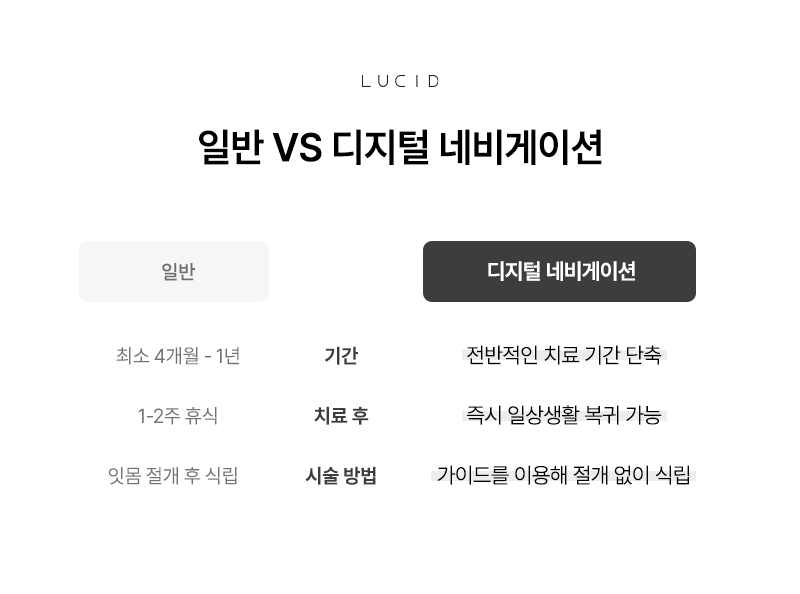
How is it different from a regular implant?
Compared with conventional implants, the navigation method has several characteristics.
Because the position is planned in advance through digital simulation, placement can be more precise, and because the treatment plan is based on the patient’s oral structure, a personalized approach is possible.
It also differs in that the overall treatment period can be shortened, return to daily life may be possible immediately, and placement can be done without incision using a guide.
Because of these points, more people visiting Lucid Dental Clinic are considering navigation implants.
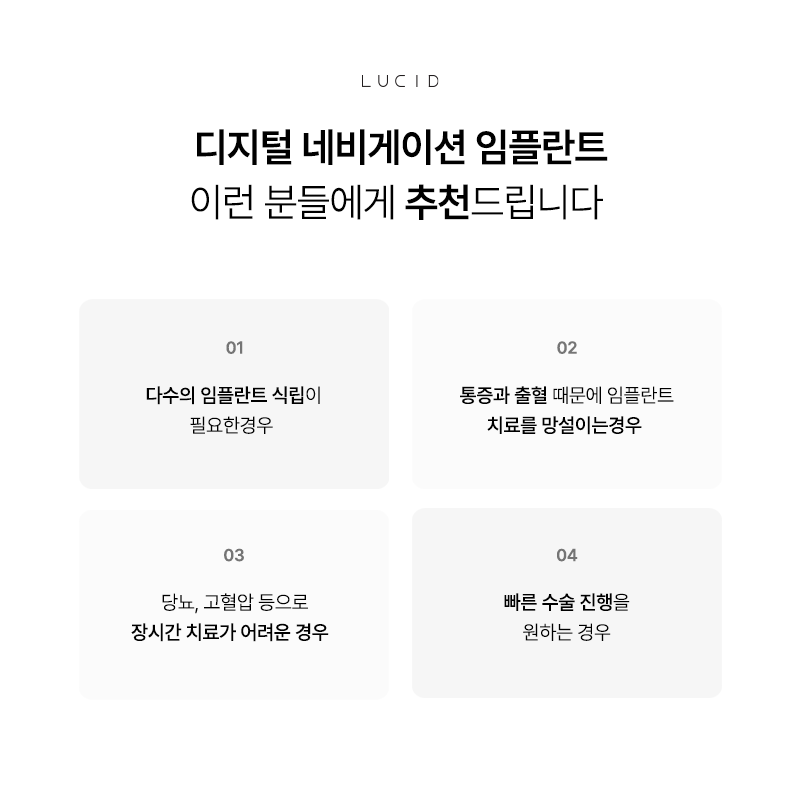
When is a navigation implant suitable?
It can be applied not only to general tooth loss, but also to complex cases where bone tissue is insufficient or the site is close to nerves.
It is especially suitable in the following cases:
-
When tooth loss causes difficulty with eating or speaking
-
When existing dentures do not fit well and are uncomfortable
-
When bone tissue is insufficient or the implant site is close to a nerve
-
When long-term oral health and functional recovery are needed
It is important to develop a customized plan through 충분한 consideration and detailed analysis in advance, and receiving detailed care before and after treatment can help you undergo the procedure with greater confidence.
In addition, it is advisable to consider this not only for dental health, but also for the recovery of overall oral function.
If you want to reduce anxiety about implants and expect more accurate and predictable results, Gangnam dental navigation implants can be a very good choice.
From the pre-treatment stage, a detailed plan is established, and the surgical guide system that faithfully implements that plan reduces the burden of surgery and improves the stability of the results.
If a dental clinic is equipped with digital diagnostic equipment, a precise surgical system, an experienced medical team, and a structured aftercare system, you can experience these advantages more reliably.
In addition, one of the main reasons people delay treatment is often the burden of time.
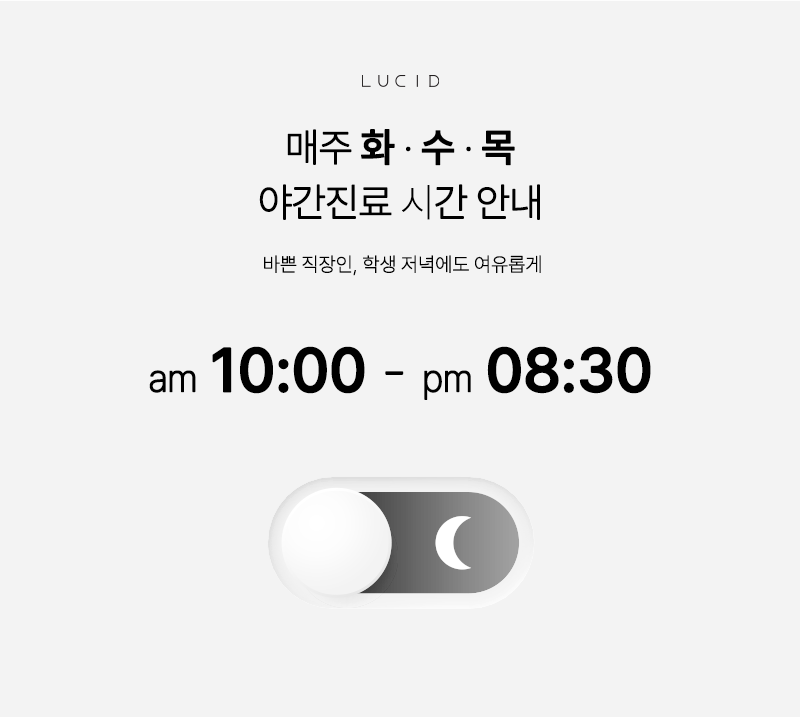
At Lucid Dental Clinic, weekday evening care and Saturday appointments are available, so you can visit with relatively less difficulty even during a busy schedule.
Treatment is available until 8:30 p.m. from Tuesday to Thursday, and until 4:00 p.m. on Saturdays, so if time has been a major concern for you, please use these time slots to continue your treatment consistently. Thank you.