
Hello. This is Lucid Dental Clinic.
If your gums show before your teeth when you smile,
it may have been something you have worried about at least once.
This is what we call a gummy smile.
A bright smile clearly makes a good impression,
but if too much gum shows or the teeth appear
excessively large overall, some people may feel self-conscious.
Typical examples include covering your mouth for no reason when taking photos,
or becoming hesitant to smile widely.
So today, we’d like to talk about Gangnam gum contouring
as a way to help improve these concerns.
It is a treatment that helps balance the gums.

How is gum contouring performed?
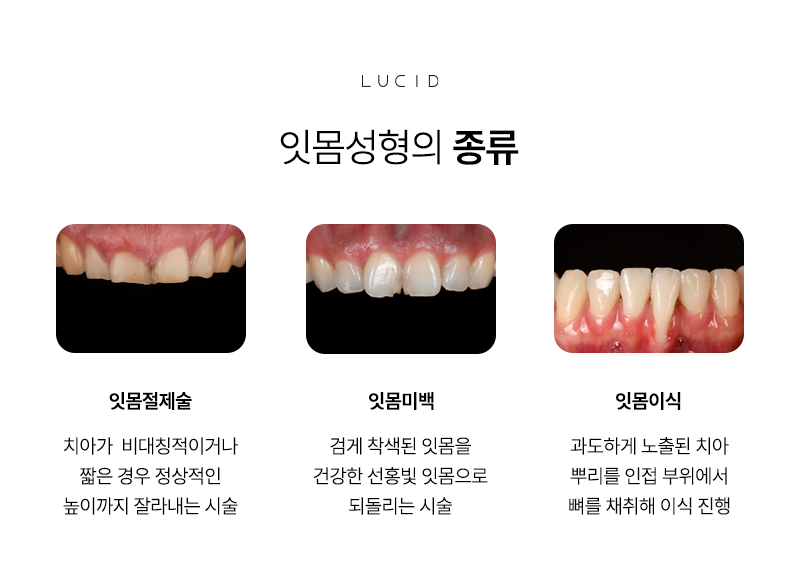
Gangnam gum contouring refers to a treatment that trims along the shape and line of the gums surrounding the teeth to make the proportions look more natural and visually pleasing.
It is not about simply removing gum tissue, but is closer to a process of designing an aesthetic line while considering both length and position.
Because this area is most visible when smiling, even a slightly awkward line can change the overall impression. That is why, when Gangnam gum contouring is used to arrange the teeth so they show more clearly, it can give a much neater and more refined look.
These days, although it still has functional purposes,
it has become a field that people start for the sake of creating aesthetically balanced tooth proportions.
Why does a gummy smile occur?
A gummy smile cannot simply be said to happen only because too much gum is visible; there are various causes.
The most common cases include the upper lip rising more than usual when smiling, the gums covering too much of the teeth so the teeth appear short on their own, or increased exposure due to structural issues with the jaw or jawbone.
When the cause differs, the solution also changes. In some cases, gum contouring alone can improve the condition, while in others, better results may require additional treatments such as veneers or orthodontic treatment.

In which cases is gum contouring effective?
There are cases where it is especially suitable.
This refers to when the actual tooth length is normal, but the gums cover the teeth excessively.
In such cases, even a slight adjustment along the line can lead to a noticeable improvement and a more refined appearance.
The teeth appear longer, the amount of gums visible when smiling is reduced, and the overall balance is naturally achieved. The line of the front teeth, which may have looked cramped, becomes more open, and confidence can gently come through in your smile.
However, there is one very important point before Gangnam gum contouring.
Removing more is not necessarily better.
The ratio between teeth and gums, left-right symmetry,
and even lip movement when smiling must be considered
for a natural result.
If too much is removed, sensitivity may occur,
or the line may not match and require re-treatment,
so pre-treatment planning is truly important.

What should be considered when making a pre-treatment plan?
Just as natural aesthetics are important, Gangnam gum contouring chosen to address a gummy smile is closer to a design-based treatment.
When planning before treatment, several factors should be examined together.
First, it is important to check the position of the alveolar bone.
Depending on the bone position beneath the gums, the range that can be trimmed changes, so if tissue is removed carelessly and the bone becomes exposed, it can actually cause a bigger problem.
Next are tooth length and proportion.
There is an ideal length-to-width ratio for the front teeth. If only the gums are reduced without considering this, the teeth may end up looking too long.
Lastly, the balance of the smile line,
lip movement, and even the face shape must be considered.
Because everyone has a different smiling pattern,
a line that looks good on one person may look awkward to another, so it must be tailored to each individual and performed only within the necessary range.
Above all, I think it is important to remember that it should look natural.
Gum Contouring Q&A
Q. Does the procedure hurt a lot?
A. Since it is usually performed under local anesthesia,
there is almost no pain during the procedure.
Q. Can the gums grow back?
A. Because gums have a natural tendency to maintain their thickness,
they can grow back.
Q. How long do the procedure and recovery take?
A. It depends on the number of teeth, but usually takes about 20 to 40 minutes,
and recovery generally takes about 1 to 2 weeks.