
Hello. This is Lucid Dental Clinic.
As you use your teeth for a long time, some changes are among the first signs you can actually feel.
For example, even when there does not seem to be a big difference at a glance, there are often cases where your gums bleed slightly when brushing, or your mouth repeatedly feels unrefreshed.
These changes are easy to dismiss as temporary, but in reality they may be signs that traces have gradually accumulated within the oral environment. That is why some people choose to have their condition checked through a Gangnam scaling dental clinic in this flow.
In particular, because there are parts of the teeth that are difficult to see with the naked eye, it is not easy to judge when care is needed, and tartar is one of the factors involved.
Since it is difficult to judge the condition based only on visible dirt, a systematic approach is necessary.

About the principle of scaling
Tartar refers to plaque formed by food debris and bacteria that has hardened over time.
It starts off soft at first, but gradually becomes harder and changes into a state that is difficult to remove with ordinary brushing.
The care method used at this stage is scaling. Scaling is the process of physically removing hardened deposits attached to the tooth surface and the gumline.
Its purpose is not simply to wipe the surface clean, but to reach the gap between the teeth and gums and clear away accumulated deposits.
At the Gangnam scaling dental clinic, ultrasonic instruments and hand tools are used to separate tartar attached to the teeth, and the process also includes smoothing the tooth surface.
Once the surface has been cleaned like this, you may also notice that daily hygiene becomes easier, and it is helpful for dental health to understand scaling not as simple cleaning, but as a basic step in organizing the oral environment.
How does tartar affect the teeth?
The reason tartar management is important can be seen in its relationship with the gums.
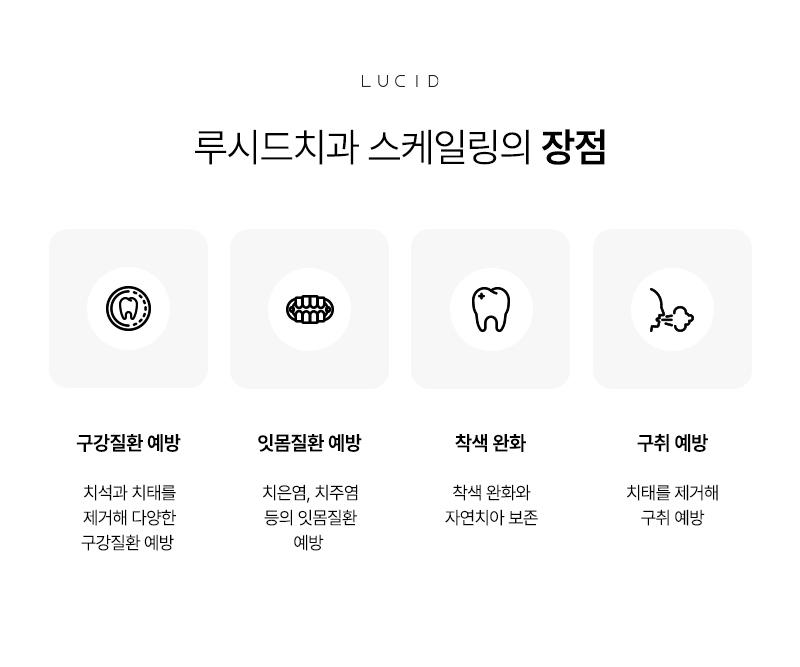
Hard deposits create an environment where bacteria can remain easily and act as a factor that continuously irritates the tissues around the gums. Over time, this can lead to swollen gums or bleeding when brushing, and it may also worsen bad breath.
These changes usually do not appear suddenly, but progress gradually, which makes them difficult to recognize early. Therefore, to prevent these issues, it is important to regularly check the condition through a Gangnam scaling dental clinic.
Judging the timing of care based on small signs rather than visible problems can help maintain a stable oral environment.
In particular, even if there is no discomfort, tartar tends to form naturally over time, so additional checkups are necessary. However, the interval may be shorter or longer depending on personal oral hygiene habits or gum condition.

Who is scaling recommended for?
If you have the following symptoms, they are likely not just simple discomfort but signs that gum disease may be progressing.
- Your gums bleed when brushing
- Your gums swell often
- Bad breath has become severe
- Your teeth feel sensitive to cold water or cold food
- Your gums have receded and your teeth look longer
- Your teeth feel loose or weak when chewing
- Food often gets stuck between your teeth
If you have these symptoms, you may need not only scaling but also a gum examination and periodontal treatment. Therefore, it is important to receive an accurate examination at a dental clinic in Gangnam.

The scaling process and habit management
The scaling process is relatively simple, but if it is your first time, it may feel unfamiliar.
In particular, some people are surprised by the sensation or sound when the instrument touches the teeth, but in reality it is performed within a range that does not damage the tooth surface.
At the Gangnam scaling dental clinic, the process is often carried out with individual sensitivity in mind, and depending on the situation, a sensitive feeling may occur.
This is a reaction that happens as the area covered by tartar is exposed, and it is natural for it to gradually ease over time.
During scaling, daily habits are also an important factor. Since tartar can form again, your usual brushing method and diet have an effect. Therefore, maintaining the habit of carefully cleaning even between the teeth can help slow the rate at which deposits form.
If you often consume sticky or hard foods, careful management is necessary.
Regular checkups through a Gangnam scaling dental clinic, along with daily care habits, play an important role in maintaining dental health. Scaling is not care that ends after one session; its meaning is maintained only when it is connected to ongoing care.
A process of organizing changes that are not visible
Scaling is closer to a process of organizing invisible changes than to treatment that resolves visible problems.
Because the teeth are used every day, small changes easily accumulate, and the results often appear later.
Therefore, even if there is no particular discomfort, checking the current condition and continuing the necessary care can affect long-term oral health. From this perspective, regular checkups through a Gangnam scaling dental clinic can be understood as one method of management.
What matters is not the changes you can see, but how you manage the accumulated environment.
If you maintain dental health through regular scaling and check your condition, it will greatly help you keep your teeth healthy for a long time.
Scaling Q&A
Q. How far does scaling treatment go?
A. Dental treatment for removing tartar can be divided into basic scaling and periodontal curettage depending on the purpose and the condition of the teeth.
Basic scaling is a fundamental procedure that removes tartar and plaque visible to the naked eye on the outer tooth surfaces and above the gumline. It is mainly performed for preventive purposes to block periodontal disease in advance and maintain healthy gums.
Periodontal curettage is an advanced treatment performed when periodontal disease has worsened and basic scaling alone is not enough to improve the condition.
Q. Why do gums swell after scaling?
A. Many people experience swollen gums, throbbing pain, or bleeding during brushing after scaling.
If tartar is not removed in time and is left untreated, it gradually travels along the tooth root and into the periodontal pockets, the deep spaces inside the gums.
Tartar that has entered deep into the gums can continuously release bacteria and toxins, which may cause chronic inflammation in the gums.
If the swelling does not go down even after several days following scaling, and instead becomes increasingly severe, it may not be a temporary reaction caused by simple physical irritation, so it is advisable to check whether additional treatment is needed.
Q. Why do gums feel sensitive after scaling?
A. Right after scaling, you may feel sensitivity or a sharp, tingling sensation when drinking cold water or brushing your teeth.
Rather than being caused by damage from the instrument, this is a natural response that occurs as the root portion of the tooth, which had long been covered by layers of tartar, becomes exposed.
If tartar built up at the junction between the tooth and gum is left untreated for a long time, bacteria and inflammation cause the gums to gradually recede. At this point, hardened tartar fills the space left by the receding gums and thickly covers the sensitive tooth roots.
When scaling removes that tartar, the tooth roots that had been hidden are fully exposed.
Because tooth roots are sensitive to temperature and stimulation, temporary sensitivity occurs. This is the process by which the body adapts to a new environment after tartar has been removed, so it tends to gradually improve over time.
Q. Won't getting scaling too often weaken the teeth?
A. Scaling performed in the proper way removes tartar and bacteria; it does not remove healthy teeth.
If tartar is left untreated, the jawbone can gradually dissolve and the teeth may even become loose.
In general, annual scaling once a year is recommended, but if gum inflammation occurs frequently or if you have periodontitis, care may be needed every 3 to 6 months.
The important thing is not how often you receive it, but whether it is managed according to the condition of your gums.