Hello, this is Lucid Dental Clinic.
Have you ever experienced a tingling, throbbing feeling in your gums whenever you are tired or your immune system is weakened?
People often say that when teeth become sensitive and loose with age, periodontal disease has set in.
Recently, due to stress and irregular lifestyle habits, many people in their 20s and 30s have also been visiting the clinic with symptoms of periodontal disease.
Periodontal disease is easy to neglect because the early symptoms are not very clear, and by the time pain is noticed, the teeth may already be severely loose and extraction may be necessary.
Today, I’ll introduce everything in detail, from the definition of periodontal disease to the causes of pain, self-check methods, and daily prevention tips, so you can preserve your precious natural teeth for as long as possible.
What is periodontal disease?
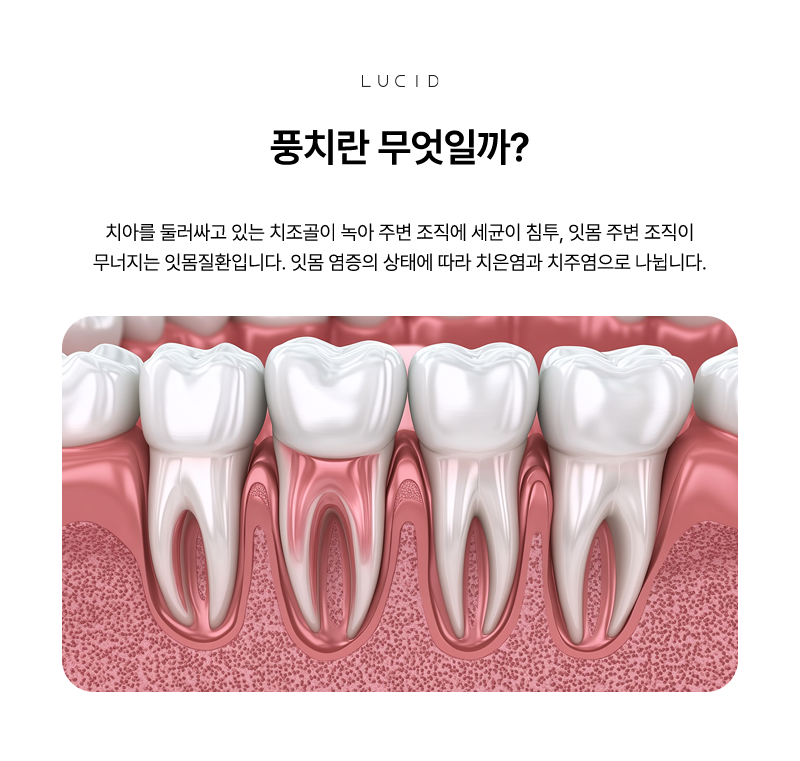
Periodontal disease literally means that wind has entered the teeth. Its medical term is periodontal disease or gum disease.
Our teeth are firmly supported not only by the visible crown but also by the gums and the jawbone underneath them, which are not visible from the outside.
Periodontal disease refers to a chronic inflammatory condition in the gum tissue and jawbone surrounding the teeth. As the inflammation progresses, the bone supporting the teeth gradually erodes, eventually causing the teeth to lose support and become loose in all directions or trigger sensitivity and pain.
Periodontal disease can be broadly classified into two stages depending on the degree of inflammation and destruction.
-
Gingivitis (early stage): This is the initial stage where inflammation is limited only to the soft tissue on the surface of the gums. During this stage, the gums turn red and bleed when brushing are the main symptoms. Fortunately, because it has not spread to the jawbone, it is relatively easy to restore to a healthy state with dental scaling or proper brushing.
-
Periodontitis (advanced stage): This is a serious condition in which gingivitis has been left untreated, the inflammation has progressed deep into the gums, and the jawbone supporting the teeth has been destroyed. As the space between the teeth and gums widens, pocket-like gaps form, pus may come out, and bad breath becomes severe. At this stage, the teeth begin to visibly loosen, and since lost jawbone does not regenerate naturally, treatment becomes more difficult and the likelihood of extraction increases.
Why does periodontal disease occur?
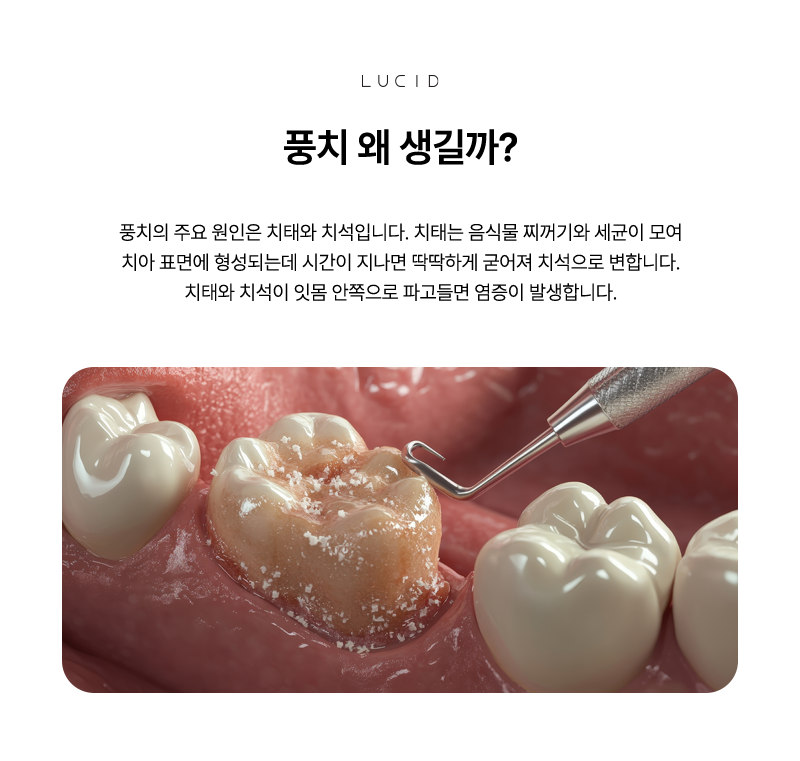
The most decisive and fundamental cause of periodontal disease is plaque and tartar left in the mouth.
If we do not brush our teeth cleanly after eating, bacteria in the mouth and food debris combine to form a sticky, transparent film on the surface of the teeth. This is called plaque.
You can think of this plaque as a mass of many bacteria. If plaque is not removed in time and enough time passes, it combines with minerals such as calcium and phosphorus in saliva and hardens like stone. This is tartar.
Tartar has a very rough surface, which creates a vicious cycle in which more bacteria and plaque easily adhere to it.
When bacteria live around tartar and release toxins, inflammation develops in the gums, and as this inflammation gradually penetrates deeper into the jawbone, periodontal disease occurs.
Because tartar cannot be removed by brushing alone, the longer it is left untreated, the more it accelerates the destruction of the alveolar bone.
In addition, excessive stress or lack of sleep lowers overall immunity, making the gums more vulnerable to bacteria. If a person has a chronic condition such as poor nutrition or diabetes, the gum tissue can be easily damaged due to systemic circulatory problems, and periodontal disease can worsen more rapidly.
What causes the pain in periodontal disease?
The tingling, heavy pain that patients feel when periodontal disease occurs is closely related to structural changes inside the gums.
When inflammation persists around the teeth, the swollen gums gradually recede downward, causing gum recession. As the gums sink down, the root of the tooth, which had been safely protected from external exposure, becomes fully exposed.
Unlike the hard enamel on the surface, tooth roots have developed tiny pathways that directly transmit stimulation to the internal nerves.
Because of this, you feel a sharp, sensitive pain when drinking cold water, chewing food, or even when cold winter air touches the teeth.
As the inflammation worsens, pus and gas build up in the space formed between the teeth and gums.
This raises the internal pressure and presses on the nerves at the tip of the tooth root. At this point, even when you are not chewing and simply sitting still, the entire tooth continues to ache with a heavy, throbbing pain.

Could I have periodontal disease too? Self-check test
Periodontal disease often does not cause clear pain in the early stages, so it is easy to miss the symptoms. Check whether any of the following apply to you.
-
Blood appears on the toothbrush bristles or in the foam when brushing
-
Teeth feel sensitive and sharp when eating cold water or cold foods
-
The gums have turned red rather than light pink and swell frequently
-
When tired, the gums feel itchy or internally throbbing
-
Teeth seem longer than before, and gaps are visible between the teeth
-
Persistent bad breath and a frequent feeling of stuffiness in the mouth
-
When a finger pushes the teeth with the tongue, they feel slightly loose
-
It hurts when chewing hard or chewy foods, and you cannot put strength into the teeth
If two or more of the above apply to you, there is a high chance that periodontal disease is already progressing, so it is safest to visit Wonjuro Station Dental Clinic sooner rather than later for an accurate examination.

How to prevent periodontal disease and protect your precious gums
Once periodontal disease progresses, it is difficult to completely restore the lost jawbone to its original state, so the wisest approach is to prevent it thoroughly before it occurs.
-
Receive regular scaling treatment at Wonjuro Station Dental Clinic: Daily brushing is useful for removing soft plaque on the tooth surface, but hardened tartar can never be removed by brushing alone. It can only be safely removed through scaling treatment using professional dental equipment. In general, receiving regular scaling once every 6 months to 1 year can excellently prevent gum inflammation caused by tartar.
-
Make flossing and brushing a habit: No matter how diligently you brush, a regular toothbrush cannot perfectly reach the narrow spaces between teeth or the gumline. Because tiny debris left in these areas is a major cause of periodontal disease, after brushing you must use oral care aids such as dental floss or interdental brushes to thoroughly remove plaque trapped between the teeth. Simply making the use of these aids a habit can greatly reduce the incidence of gum disease.
-
Visit Wonjuro Station Dental Clinic periodically to check your condition: By the time people notice symptoms on their own, it is often already too late for treatment. Therefore, even if you do not feel any special pain or abnormal symptoms, it is necessary to visit the dental clinic every 6 months to regularly check the condition of the gums and whether the alveolar bone is healthy. The earlier invisible initial inflammation is detected through regular checkups, the simpler the treatment process and the higher the likelihood of preserving the teeth.
-
The first step toward a healthy oral environment: quit smoking: Smoking is a factor that has a severe negative effect on gum health. Nicotine and tar in cigarettes dry out the mouth, creating an environment where bacteria can thrive, and constrict the tiny blood vessels in the gums, interfering with blood circulation. As a result, nutrients and oxygen are not properly delivered to the gum tissue, immunity drops, and the destruction of the jawbone accelerates. Smokers have a much higher rate of periodontal disease than non-smokers and recover more slowly after treatment, so it is important to quit smoking.
As we learned today, periodontal disease is something that can be sufficiently prevented depending on how much attention and careful management we give it in daily life.
Rather than being complacent and thinking that you are still young so it will be fine, I hope you will protect your precious dental health for a long time through thorough oral care and regular checkups at Lucid Dental Clinic.
Lucid Dental Clinic places patients’ precious natural teeth first and promises honest, attentive care. If you have any questions about gum health or need a regular scaling checkup, please feel free to visit us anytime. We will always do our best for our patients’ bright smiles. Thank you.