Hello. This is Lucid Dental.
When considering implant treatment, many people first check the cost or the implant brand. However, something else is actually more important than which implant is used.
It is how accurately the implant is placed.
Implant treatment involves placing an artificial tooth root, which replaces the root of a natural tooth, into the jawbone. The treatment does not end simply by placing it where the tooth is missing. The relationship with the surrounding teeth, the condition of the jawbone, the location of the nerves, and the direction of chewing forces all need to be considered comprehensively.
Recently, digital technology has been used to plan this process more precisely.
One representative treatment method is the digital navigation implant.
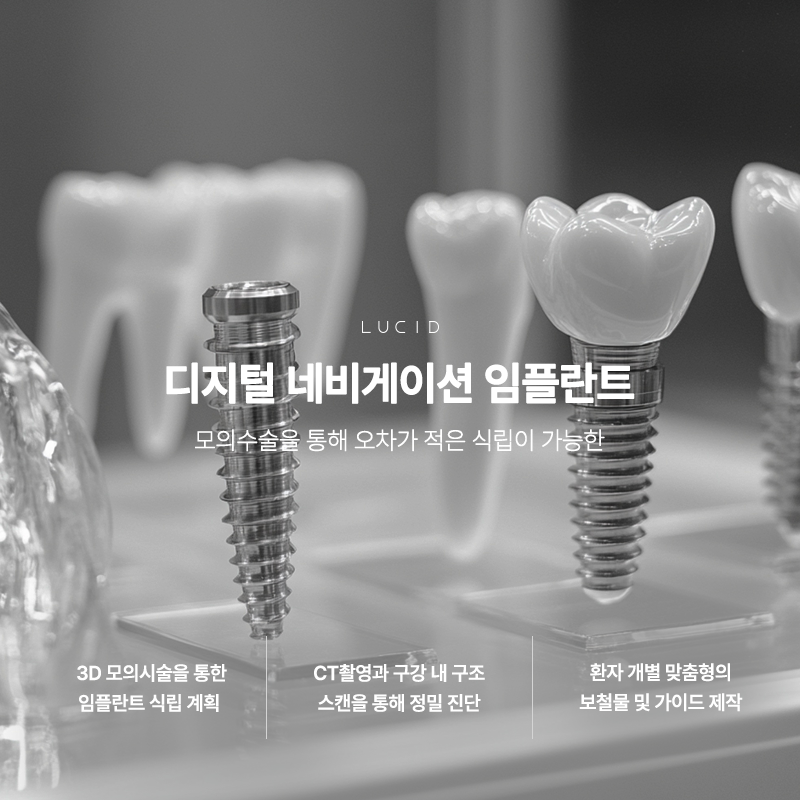
Digital navigation implants are a digitally based implant system that uses 3D CT scans and oral data to analyze the patient’s oral structures three-dimensionally and plan the implant’s position, angle, and depth in advance.
Just as a car navigation system guides you to your destination, this system helps make implant placement more systematic based on a pre-established plan.
Today, we will take a detailed look at what digital navigation implants are, why position, angle, and depth are important, and who may benefit from them.

What kind of technology enables highly precise placement with digital navigation implants?
In the past, implant treatment generally involved determining the placement position based on CT scans and X-rays, together with the medical team’s experience and expertise. Of course, the clinician’s experience remains a very important factor today.
However, as digital technology has advanced, it has become possible to go beyond simply examining structures visually, analyze the patient’s oral structures in three dimensions, and develop more detailed plans.
Digital navigation implants use the patient’s CT data to analyze the height and width of the jawbone, the location of the nerves, and the position of the maxillary sinus three-dimensionally.
The implant position is then simulated in advance using a computer program, and a placement plan is established.
Because the condition of the jawbone and the location of missing teeth vary from person to person, individualized diagnosis is important rather than a standardized treatment approach.
At Lucid Dental, we carefully examine each patient’s oral condition using detailed CT scans and a digital analysis system.
We strive to establish treatment plans that consider not only the missing area but also the expected period of use and long-term maintenance.
The words that come up most often when discussing digital navigation implants are position, angle, and depth.
So why are these three factors important?
An implant is not simply a metal structure fixed into the bone. A prosthesis is later connected to it, allowing it to function like a real tooth for chewing and daily use.
First, position is important. If the placement position is inappropriate, abnormal gaps may form between the implant and the surrounding teeth, which can cause food to become trapped frequently and make maintenance difficult. It may also be difficult to create a natural-looking prosthesis.
Angle is also important. If the implant is placed at an angle, it may affect the gum line or the shape of the prosthesis, and it also needs to be considered from a maintenance perspective.
Ultimately, Gangnam Station implant treatment is not simply about placing an implant. What matters is where it is placed, in which direction, and at what depth.
Because a digital navigation system helps analyze and plan these factors in advance, it enables a more systematic treatment plan to be established.

What are the advantages of digital navigation implants?
The greatest advantage is that the planning process before treatment can be carried out more precisely.
-
Precise diagnosis is possible.
Based on CT data, the condition of the patient’s jawbone and the location of the nerves can be examined three-dimensionally, allowing for more detailed analysis.
-
They help establish individualized treatment plans.
Because each patient’s dental and bone conditions differ, personalized diagnosis is important. Digital analysis makes it possible to establish a treatment plan that takes each individual’s oral structure into account.
-
Simulation is possible before treatment.
A plan can be established before actual placement, and various situations can be anticipated, allowing for a more systematic approach.
-
Aesthetic considerations can also be taken into account.
In particular, aesthetics are as important as function for front tooth implants. Planning the placement position and angle helps create a natural-looking prosthesis.
-
Long-term maintenance can be considered.
Care after implant placement is important. Therefore, a plan that considers maintenance from the beginning is necessary, and digital analysis can help review these aspects.
Gangnam Station’s Lucid Dental establishes treatment plans with the aim of creating teeth that patients can use for a long time, rather than simply placing implants.
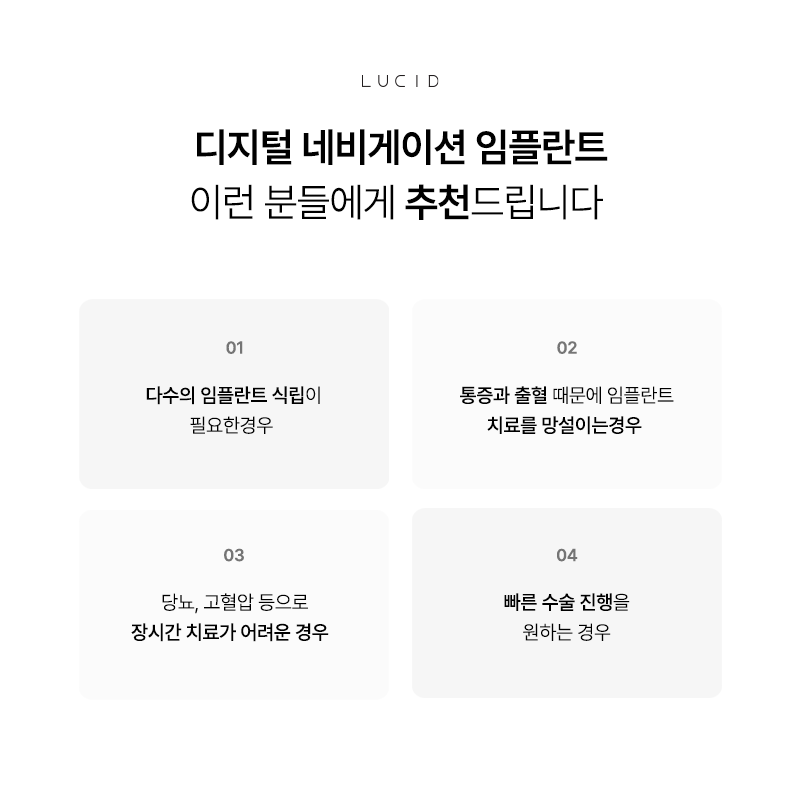
This approach may be worth considering for:
The digital navigation approach for Gangnam Station implants may be considered when more precise analysis and planning are needed.
-
People who are concerned because they are receiving implants for the first time
-
People who want a more systematic treatment plan
-
People who need multiple implants placed
-
People for whom aesthetics are important, such as those receiving front tooth implants
-
People whose jawbone condition needs to be examined precisely
-
Older patients or people who require a cautious approach due to a systemic condition
-
People who consider a thorough diagnostic process before treatment important
Implant treatment is not simply a way to replace missing teeth; it is also connected to future oral health. Therefore, it is important to carefully review the process starting from the treatment-planning stage.

Implant Q&A
Q. Is a navigation implant necessary when bone grafting is required?
A. A digital navigation system can also be used when bone grafting is required. In fact, CT-based analysis may help establish a treatment plan in cases where the condition of the jawbone needs to be examined accurately. However, whether it is appropriate depends on the individual’s oral condition.
Q. Does receiving a navigation implant guarantee success?
A. The outcome of any treatment cannot be predicted with certainty. Digital navigation implants are a system that helps with more precise diagnosis and planning, but various factors—including the patient’s oral condition, jawbone condition, lifestyle, and aftercare—also have an impact.
Therefore, what matters is not simply whether the equipment is available, but whether there is a sufficient diagnosis and treatment plan, along with consistent maintenance.
Gangnam Station implant treatment is not completed with a single procedure; it is treatment that will be used for a long time. For this reason, how the implant is placed under a treatment plan may be more important than simply choosing a good product.
Recently, advances in digital technology have made more precise analysis and planning possible, and digital navigation implants are also being used as part of this trend.
Lucid Dental always strives to carefully examine each patient’s oral condition using detailed CT scans and a digital analysis system, and to establish treatment plans suited to each individual’s situation.
If you are considering implants, rather than comparing only costs, please also review how the diagnostic process and treatment plan are carried out.
An accurate diagnosis and thorough plan can be an important starting point for satisfactory implant treatment.