Hello. This is Lucid Dental.
There may be times when you have no particular discomfort normally, but suddenly the area behind your very back molar begins to throb, or your gums swell and make it uncomfortable to chew. It may hurt or bleed when the toothbrush merely touches the area, and you may also notice an unpleasant smell or taste in your mouth that you do not normally have.
At first, it is easy to think that your gums have temporarily swollen because you are tired. In fact, the symptoms may lessen after a few days, so many people move on without receiving any particular treatment.
However, if the gums at the very back repeatedly swell and then subside, it is worth considering the possibility that a wisdom tooth may be the cause.
Depending on its position and direction of growth, a wisdom tooth can create an area that is difficult to brush. Food debris and plaque can accumulate there, making inflammation in the surrounding tissue more likely. The reason the swelling may recur after subsiding once is that this structural problem may remain unchanged.
Therefore, if you are looking into wisdom tooth extraction at an Eonju Station dental clinic, it is important not only to check whether the wisdom tooth hurts at present, but also to examine the direction in which it is growing and whether it is affecting the surrounding gums or the molar in front of it.
Today, we will take a step-by-step look at what wisdom teeth are, why inflammation develops in the surrounding gums, the symptoms that may occur, treatment, and situations in which extraction may be considered.
What kind of teeth are wisdom teeth?
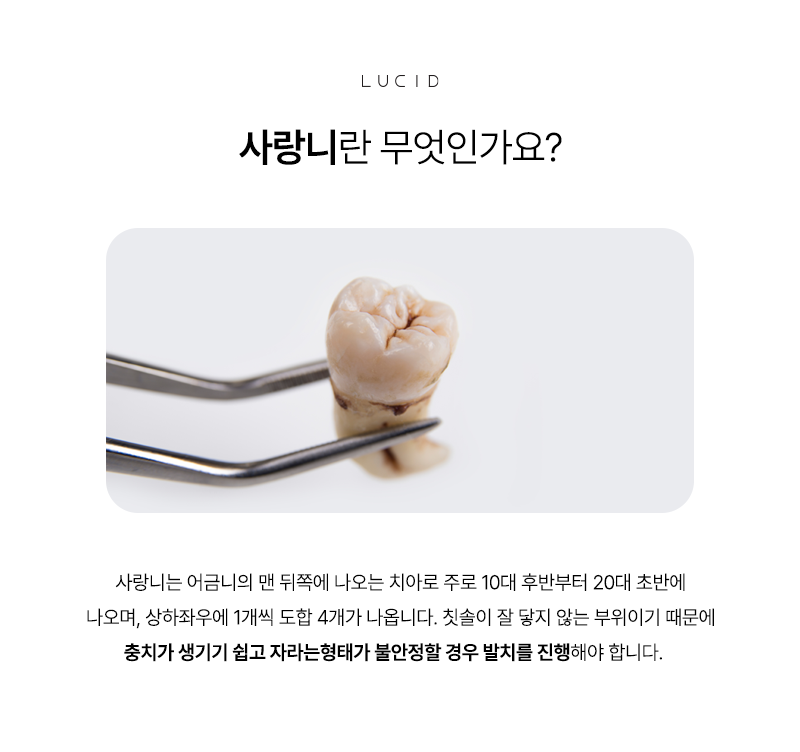
Wisdom teeth are the molars located at the very back of the dental arch. Their official name is the third molars.
They erupt relatively late, after most permanent teeth have already settled into place. There may be up to four wisdom teeth, one on each side of the upper and lower jaws. However, not everyone develops all four; some people develop only a few, while others are born without them.
Having wisdom teeth does not necessarily mean that they will cause problems.
If there is enough room in the jawbone, the teeth erupt normally in a direction similar to the other molars, and the upper and lower teeth fit together properly, they can be used like ordinary molars. If they can be kept clean through brushing and do not significantly affect the surrounding tissues, they do not necessarily need to be removed.
The problem occurs when there is not enough room for the wisdom teeth to grow.
When there is insufficient space for a tooth to emerge, it may stop growing after only part of it has come through the gums, or it may tilt diagonally toward the molar in front of it. It may also remain completely embedded in the gums or jawbone, a condition known as an impacted wisdom tooth.
Because the direction and position of growth vary from person to person, wisdom tooth care and treatment at an Eonju Station dental clinic should not be decided uniformly. The first step is to check the current condition.
Care varies depending on how the wisdom tooth grows
If a wisdom tooth has erupted normally, the entire tooth is visible outside the gums, making it relatively easy to care for. In contrast, when only a small part of the crown is visible in a partially impacted state, the gums may partially cover the top of the wisdom tooth.
This can create a narrow space between the wisdom tooth and the gums where food can easily become trapped.
Because the tooth is located at the very back of the mouth, it may be difficult to position the toothbrush bristles accurately. There may also be limitations when using floss or other oral-care products.
If the tooth is tilted sideways, another narrow gap may form between the wisdom tooth and the molar directly in front of it. Although it may not look like a major problem from the outside, plaque can continue to accumulate in an area that is difficult to clean.
For this reason, rather than simply whether a wisdom tooth is present, the form in which it is positioned is an important factor in determining how it should be managed in the future.

Why does inflammation develop in the gums around wisdom teeth?
One of the most common problems that repeatedly occurs around wisdom teeth is pericoronitis.
In particular, when only part of the tooth has erupted and the rest is covered by the gums, a small gap may form between the wisdom tooth and the gums. If food debris and bacteria enter this space, they may be difficult to remove sufficiently with ordinary brushing alone.
Small particles may enter whenever you eat, and as plaque accumulates, the surrounding tissues may be continually irritated.
Discomfort may become more pronounced if the opposing tooth repeatedly touches the swollen gum when you bite, or if the wisdom tooth is positioned at an angle and presses against the surrounding area.
Initially, the condition may begin with slight swelling or bleeding while brushing. As the inflammation progresses, throbbing pain may develop, making it difficult to chew, and an unpleasant odor may be noticed in the mouth.
Therefore, if the gums at the very back of the molars repeatedly swell, it is advisable to check the condition of the wisdom tooth and surrounding tissues rather than assuming it is simply temporary gum fatigue.
What symptoms may occur?
Problems around wisdom teeth do not always begin with severe pain.
The most common change is a feeling that the gums behind the molars are thicker or more swollen than usual. You may feel that the area is more swollen than the opposite side when you touch it with your tongue, or you may feel pressure on the gums while chewing.
The area may hurt or bleed when the toothbrush touches it during brushing, and the persistent sensation of food becoming trapped there may also cause discomfort.
As the condition worsens, throbbing pain may occur even when you are still, and the area around the jaw may feel stiff or achy. It may also become uncomfortable to open your mouth wide, or pain may accompany swallowing.
Because the pattern of symptoms varies from person to person, it is difficult to determine the current condition based solely on the intensity of the pain.
If it hurt and then got better, can I leave it alone?
When pain around a wisdom tooth disappears after a few days, it is easy to assume that the problem has healed naturally.
However, a reduction in symptoms alone does not necessarily mean that the problem has been resolved.
If the gum covering part of the wisdom tooth or the structure that allows food to become trapped remains unchanged, the same area may develop problems again.
It is particularly important to check the eruption status of the wisdom tooth if the same location repeatedly swells whenever you are run down, tired, or have not maintained sufficient oral hygiene.
If this situation is continually left untreated, it may not only cause discomfort in the surrounding tissues but also make it more difficult to care for the molar directly in front of the wisdom tooth.
Therefore, rather than using the standard of “It does not hurt now, so it is fine,” it is better to consider how many times the same symptoms have occurred in the past.

The molar in front of the wisdom tooth should also be examined
When undergoing an examination for wisdom tooth extraction at an Eonju Station dental clinic, it is important to examine not only the wisdom tooth but also the second molar directly in front of it.
If the wisdom tooth is tilted forward, food can easily remain in the area where the two teeth touch.
The problem is that this area is at the very back of the mouth and is difficult to see. The toothbrush bristles may not reach far enough, and using floss may also be uncomfortable, making the area difficult to care for without you realizing it.
If this environment persists, cavities or gum problems may develop not only around the wisdom tooth but also in the molar in front of it.
A wisdom tooth itself may not cause significant pain, yet a problem with an adjacent tooth may be discovered during an examination. Therefore, if you experience recurring discomfort, the surrounding teeth should also be examined.
How is it treated when inflammation develops?
Not every case of inflammation around a wisdom tooth is treated in the same way.
First, the degree of swelling and pain, the presence of pus or bleeding, and the eruption status of the wisdom tooth are assessed. If food debris or plaque has accumulated around the area, it may be cleaned thoroughly and any necessary treatment can be provided.
If the inflammation is severe and acute, it may first be necessary to stabilize the condition of the surrounding tissues.
Afterward, if the wisdom tooth has erupted normally and can be maintained hygienically, oral hygiene instructions may be provided and the condition may be monitored.
Conversely, if structural problems make recurrent inflammation likely or the front tooth is being affected, treatment options including extraction may be considered.
In other words, the goal of treatment is not simply to reduce the current pain, but to identify why the same problem keeps recurring and determine an appropriate approach.
Does a wisdom tooth have to be removed if there is inflammation?
The presence of a wisdom tooth does not necessarily mean that it must be extracted.
If it has erupted sufficiently in a normal direction, the upper and lower teeth fit together properly, and it can be kept clean independently, it may be retained with regular monitoring.
On the other hand, extraction may be considered if part of the wisdom tooth is covered by the gums and inflammation keeps recurring, if food repeatedly becomes trapped, or if the tooth is tilted sideways and makes it difficult to care for the adjacent tooth.
The same applies if the wisdom tooth itself has developed a cavity or is continuously causing problems in the surrounding tissues.
However, when the inflammation is particularly severe, it may be appropriate to first manage the condition of the surrounding area rather than extracting the tooth immediately, and then determine the appropriate timing.
Ultimately, deciding whether wisdom tooth extraction is necessary requires a comprehensive assessment of the tooth’s direction and depth, whether symptoms are recurring, and how it is affecting the surrounding tissues—not merely whether the wisdom tooth is present.
Why an accurate diagnosis before extraction is important
It is difficult to assess the overall condition of a wisdom tooth based solely on its visible appearance.
Even if part of the tooth is visible outside the gums, its roots may be located deep inside the jawbone. Conversely, the tooth may have erupted in a relatively straightforward form.
In particular, nerves associated with sensation pass through the lower jaw, so it is important to check the positional relationship between the roots of an impacted wisdom tooth and the surrounding structures.
At an Eonju Station dental clinic, oral examinations and radiographs can be used to assess the direction and depth of eruption, the shape of the roots, and the distance from the molar in front. When necessary, three-dimensional imaging can provide a more detailed evaluation.
The need for extraction and the extraction method are determined based on these diagnostic findings.
Because the position of wisdom teeth differs from person to person, it is more important to accurately understand your own oral condition than to estimate the difficulty or process of your treatment based solely on someone else’s extraction experience.
How should the area be cared for after extraction?
After a wisdom tooth has been extracted, it is also important to care for the area so that it can recover steadily.
Immediately after extraction, bite down on the gauze for the instructed period to control bleeding, and avoid repeatedly touching the area with your tongue or fingers. It is also helpful to avoid using a straw or forcefully spitting.
For meals, choose foods that are easy to tolerate rather than foods that are very hot or irritating, and chew slowly on the side opposite the extraction site.
Brushing is necessary for oral hygiene, but the surrounding area should be cleaned carefully rather than rubbing the wound forcefully with a toothbrush.
The recovery process and precautions may vary depending on the extraction method and your individual condition, so it is important to follow the instructions provided by your dentist.
For recurring wisdom tooth pain, check the cause first
Wisdom teeth do not cause problems for everyone.
However, their location at the very back of the mouth and the way they erupt can create an environment that is difficult to manage independently, which may lead to recurring swelling and pain in the surrounding gums.
In particular, if the cycle of pain followed by improvement has occurred several times, it is better to check how the wisdom tooth is positioned rather than simply waiting for the symptoms to disappear each time.
At Lucid Dental, we comprehensively assess the wisdom tooth’s direction of eruption and degree of impaction, the shape of its roots, the condition of the surrounding gums, and the relationship between the tooth in front and nearby structures to create a treatment plan suited to each patient’s oral condition.
If you are looking into wisdom tooth extraction in Gangnam, or if the area at the very back of your molars has recently been swelling repeatedly and you feel discomfort when chewing, we recommend checking where the cause originates rather than examining only the symptoms currently present.
An examination can also determine whether the wisdom tooth must be removed or whether it can be retained with appropriate care.
Rather than waiting until the pain becomes severe before considering treatment, examining the condition of the wisdom tooth and surrounding teeth when small, recurring discomfort appears may help with the future management of your oral health.