Mokdong nasolabial folds: What is the standard between fillers and lifting?
Nasolabial fold filler lifting
Nasolabial fold filler lifting
Hello. I am Lee Young-soo, the chief director of Troy Plastic Surgery, where I provide both lifting and filler treatments in Mokdong.
When I counsel patients about nasolabial folds in the clinic, most of them begin with this question.
“Doctor, is filler better for nasolabial folds? Or should I lift them?”
“If I get lifting, will this wrinkle disappear completely?”
These are the questions I hear most often in Mokdong nasolabial fold consultations, and the ones that cause the most confusion.
But from a medical perspective, the two procedures are not in a competitive relationship.
Even when looking at the same nasolabial fold, the choice must change completely depending on the cause of its appearance.
-
Why do nasolabial folds form in the first place?
-
In these cases, consider ‘filler’ first
-
In these cases, ‘lifting’ becomes the standard
-
Is it better to do both at the same time?
-
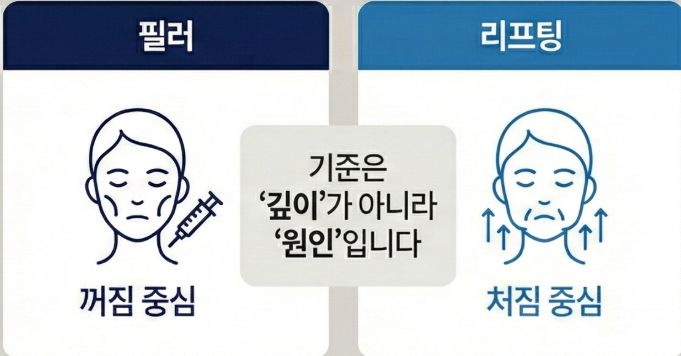
The standard is not ‘depth’ but ‘cause’
-
Q&A
-
Summary
-
Why do nasolabial folds form in the first place?
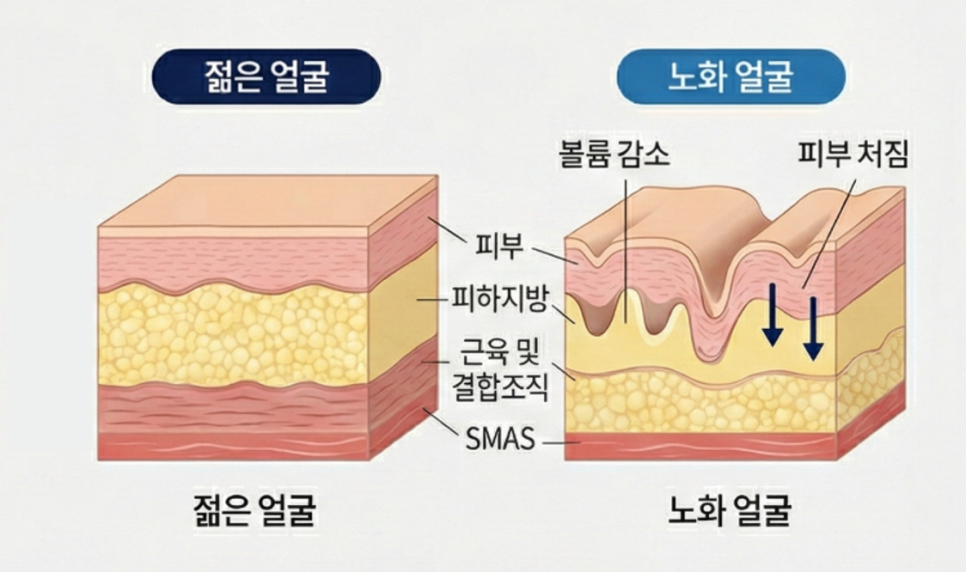
Skin structure image for understanding
Nasolabial folds are not simply wrinkles caused by the skin folding like paper.
• Reduced skin elasticity
• Sagging of cheek fat (shifting in position)
• Loss of volume in the area below the cheekbone (the front cheek)
• Differences in natural bone structure
The causes are highly complex in this way.
That is why, when I consult on Mokdong nasolabial folds, I do not only look at the wrinkle’s “depth.”
I first identify “what created this wrinkle” (the cause).
- In these cases, consider ‘filler’ first
Nasolabial fold filler lifting
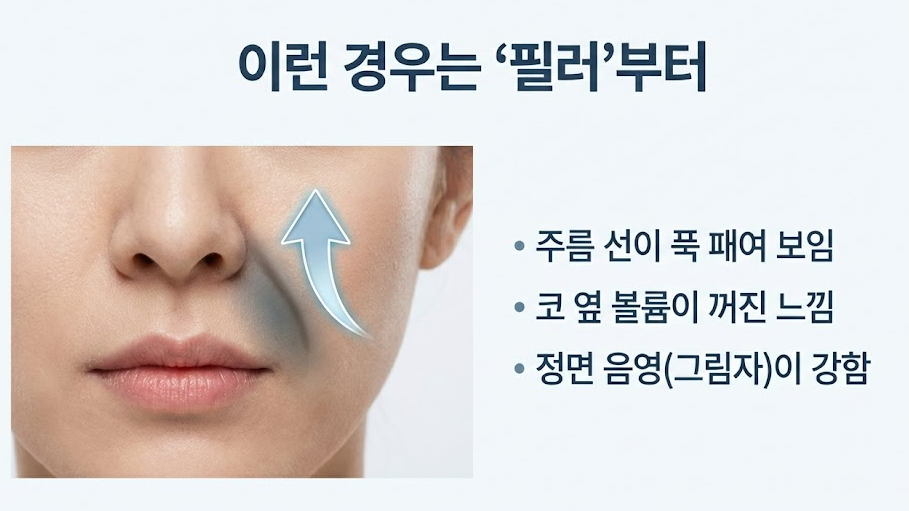
This image is an AI-generated staged cut created to aid understanding.
If you look in the mirror and notice the following features, a volumizing procedure may be needed.
• The wrinkle line itself appears deeply sunken
• The area beside the nose feels noticeably hollowed out
• A strong shadow appears when viewed from the front
In this case, the most natural approach is to fill the sunken area with volume, remove the shadow, and soften the shading.
However, if too much is added out of excessive eagerness, the cheeks may look heavy or unnatural, so precise dose control is especially important.
- In these cases, ‘lifting’ becomes the standard
Nasolabial fold filler lifting
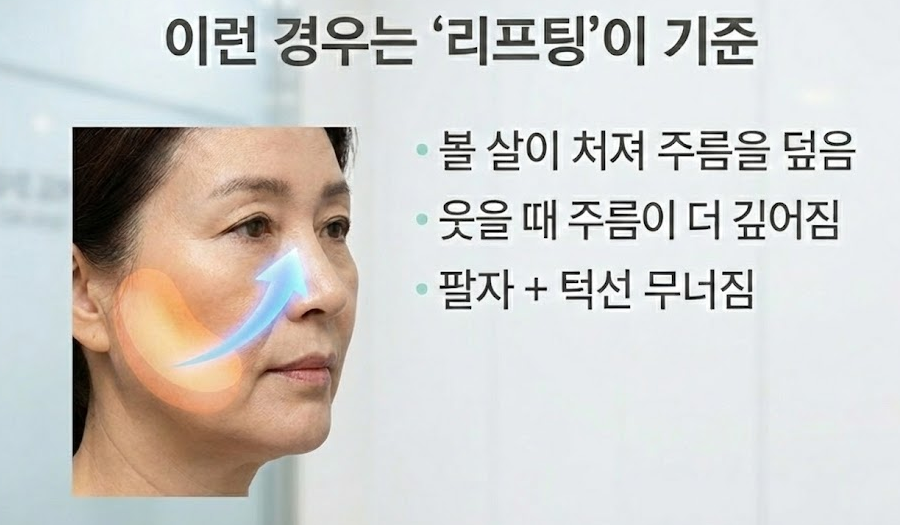
This image is an AI-generated staged cut created to aid understanding.
On the other hand, in the following cases, lifting is closer to the right answer than filler.
• The cheek tissue as a whole has sagged downward and is covering the wrinkle
• It looks fine when the face is at rest, but the fold becomes deeply creased when smiling
• The jawline feels as though it has collapsed along with the nasolabial folds
In this case, it is likely not simply a lack of volume, but rather a problem of sagging (position shift) in which the facial structure has moved downward.
(Just as Shurink approaches a sagging structure by pulling it upward.)
At this time, rather than adding something, an approach that restores the original position through lifting is needed.
- Is it better to do both at the same time?

Nasolabial fold filler lifting
This image is an AI-generated staged cut created to aid understanding.
Of course, in improving Mokdong nasolabial folds, there are cases where filler and lifting are combined.
For example,
-
Lift the position of the sagging cheek tissue with lifting
-
Then fill only the remaining small hollow with a small amount of filler
This is the kind of synergy one aims for. However, “combining both without exception” is not the answer.
Because unnecessary stimulation or procedures can make the result look unnatural, caution is needed.
- The standard is not ‘depth’ but ‘cause’

Nasolabial fold filler lifting
When I look at a patient’s face in the clinic, this is what I observe most carefully.
• Is it a fixed wrinkle that has already settled in place?
• Does it deepen only when smiling due to muscle movement?
• Is it accompanied by cheek sagging from above?
• What is the patient’s skin thickness like?
Ultimately, the success standard for improving Mokdong nasolabial folds is not “which procedure was received,” but “how accurately the structure of my face was analyzed.”
- Q&A

Nasolabial fold filler lifting
Q. Can filler alone maintain the effect for a long time?
A. Since this is an area with a lot of movement, results vary by person.
It is much more natural to approach it as maintenance care, gradually filling in the insufficient areas rather than trying to finish it all at once.
Q. If I get lifting, will the nasolabial folds disappear completely?
A. The degree of improvement varies depending on the depth of the wrinkle.
Rather than the concept of completely erasing it like ironing, the goal is to create a line that looks softer and more youthful.
Q. What about pain?
A. It depends on whether the method is an injection or a laser, but in most cases it can be managed with numbing cream and similar measures.
A word from the doctor
Nasolabial folds are not something you simply fill to make them disappear. They are a problem to be solved by finding the cause.
Nasolabial fold filler lifting
- Summary
Nasolabial fold filler lifting
Has the standard for improving Mokdong nasolabial folds become a little clearer now?
• If hollowing is the problem → filler (filling)
• If sagging is the problem → lifting (pulling up)
This is the most basic direction.
The standard for choosing should not be which procedure others say is good, but what your own face currently needs.
▼ After lifting, how long is swelling considered normal? ▼
This article was written based on general medical information, and the appropriate treatment plan may vary depending on an individual’s skin thickness and degree of sagging. Please confirm an accurate assessment through consultation with medical staff.
This article was written based on the clinical experience of Lee Young-soo, the chief director who provides lifting and filler treatments.