Lower eyelid fat repositioning vs. lower blepharoplasty,
What are the right criteria for me?

Lower eyelid fat repositioning, lower blepharoplasty
Do you worry because the area under your eyes looks dark or gives off a stern impression?
At times like this, people often think of lower eyelid fat repositioning and lower blepharoplasty. The two procedures have similar goals, but there are major differences in who they are for and how they are performed.
Today, we’ll organize clear selection criteria based on age and the condition of the under-eye area.
-
Surgery selection guide by under-eye condition
-
Age and skin elasticity determine the procedure
-
Procedure method and recovery process at a glance
-
Checkpoints for highly satisfying middle-aged eye surgery
-
Frequently asked questions
-
Surgery selection guide by under-eye condition
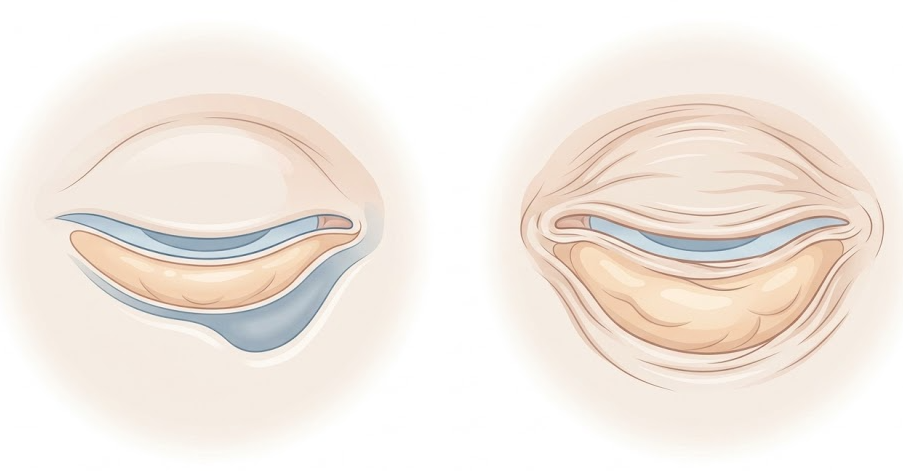
Lower eyelid fat repositioning, lower blepharoplasty
Take a look in the mirror and identify the most noticeable feature of your under-eye area.
• Cases where lower eyelid fat repositioning is suitable (mainly people in their 30s and 40s)
-
When the under-eye skin has good elasticity, but only the fat bulges outward
-
When a deep tear trough forms beneath the bulging fat, creating shadows
-
Key point: The goal is not to remove the fat, but to move it into the hollow area and smooth the contour.
Because the procedure is performed through the inner conjunctiva of the eye, there is almost no visible external scar.
• Cases where lower blepharoplasty is needed (mainly people in their 50s and 60s)
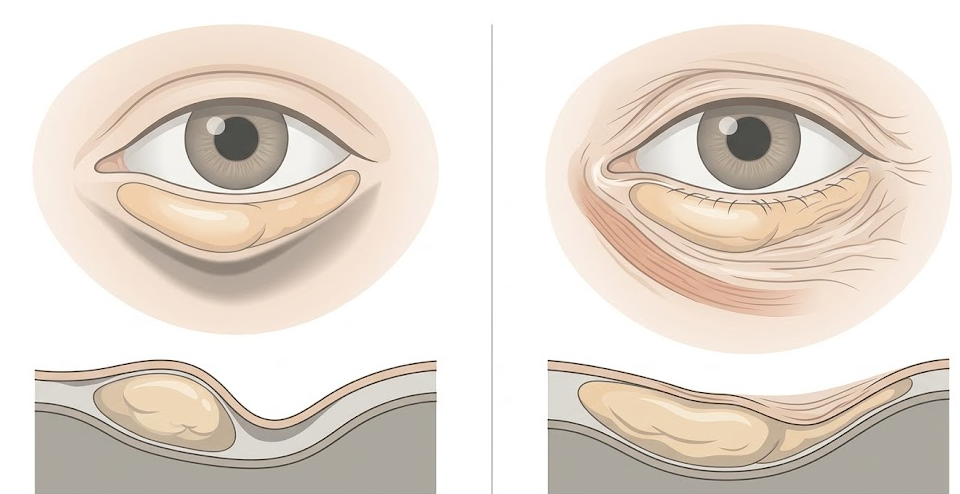
Lower eyelid fat repositioning, lower blepharoplasty
-
When the under-eye skin is loosened and wrinkled, along with protruding fat
-
When the muscles around the eyes weaken, making the eyes look saggy
-
Key point: In addition to fat repositioning, the process must include excising and tightening the sagging skin.
By making a small incision along the lash line and refining the wrinkled skin, the improvement is more definite.
- Age and skin elasticity determine the procedure
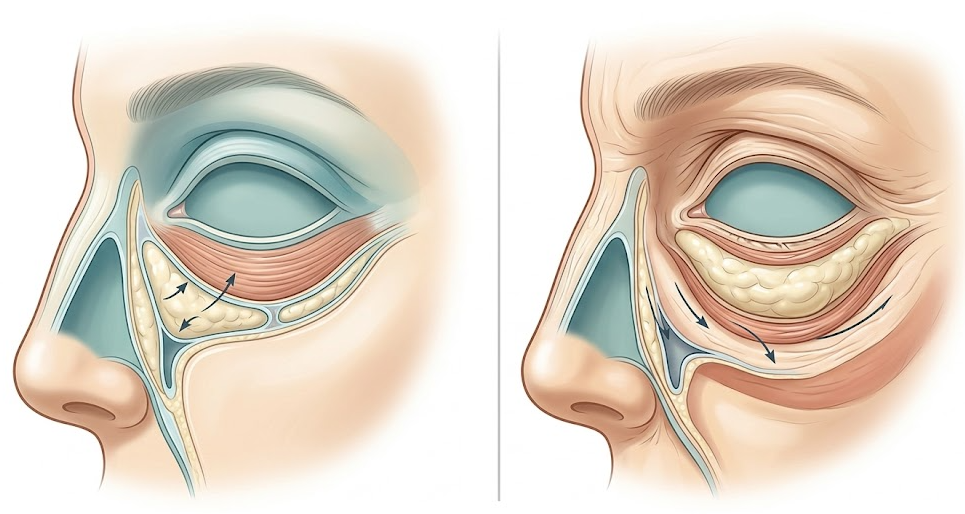
Lower eyelid fat repositioning, lower blepharoplasty
As people age, the tissues around the eyes undergo different changes layer by layer.
- Early stage: The membrane surrounding the fat weakens, and only the fat protrudes.
At this stage, fat repositioning alone usually produces satisfying results.
- Advanced stage: Once skin elasticity begins to decrease, even if fat is added back, the skin cannot support it and sags downward.
At this point, lower blepharoplasty that addresses both the fat and the skin is needed.
If someone in their 50s or older insists on fat repositioning alone,
it may remove the puffiness, but the stretched skin can remain wrinkled like a deflated balloon, so caution is needed.
- Procedure method and recovery process at a glance
| Category | Lower eyelid fat repositioning | Lower blepharoplasty |
|---|
| Incision site | Inside the eye (conjunctiva) | Outside the eye (under the lash line) |
| Scar | Not visible externally | Fine, along the lash line |
| Main effects | Improves contour, reduces dark circles | Removes wrinkles, lifts sagging eyes |
| Recovery period | About 3–5 days | About 7–10 days |
- Checkpoints for highly satisfying middle-aged eye surgery

Lower eyelid fat repositioning, lower blepharoplasty
• Customized diagnosis: Rather than simply looking at the amount of fat, a comprehensive analysis should consider the degree of eyeball protrusion, the structure of the under-eye bone, and the cause of the dark circles (pigment-type vs. shadow-type).
• Combined solution: Depending on the case, microfat grafting may be performed together to fill hollow areas under the eyes, or
laser treatment may be used to even out the skin tone for a synergistic effect.
• Natural results first: If too much skin is removed out of excessive desire for improvement, side effects such as ectropion, where the eyelid turns outward, can occur.
A thorough consultation with a board-certified plastic surgeon who has extensive anatomical knowledge is essential.
- Frequently asked questions

Lower eyelid fat repositioning, lower blepharoplasty
Q: Will dark circles disappear 100% after surgery?
A: Dark circles caused by protruding fat and shadowing can be improved very effectively.
However, if the skin itself has pigment deposition, combining the surgery with laser treatment is needed for a clearer under-eye area.
Q: Won’t lower blepharoplasty make me look harsher?
A: Rather than pulling the sagging skin too tightly, if the structure is rearranged while maintaining each person’s natural eye curve, the impression can become brighter and more youthful.
Q: When can I wear makeup after surgery?
A: Light makeup is possible 2–3 days after fat repositioning, and after 5–7 days for lower blepharoplasty, once the stitches are removed.
▼If you are thinking about lower eyelid fat repositioning because of dark circles▼
▼Must read!▼