Under-eye fat repositioning: in these cases, the effect may be limited
Under-eye fat repositioning

Under-eye fat repositioning
If you are considering under-eye fat repositioning, there is something you should check first.
That is whether your under-eye area is structurally suited to improvement through fat repositioning.
Even if it looks like the same under-eye concern, the causes are all different.
The necessary approach may differ depending on whether the issue is a shadow caused by protruding fat, sagging skin, or darkness from pigmentation or visible blood vessels.
That is why, in the consultation room, we do not decide on surgery based only on statements like “my under-eyes are sunken” or “my dark circles are severe.”
We first assess whether fat repositioning is appropriate by looking at the current under-eye structure, skin condition, and the results you are hoping for.
-
Cases in which it is difficult to expect good results from under-eye fat repositioning
-
What matters more than age is the actual skin condition
-
When the expected results differ too much from reality
-
Cases in which the effect may be limited due to under-eye structure
-
Cases that require caution depending on health condition
-
Things you should definitely check during the consultation
-
Even when fat repositioning is not the answer, there are still options
Under-eye fat repositioning
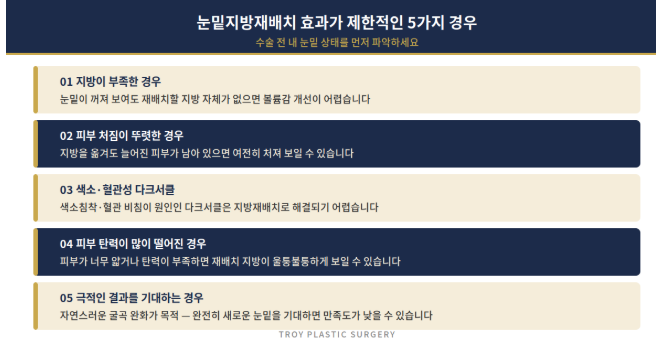
- Cases in which it is difficult to expect good results from under-eye fat repositioning
Under-eye fat repositioning is not a surgery that solves every under-eye concern.
This is also the point that is most often misunderstood during consultations.
First, there are cases where there is little or not enough fat to reposition under the eyes.
Just because the under-eye area looks hollow does not always mean that fat is protruding. In fact, some people look sunken because they do not have enough fat in the area.
In such cases, there may not be enough fat to reposition, so the expected volume improvement or shadow reduction may be limited.
The same applies when skin sagging is pronounced.
Even if the fat position is adjusted, if the loose skin remains as it is, the under-eye area may still look saggy or make you look older.
Dark circles caused by pigmentation or visible blood vessels are also difficult to address with fat repositioning alone.
This is because fat repositioning is fundamentally a surgery that deals with structural hollows and bulging under the eyes.

Under-eye fat repositioning
- What matters more than age is the actual skin condition
If you are in your 60s or older, or if your skin elasticity has significantly decreased, it should be examined more carefully.
However, age alone is not used to determine whether it is possible.
What matters is the actual skin thickness, elasticity, and degree of sagging.
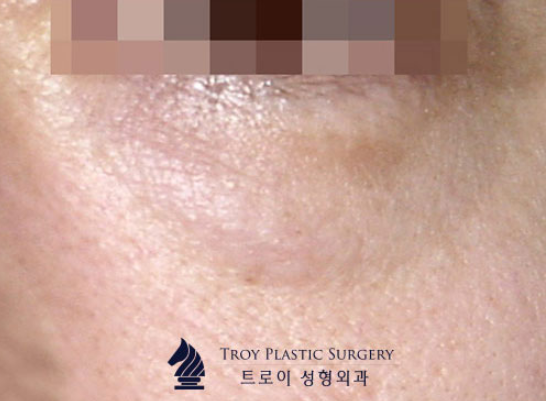
Image before under-eye fat repositioning surgery
This image was shared with the patient's consent
If the skin is too thin, the repositioned fat may not look smooth and could appear uneven.
If the procedure is forced in such cases, the under-eye area may look even more unnatural.
Extra caution is also needed for people who have smoked for a long time or have reduced recovery ability due to diabetes or other conditions.
This is because the recovery process may be slower, or it may affect how well the fat settles in place.
- When the expected results differ too much from reality
Some people expect that after under-eye fat repositioning, the under-eye area will become completely smooth, like in their 20s.
However, such expectations may differ from reality.
The purpose of fat repositioning is not to completely recreate the under-eye area, but to naturally soften the tired-looking impression and uneven contours.
Therefore, if you expect dramatic changes or a perfectly flat under-eye area, satisfaction after surgery may be low.
Some people also expect that one surgery will solve every problem under the eyes.
However, depending on the individual's skin condition and underlying cause, additional care or other treatments may be needed as well.
- Cases in which the effect may be limited due to under-eye structure
Under-eye fat repositioning is strongly influenced by anatomical structure.
If the eyeballs are somewhat protruding or the under-eye bone structure is significantly sunken, it may be difficult to expect sufficient improvement from fat repositioning alone.
This is because these structural characteristics are difficult to resolve simply by moving the fat position.

Under-eye fat repositioning
People whose under-eye muscles rise a lot when they smile should also be examined carefully.
If the under-eye muscle movement is strong, it may affect how stably the repositioned fat is maintained.
If you have previously had under-eye surgery, that must also be confirmed during the consultation.
If there is scar tissue or adhesions, the process may become more complicated than with a typical fat repositioning procedure.
- Cases that require caution depending on health condition
Your overall health condition is also an important factor when determining whether under-eye fat repositioning is possible.
If you have severe allergies or an autoimmune disease, the possibility of problems during inflammatory reactions or recovery should be considered.
Caution is also needed if you have poor circulation or issues related to blood clotting.
This is because bruising or swelling after surgery may be severe or last for a long time.
If you are pregnant or breastfeeding, it is generally safer to postpone procedures or surgery.

Under-eye fat repositioning
- Things you should definitely check during the consultation
During the consultation, rather than deciding on fat repositioning simply because the under-eye area is dark, you should first determine what is causing the problem under your eyes.
-
Whether protruding fat is the main cause,
-
Whether hollowness is the bigger issue,
-
Whether skin sagging or pigmentation is also involved,
The direction may change depending on these factors.
You must also tell the clinic about any medications you are currently taking or any history of allergies.
If you are taking anticoagulants or aspirin-type medications, adjustments before and after surgery may be necessary.
It is also a good idea to discuss whether the results you want match the range of improvement that is actually possible.
If there is a large gap in this area, it is necessary to take another careful look rather than proceeding right away.

Under-eye fat repositioning
- Even when fat repositioning is not the answer, there are still options
If under-eye fat repositioning is not suitable, that does not mean under-eye improvement is impossible.
If hollowness is the main issue, fillers or other volume-enhancing methods may be considered,
and if pigmentation is the cause, device-based treatments such as Pico laser or IPL may be helpful.
If skin elasticity has declined significantly, lifting procedures such as Ulthera or Thermage may also be considered together.
Sometimes, combining several methods step by step is more likely to lead to a natural and stable result than relying on one surgery alone.
Conclusion
Under-eye fat repositioning is certainly an effective surgery, but it is not the right method for every under-eye concern.
What matters is whether there is enough fat to reposition under my eyes,
whether skin sagging or pigmentation is the main cause,
and whether the results I expect are realistically achievable.
The under-eye area is a region where even a small change can significantly alter your appearance.
That is why, rather than deciding based on trends or reviews, it is important to receive an accurate diagnosis of your current condition and find the direction that suits you.
▼More stories about under-eye fat repositioning▼