After Under-Eye Fat Repositioning,
Is It Possible for the Under-Eye Area to Become Puffy Again?
Under-Eye Fat Repositioning
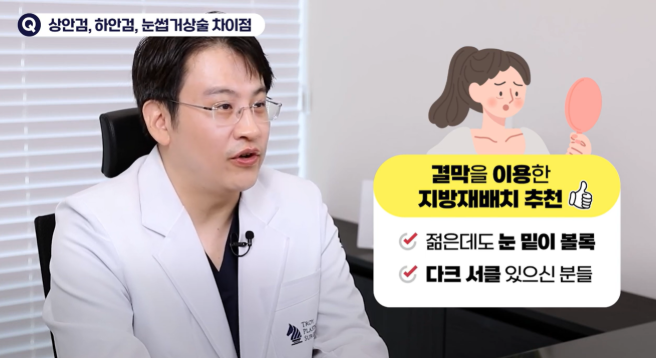
Hello. Under-eye fat repositioning is an effective surgery that removes protruding under-eye fat or moves it to a hollow area to create a natural, youthful eye area.
However, when talking with patients in the consultation room, we often hear concerns such as, "Even if I have the surgery, won’t it become puffy again later?"

Under-Eye Fat Repositioning
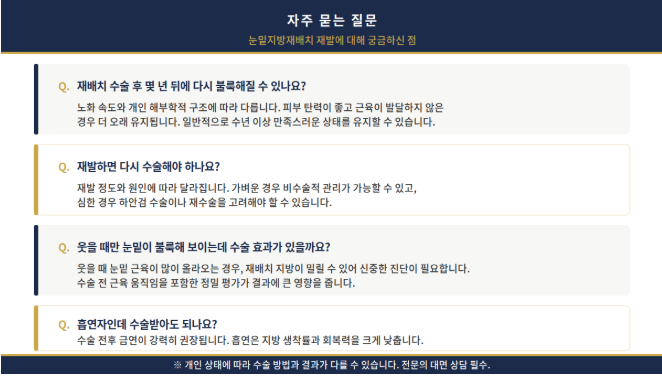
To put it simply, even after surgery, there is definitely a possibility that the under-eye area may become puffy again or look uneven due to the patient’s anatomical characteristics or the progression of aging.
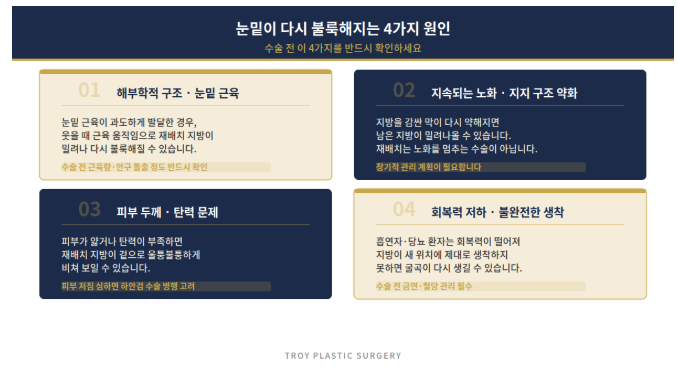
From a medical team’s perspective, I will summarize the main causes into four categories.
-
Anatomical structure and development of the under-eye muscles
-
Ongoing aging and weakening of supporting structures
-
Problems with skin thickness and elasticity
-
Reduced recovery ability and incomplete engraftment
-
Conclusion

Under-Eye Fat Repositioning
- Anatomical structure and development of the under-eye muscles
The bone structure around the eyes and the degree of muscle development differ from person to person.
In particular, for people whose under-eye muscles are overly developed and whose under-eye area lifts a lot when they smile, the repositioned fat may have difficulty staying in place stably.
Due to the continuous movement of the muscles, the relocated fat may be pushed out and become puffy again.
Under-Eye Fat Repositioning
- Ongoing aging and weakening of supporting structures
Under-eye fat repositioning is not a procedure that permanently stops the aging process.
The main reason under-eye fat originally protrudes is that the membrane surrounding and supporting the fat weakens.
Even if surgery is used to smooth the under-eye area, as time passes and the support of the under-eye structures weakens again, the remaining internal fat may push outward and protrude once more.
Under-Eye Fat Repositioning
- Problems with skin thickness and elasticity
For people whose skin is too thin or whose elasticity has significantly decreased, fat repositioning may actually lead to unnatural results.
When the skin is thin, the repositioned fat inside may show through as uneven bumps, increasing the risk that the under-eye area will look puffy again and not smooth.
Also, if sagging skin itself is the cause, simply repositioning the fat will not fundamentally resolve the aged appearance.

Under-Eye Fat Repositioning
- Reduced recovery ability and incomplete engraftment
After surgery, the "engraftment" process, in which the fat settles well into its new position, is very important.
If the patient smokes or has diabetes, the body’s recovery ability decreases, and the likelihood that the repositioned fat will not engraft properly increases significantly.
If the fat does not settle completely, irregularities under the eyes may occur again.
- Conclusion

Under-Eye Fat Repositioning
Under-eye fat repositioning is an excellent procedure that naturally improves a tired-looking appearance, but it is not a magic treatment that completely restores the eye area to how it looked in your 20s or keeps it that way forever.
To maintain satisfying results for a long time, you should receive an accurate diagnosis before surgery regarding your under-eye muscle volume, degree of eyeball protrusion, skin elasticity, and skin thickness.
If skin sagging is severe or if the anatomical conditions make it difficult for fat repositioning to be effective, rather than forcing repositioning alone, I recommend carefully considering alternatives such as lower blepharoplasty that directly tightens the sagging skin, together with the medical team.
Under-Eye Fat Repositioning
▼When should you get a facelift?▼