Hello.
After undergoing lower blepharoplasty to improve signs of aging under the eyes, quite a few people suffer from an unexpected condition called ectropion, in which the eyelid turns outward.
Today, I will explain in detail the medical causes of ectropion after lower blepharoplasty and how it can be managed.

- The Biggest Cause of Ectropion: Excessive Lower Blepharoplasty
The most significant cause of ectropion is considered to be a complication of lower blepharoplasty.
This procedure is traditionally performed most often on middle-aged and older adults to address sagging under the eyes caused by aging.
Recently, ectropion caused by complications of lower blepharoplasty has also been occurring frequently among people in their 20s and 30s who have undergone overly aggressive cosmetic eye surgery.

- Changes in the Eyelid Structure: Loosening and Outward Turning of the Eyelid
Ectropion is initially noticed through symptoms such as stinging or dryness of the eyes.
However, unlike simple dry eye, the actual cause is a structural change in which the lower eyelid becomes loose, rolls outward, and turns inside out.
If excessive manipulation is applied to the skin or tissue during lower blepharoplasty, the forces supporting the eyelid may weaken, causing this deformity.

- Why Ectropion Should Not Be Left Untreated: Conjunctival Exposure and Secondary Damage
When the eyelid rolls outward, the conjunctiva, which should be protected on the inside, remains continuously exposed to the air.
As a result, tears cannot collect properly and moisture evaporates, causing symptoms such as eye stinging, dry eye, and redness to become increasingly severe.
Therefore, if you are already experiencing discomfort in daily life, it is advisable to recover promptly through a stable corrective procedure to prevent more serious problems, such as corneal damage.
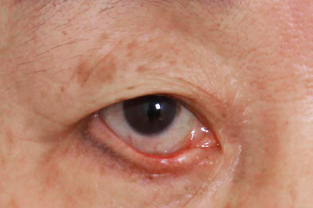
The image above is provided to help explain the surgical procedure.
- Key Points of Ectropion Correction to Resolve Complications
When correcting ectropion caused by complications of lower blepharoplasty, it is not sufficient to examine only the condition inside the eye in isolation.
For effective correction, it is essential to carefully assess the eyelid skin and muscles, as well as the supporting tissues around the outer corners of the eyes, as a whole.
Therefore, it is recommended that the procedure be performed by a plastic surgery specialist who can comprehensively assess the entire eyelid structure and the condition of the surrounding skin.
The risk of recurrence can be minimized only by carefully considering the condition of each individual's periorbital skin, muscles, and supporting tissues and performing a precise correction limited to what is necessary.

- Conclusion
If your eyes keep stinging and becoming red after lower blepharoplasty, it may not be simply due to fatigue or dryness.
Please check in the mirror whether the lower eyelids appear pulled away from the eyes or whether an excessive amount of the conjunctiva is visible.
If you suspect these symptoms, please seek an examination from a specialist without delay so that the disrupted structures around the eyes can be safely restored.
▼More Information About Lower Blepharoplasty▼