
Why Does Color Remain After Eyeliner Tattoo Removal?
Is It Simply a Matter of the Number of Sessions?
There are people who worry, saying, "There is still a black line left," or "I have had several sessions, so why hasn't it been completely removed?" even after undergoing eyeliner tattoo removal.
Eyeliner tattoos involve placing pigment in an area close to the eyes, so the removal process requires a more delicate approach than the removal of ordinary tattoos.
In particular, one of the important factors determining the removal results is the depth of the pigment.
Today, we will explain in simple terms why color remains after eyeliner tattoo removal and what should be checked when planning treatment.
- Why Is an Eyeliner Tattoo Difficult to Remove in a Single Session?
Eyeliner tattoo pigment is usually located in the dermal layer of the skin.
The problem is that all the pigment is not placed uniformly at the same depth.
Depending on the tattooing technique, the pigment used, and the pressure applied by the practitioner, some pigment may remain near the surface while some may have entered deeper layers.
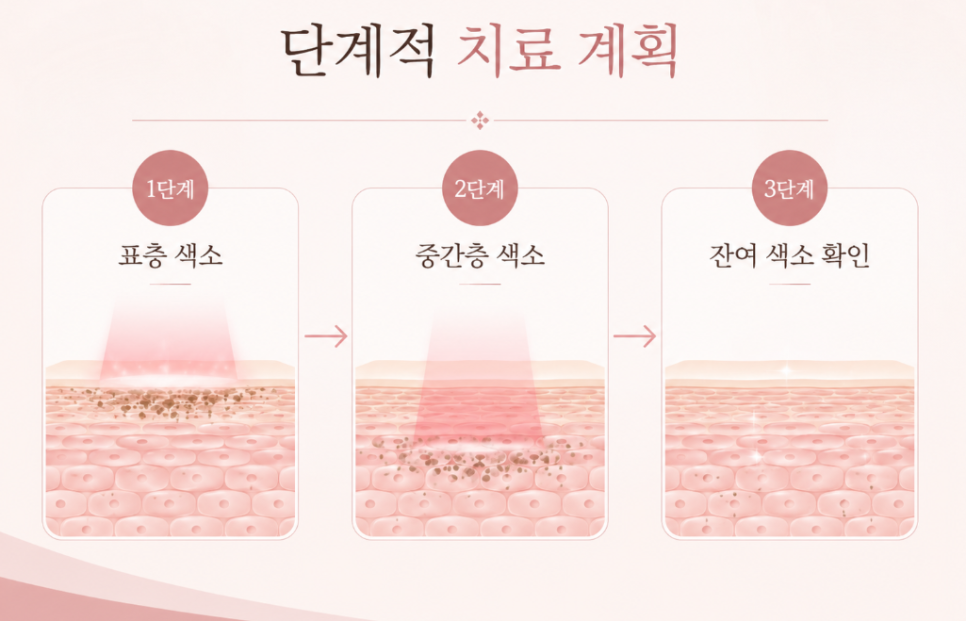
Shallow pigment may respond relatively quickly, but deeper pigment may require multiple treatments because the laser energy must reach it gradually in stages.
Therefore, rather than simply deciding that eyeliner tattoo removal will be completed in “a certain number of sessions,” it is important to first determine how deeply and how much pigment remains.
- Common Reasons Color Remains After Removal

There is no single explanation for why color remains after eyeliner tattoo removal.
The most common cause is a difference in pigment depth.
Although it may look like the same black line on the surface, pigment may actually remain in separate layers: superficial, intermediate, and deep.
The pigment composition also has an effect.
Tattoo pigments often contain a mixture of several ingredients, so they may respond at different rates even to the same laser.
Some pigments may fade quickly, while others may remain and fade more slowly.
The skin's ability to recover is also important.
Pigment broken down into small particles by the laser is gradually eliminated through the body's metabolic processes, and the degree to which it fades may vary depending on the condition of the skin and its recovery rate.
In other words, the fact that color remains does not necessarily mean that the procedure was performed incorrectly. The depth and response of the remaining pigment must be assessed again.
- Should Deeper Pigment Simply Be Removed with More Intensity?
No.
The eyeliner area is sensitive and close to the eyes.
Trying to remove deep pigment in a single session with high energy can increase the risk of skin irritation, scarring, and hyperpigmentation.
The skin around the eyes is especially thin and sensitive, so a gradual approach is necessary rather than an excessive treatment.
Usually, the response of the pigment closer to the surface is checked first, and then treatment is adjusted gradually according to the skin's condition to address the deeper pigment that remains.
The important thing is to plan for the color to fade safely rather than trying to remove it quickly.
It is also not advisable to set the intervals between procedures too close together or to undergo repeated treatments before the skin has recovered sufficiently.
The next treatment should be decided after allowing time for the skin to recover in order to expect stable results.
- What to Check Before Eyeliner Tattoo Removal

If you are planning eyeliner tattoo removal, it is necessary to first accurately assess the current condition of the tattoo.
During a consultation, the following points are generally checked.
-
How long ago the tattoo was applied
-
Whether the color is black or has a bluish or grayish tint
-
Whether the line is clearly defined or appears blurred
-
Whether you have previously undergone a removal procedure
-
Whether the skin around your eyes is sensitive or prone to hyperpigmentation
Depending on these factors, the type of laser, energy level, treatment interval, and expected number of sessions may vary.
Eyeliner tattoo removal is not simply a procedure to erase a tattoo; it is a treatment that must take both the skin around the eyes and the pigment's response into consideration.
Therefore, if you are concerned about the remaining color, rather than undergoing repeated procedures without caution, it is advisable to first check the pigment depth and the condition of your skin, then establish a plan tailored to you.

Conclusion
If color remains even after eyeliner tattoo removal, it may not be simply because “there have not been enough sessions.”
The depth at which the pigment was placed, the pigment composition, the skin's ability to recover, and the history of previous procedures must all be considered together.
Because the area around the eyes is sensitive, safe removal should take priority over rapid removal.
If you are considering eyeliner tattoo removal, consult thoroughly with a specialist physician about how deeply the remaining pigment is located and what approach would be appropriate given the current condition of your skin.
▼Information about laser treatment for eyeliner tattoo removal▼