
Lower Eyelid Fat Repositioning: Some Under-Eye Concerns May Not Improve
Hello. This is Troy Plastic Surgery Clinic.
When the area under the eyes looks puffy, you may appear tired even when you are not, and you may look older than you actually are.
That is why many people look into lower eyelid fat repositioning in Gimpo.
However, during consultations, we often hear questions like these:
“Does lower eyelid fat repositioning improve everything?”
“Will it get rid of my dark circles too?”
“Why might I see only limited results even after fat repositioning?”
First, it is important to be clear: lower eyelid fat repositioning is not the right surgery for every under-eye concern.
It may be effective for people whose main issue is protruding under-eye fat. However, if sagging skin, pigmentation, or deep hollowness is the primary cause, it may be difficult to achieve the degree of change you expect.
If the cause is misidentified, the under-eye area may instead look more hollow, dark circles may remain, or you may feel that “not much has changed” even after surgery.
Today, we will explain how to distinguish under-eye conditions that are likely to respond well to lower eyelid fat repositioning from those in which the results may be limited—something anyone considering this procedure should know.
- Do Not Decide on Lower Eyelid Fat Repositioning Based on the Name Alone
Lower eyelid fat repositioning is, as the name suggests, a procedure that repositions fat beneath the eyes.
The important point is that it is not a procedure that simply removes fat unconditionally.
Under the eyes, there may be fat that protrudes outward, a tear trough that appears hollow beneath it, and areas that look dark because the skin is thin and underlying structures show through.
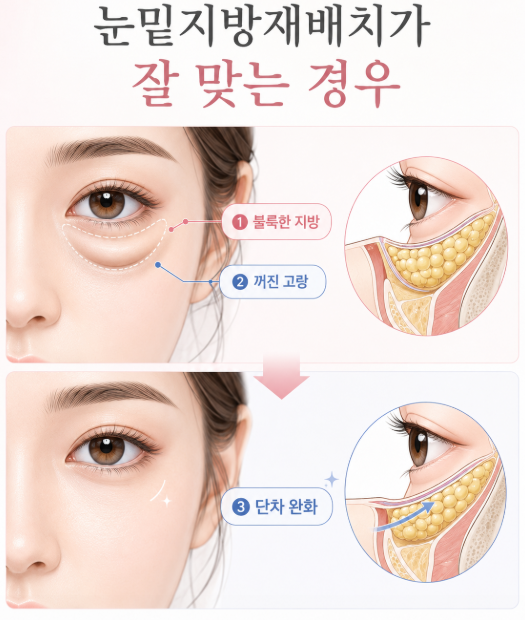
Lower eyelid fat repositioning is more likely to be effective when both protruding fat and a hollow tear trough are present.
In other words, the actual cause of the puffy appearance must be protruding fat.
Just because the under-eye area looks dark or hollow does not automatically mean that fat repositioning is the right answer.
Before focusing on the name of the procedure, the first thing to consider is why your under-eye area makes you look tired.
- These Under-Eye Conditions Are More Likely to Respond to Fat Repositioning
The cases that are well suited to lower eyelid fat repositioning are relatively clear.
The under-eye fat protrudes noticeably, and a groove-like hollow line is also visible below it.
People with this appearance often look more tired than they actually are, have deep-looking shadows under the eyes, and show a clear boundary between the under-eye area and the upper cheek.
Typical examples include:
-
The area under the eyes always looks puffy
-
Fat appears to protrude even when you are not smiling
-
Shadows form beneath the eyes
-
You are told that you look tired even when you are not
-
Fat protrusion is more prominent than skin sagging
In these cases, the protruding fat can be repositioned as needed to reduce the contour difference between the under-eye area and the upper cheek.
However, removing too much fat can make the under-eye area look sunken instead.
Therefore, lower eyelid fat repositioning is not about removing as much fat as possible; it is about moving and preserving the necessary amount.

- These People May See Limited Results from Lower Eyelid Fat Repositioning
There are also cases in which the results of lower eyelid fat repositioning may be limited.
The first thing to examine is skin sagging.
If the skin under the eyes is significantly lax or deep fine lines have developed, repositioning the fat may not change the sagging skin itself.
In such cases, lower eyelid fat repositioning alone may not be sufficient, and an approach that addresses both the lax skin and the under-eye structures, such as lower blepharoplasty, may be needed.
The second case is when there is very little under-eye fat.
If the under-eye area is deeply hollow but there is not enough fat available to move, it may be difficult to correct the hollowness through fat repositioning alone.
Depending on the condition, options such as microfat grafting, fillers, or skin-rejuvenation treatments may also need to be considered.
The third case is pigmentation-related dark circles.
Not everyone with dark circles is a candidate for fat repositioning.
Shadows caused by protruding fat may be reduced, but if the skin itself is dark or pigmentation is the cause, the dark color may remain even after fat repositioning.
In other words, it may not be that lower eyelid fat repositioning is ineffective; the issue may not have been caused by fat in the first place.
- Confused About Lower Eyid Fat Repositioning and Lower Blepharoplasty? Focus on This
Lower eyelid fat repositioning and lower blepharoplasty are often compared.
Both are procedures intended to improve the under-eye area, but they address different concerns.
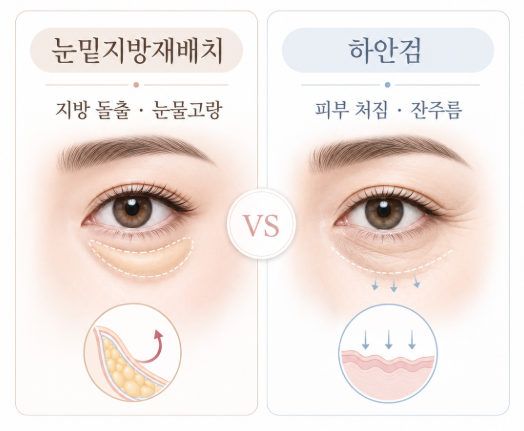
Lower eyelid fat repositioning focuses on refining the contour by addressing protruding under-eye fat and the tear trough.
Lower blepharoplasty, on the other hand, considers not only the fat but also lax skin, deep wrinkles, and eyelid laxity.
Put simply, if the under-eye area is puffy but the skin is not significantly sagging, lower eyelid fat repositioning may be considered.
However, if the skin under the eyes is lax and the wrinkles are deep, lower blepharoplasty may be more suitable.
The important thing is not to decide based on age alone.
Even someone in their 30s may need an approach involving lower blepharoplasty if the skin is significantly sagging, while someone in their 50s may be well suited to fat repositioning if protruding fat is the main cause.
Ultimately, the criteria are the structure and cause of the under-eye concern, not age.

Lower Eyelid Fat Repositioning: Some Under-Eye Concerns May Not Improve
- Lower Eyelid Fat Repositioning in Gimpo: To Reduce the Risk of a Poor Result, Start by Identifying the Cause
The most risky assumption when considering lower eyelid fat repositioning is, “I am concerned about my under-eye area, so I can just get fat repositioning first.”
Under-eye concerns are more complex than they may seem.
Each of these factors must be examined separately.
If this process is skipped, puffiness may remain after surgery, hollowness may become more pronounced, or dark circles may remain unchanged.
For people who are well suited to it, lower eyelid fat repositioning can help smooth the under-eye contour and reduce a tired-looking appearance.
However, it is not a procedure that resolves every under-eye concern at once.
Good results do not come from the name of the procedure.
They begin with accurately assessing your under-eye condition and choosing the right approach: whether to reposition fat, address the skin, correct hollowness, or treat pigmentation.
If you are considering lower eyelid fat repositioning, first consult a specialist to determine whether your under-eye concern is truly related to fat.
▼More information about lower eyelid fat repositioning▼