
Why Color Remains After Eyeliner Tattoo Removal,
Differences in Pigment Depth and Laser Response
Some people considering eyeliner tattoo removal become concerned when color remains even after undergoing several treatments.
"Why is the black line still there?"
"Does it take longer than removing tattoos from other areas?"
"Is eyeliner tattoo removal difficult to complete fully?"
Eyeliner tattoo removal is not a procedure that simply considers how dark the color is.
The removal process may vary depending on how deeply the pigment was implanted, what type of pigment was used, and how sensitive the skin around the eyes is.
Today, we will review why color can remain after eyeliner tattoo removal and why pigment depth is an important factor.
- The Characteristics of the Skin Around the Eyes Must Be Considered First

Eyeliner tattooing is a procedure in which pigment is implanted near the eyelids.
The skin around the eyes is thinner and more sensitive than skin in other areas, and because the treatment area is close to the eyeball, a more cautious approach is needed when using laser energy.
Unlike removing tattoos from the arms, legs, or body, eyeliner tattoo removal cannot be approached simply by using high energy.
If the pigment is located close to the surface, it may fade relatively quickly. However, if it is deeply embedded within the dermal layer, its response must be checked gradually over multiple treatments.
For this reason, rather than stating definitively how many sessions will be needed, it is important to consider the current condition of the pigment together with the skin’s response during eyeliner tattoo removal.
- Laser Response Varies Depending on Pigment Depth
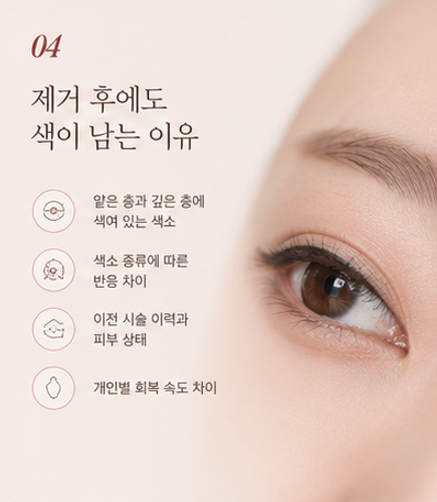
One of the important factors in eyeliner tattoo removal is pigment depth.
The closer the pigment is to the skin’s surface, the more readily laser energy can reach it.
Conversely, if the pigment is deeply embedded or unevenly distributed across multiple layers, the response may be slower even when the same laser is used.
In such cases, using excessively high energy all at once may not be appropriate.
Because the skin around the eyes is sensitive to irritation, raising the energy too much simply because the pigment is deep may increase the risk of redness, irritation, post-inflammatory hyperpigmentation, and scarring.
Therefore, with deeper pigment, a plan is needed to gradually reduce the color while minimizing skin damage.
- There Is More Than One Reason Color Remains After Removal
Color may remain after eyeliner tattoo removal for reasons beyond simply having had too few treatments.
First, the pigment may not be located at a uniform depth; it may be distributed across both superficial and deeper layers.
Second, the type of tattoo pigment may vary.
Although it may appear black, it could actually contain a mixture of several pigments, and the laser response may differ depending on the pigment components.
Third, the history of previous removal treatments can also have an effect.
If the skin has already received laser treatment several times, its recovery status, the amount of remaining pigment, and its sensitivity must all be assessed together.
Fourth, each person’s skin recovers at a different rate.
Even with the same pigment depth and type, the rate at which the color fades can vary depending on skin type, lifestyle, and recovery capacity.
Therefore, in eyeliner tattoo removal, it is important to assess not only the remaining color but also the pigment’s location, the condition of the skin, and its response to previous treatments.
- During the Consultation, the Shape and Boundaries of the Remaining Color Are Checked
During a consultation for eyeliner tattoo removal, the first step is to examine the form of the remaining pigment.
The assessment includes whether the color has faded overall, whether part of it remains as a dark line, whether its boundaries are distinct, and whether the skin is red or sensitive.
When a long time has passed since the tattoo was applied, some of the pigment may appear discolored. If previous removal treatments were performed, the color may also remain in a patchy pattern.
The next laser treatment plan may vary depending on these conditions.
For example, if much of the superficial pigment has decreased but deeper pigment remains, it may be necessary to allow time for recovery and observe the response rather than repeat treatment unnecessarily.
Because eyeliner tattoo removal involves the area around the eyes, it is important to check how much color remains and whether the skin is ready for another treatment.
- Deeper Pigment Requires a Patient, Gradual Plan
If eyeliner tattoo pigment remains deep within the skin, it is necessary to gradually reduce it while monitoring the skin’s response rather than trying to remove it completely in a single session.
In general, the response of the pigment remaining in the superficial layer is assessed first, followed by a step-by-step evaluation of residual pigment in the middle and deeper layers.
The interval between treatments is important in this process.
If the intervals are made too short simply because the color is not fading quickly, irritation may accumulate before the skin has had enough time to recover.
Because minimizing irritation is particularly important around the eyeliner area, the treatment intensity and intervals should be adjusted according to the individual’s skin condition.
If color remains after eyeliner tattoo removal, the first step is to determine why it remains rather than simply increasing the number of treatments.

Why Color Remains After Eyeliner Tattoo Removal,
Differences in Pigment Depth and Laser Response
Q&A
Q. Can eyeliner tattoo removal be completed in one session?
A. If the pigment is superficial and small in amount, it may fade quickly, but in most cases, the response is monitored over multiple treatments.
Q. If color remains, does that mean the laser is ineffective?
A. Not necessarily. Deep or unevenly implanted pigment may respond more slowly, so the progress must be monitored over time.
Q. Can I apply makeup immediately after eyeliner tattoo removal?
A. The skin may be sensitive immediately after treatment, so it is best to avoid irritating makeup and facial cleansing during the period advised by your medical provider.
▼Click here to read more▼