
Lower Eyelid Fat Repositioning, Dark Circles, and
What to Check If You Are Concerned About Tear Troughs
If the area under your eyes looks puffy or the area below it appears hollow, people may easily say that you look tired regardless of how tired you actually are.
“Under-eye fat makes me look older.”
“My dark circles do not cover well even with makeup.”
“Will lower eyelid fat repositioning make me look brighter?”
Many people look into lower eyelid fat repositioning in Mok-dong because of these concerns.
Because the skin under the eyes is thin and the area is subject to frequent facial expressions, achieving a natural improvement can be difficult by simply reducing fat.
Today, we will summarize when lower eyelid fat repositioning may be needed and what to check before surgery.
- What kind of surgery is lower eyelid fat repositioning?
Lower eyelid fat repositioning is not a procedure that simply removes all the fat protruding under the eyes. It is a procedure that restores the balance between the protruding fat and the hollow areas.
The procedure is usually performed through the conjunctiva on the inside of the eyelid, so the burden of a visible skin incision is relatively low.
When the under-eye fat protrudes forward or the tear trough below it is deeply indented and creates a shadow, the fat can be appropriately moved and repositioned to create a smoother under-eye contour.
In other words, the key is to naturally smooth out the contours under the eyes rather than simply removing fat.
- When should you consider lower eyelid fat repositioning?
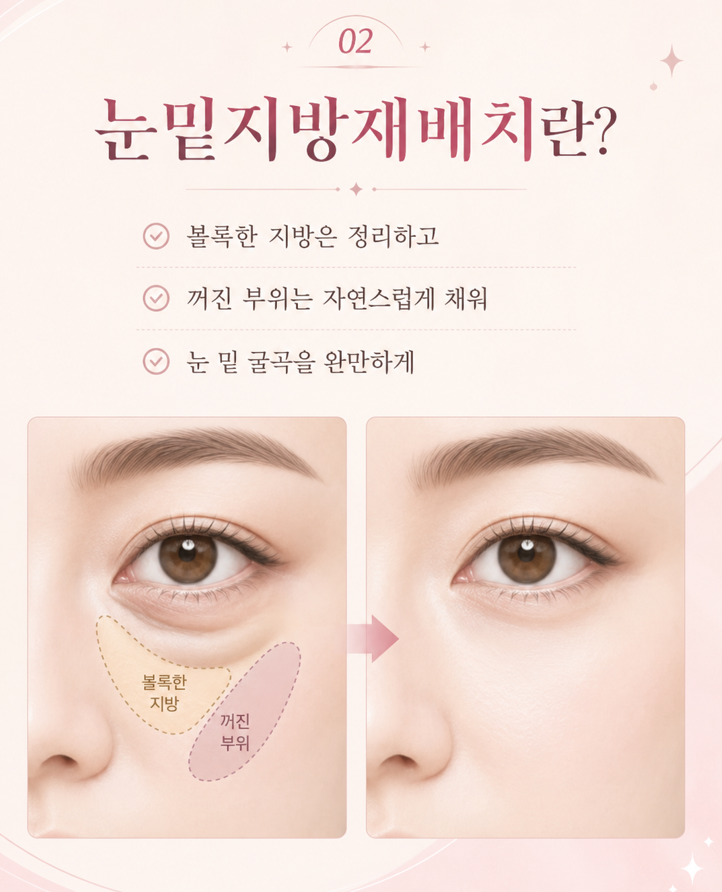
Lower eyelid fat repositioning may be considered if you have concerns such as the following.
-
Protruding, puffy fat under the eyes
-
A deep tear trough that makes the area look shadowed
-
Severe dark circles that make you look tired
-
An aged appearance caused by uneven contours under the eyes
-
Limited improvement even after trying to conceal the area with fillers or makeup
However, not everyone with dark circles needs lower eyelid fat repositioning.
The causes may differ, including hyperpigmentation, visible blood vessels, thin skin, protruding fat, and tear trough depressions. Therefore, it is first necessary to identify what structural issue is present.

- Can people in their 20s and 30s also undergo the procedure?
It is easy to think that lower eyelid fat repositioning is a procedure only for middle-aged people, but it is not needed solely because of aging.
Even people in their 20s and 30s may have naturally protruding fat under the eyes or may develop under-eye shadows easily because of the skeletal structure of the midface.
In such cases, they may look tired even after getting enough rest, and the area under the eyes may still look dark even with makeup.
On the other hand, middle-aged people often have not only protruding fat but also loose skin, fine lines, and reduced elasticity.
In these cases, it is necessary to determine whether lower eyelid fat repositioning alone will be sufficient or whether lower blepharoplasty is also needed.
- How is it different from lower blepharoplasty?
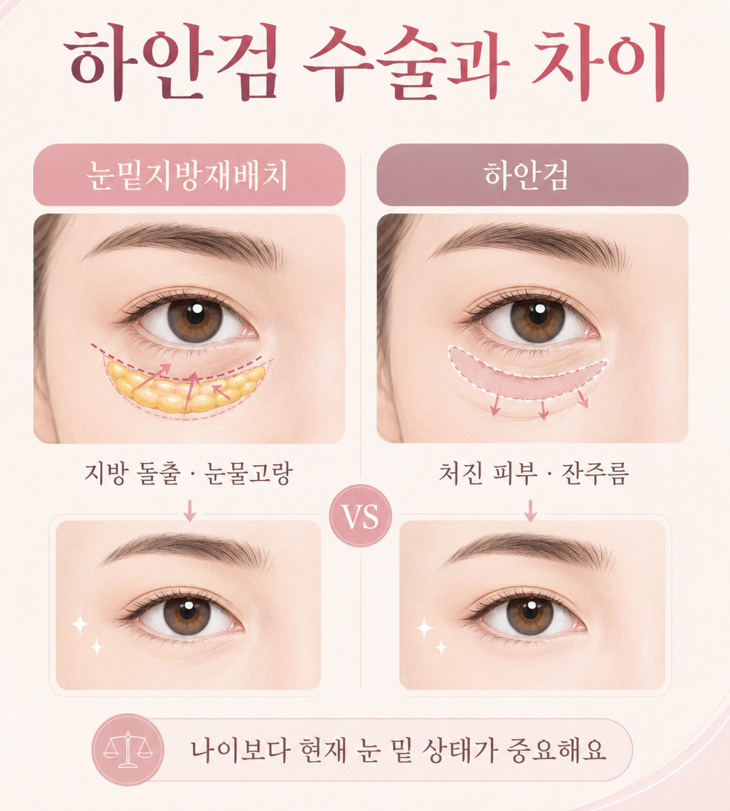
Lower eyelid fat repositioning and lower blepharoplasty are both procedures that improve the area under the eyes, but they have different focuses.
Lower eyelid fat repositioning primarily aims to address protruding fat and tear trough depressions.
Lower blepharoplasty, on the other hand, also corrects loose skin, fine lines, and sagging.
Therefore, when there is not much skin laxity, lower eyelid fat repositioning alone may produce a noticeable change. However, when the skin under the eyes is loose or the wrinkles are deep, it may be more appropriate to consider lower blepharoplasty as well.
The important point is not to choose the surgical method based only on age, but to consider the amount of under-eye fat, skin elasticity, tear trough depth, and overall facial balance together.
- What should you look for when choosing a clinic?
Lower eyelid fat repositioning is a procedure in which even small differences can change the impression of the face.
Removing too much fat may make the area under the eyes look hollow or may even make you look older, while insufficient repositioning may leave the original puffiness or shadows visible.
Therefore, if you are considering lower eyelid fat repositioning in Mok-dong, it is a good idea to check the following:
-
Whether the degree of under-eye fat protrusion is examined in detail
-
Whether the tear troughs and midface volume are considered together
-
Whether the need for repositioning versus removal is explained separately
-
Whether the need for lower blepharoplasty is assessed as well
-
Whether a board-certified plastic surgeon conducts the consultation and creates the treatment plan directly
The area under the eyes should not be evaluated on its own. To expect a natural result, it should be assessed in connection with the anterior cheekbones, midface, and skin elasticity.
Q&A
Q. Can lower eyelid fat repositioning also improve dark circles?
A. It may help improve shadow-type dark circles caused by protruding fat or tear trough depressions.
However, if hyperpigmentation or visible blood vessels is the cause, other treatment may be needed.
Q. Will there be significant scarring?
A. In general, an approach through the inside of the conjunctiva involves relatively little concern about visible scarring.
However, this may vary depending on the individual's under-eye structure and the surgical method, so it should be confirmed during the consultation.

Lower Eyelid Fat Repositioning, Dark Circles, and
What to Check If You Are Concerned About Tear Troughs
In summary
Lower eyelid fat repositioning may help improve a tired or aged appearance caused by puffy under-eye fat and deep tear troughs.
However, the important point is not simply removing fat.
The first step is to accurately determine whether your under-eye area requires fat repositioning, partial fat removal, or lower blepharoplasty performed in combination.
If you are considering lower eyelid fat repositioning in Mok-dong, it is advisable to have a consultation about the surgical approach that suits you after assessing the amount and degree of protrusion of the under-eye fat, skin laxity, and overall facial balance together.

▼Curious about lifting lasers that improve skin elasticity?▼
▼Click here to see more stories▼