
Under-Eye Filler Side Effects,
Why Bluish Discoloration and Bulging Occur, and Alternatives
Many people think of fillers first when the area under their eyes looks sunken or their dark circles appear more pronounced.
“Will under-eye fillers improve a tired-looking appearance?”
“I got fillers because of my dark circles, but now the area looks even more bluish.”
“It looked fine at first, but it became bulging over time.”
Under-eye fillers may help reduce shadows by filling sunken areas, but the area under the eyes has thin skin and a complex structure of blood vessels, fat, and ligaments.
Therefore, approaching the area simply by adding volume can lead to problems such as bluish discoloration, bulging, asymmetry, and more noticeable fine lines.
Today, for those looking into under-eye filler side effects in Mok-dong, we will explain why these problems occur and what alternatives to fillers may be considered.
- Under-eye fillers can be suitable in some cases, but they have limitations
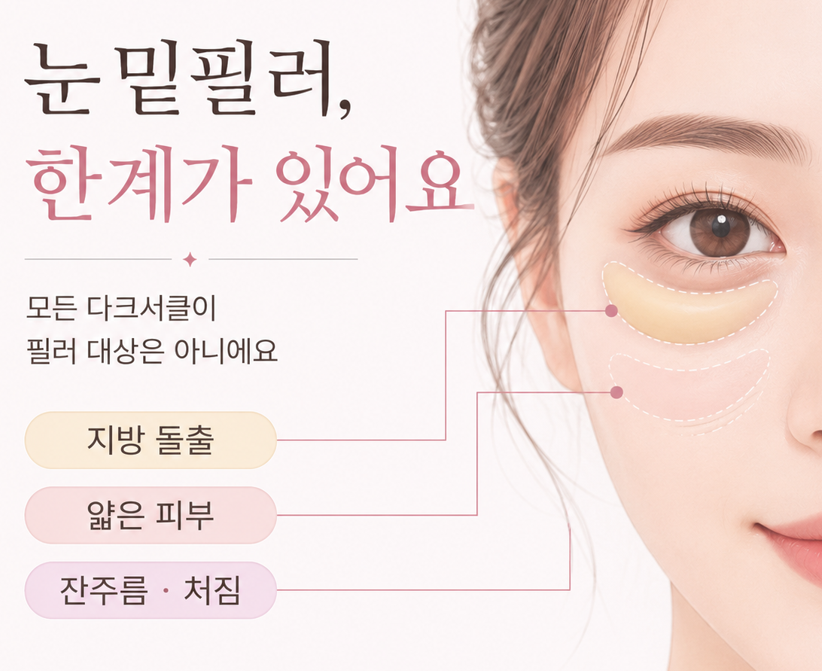
Under-eye fillers are procedures intended to supplement volume in sunken areas and reduce shadows and hollowness under the eyes.
They are often considered for improving dark circles or under-eye hollowness because the procedure is relatively brief and usually does not involve a significant recovery burden.
However, not every under-eye concern can be resolved with fillers.
Fillers may look unnatural when the under-eye fat is already protruding, when blood vessels show through very thin skin, or when skin laxity and fine lines are also present.
The under-eye area is particularly prone to showing even very small differences in volume.
Therefore, before deciding whether to inject filler, it is necessary to determine whether the cause of the concern is hollowness, fat protrusion, pigmentation, or thin skin.
- Why do under-eye filler side effects occur?
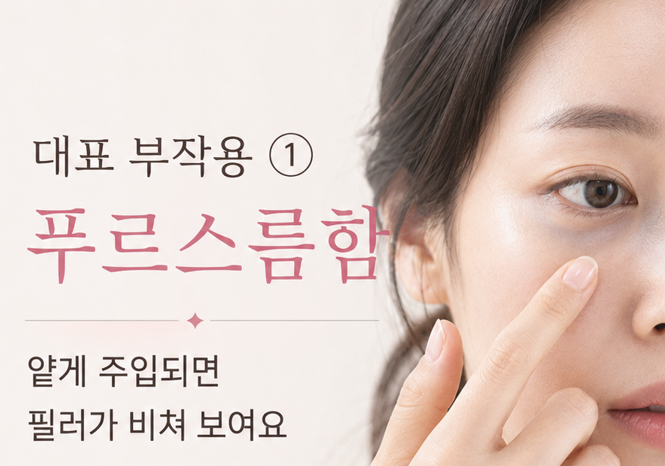
The symptoms most commonly mentioned by people visiting for consultations about under-eye filler side effects in Mok-dong are bluish discoloration and bulging.
Bluish discoloration is commonly referred to as the Tyndall effect.
When filler is placed close to the skin’s surface or the skin is very thin, the filler may reflect light and appear bluish.
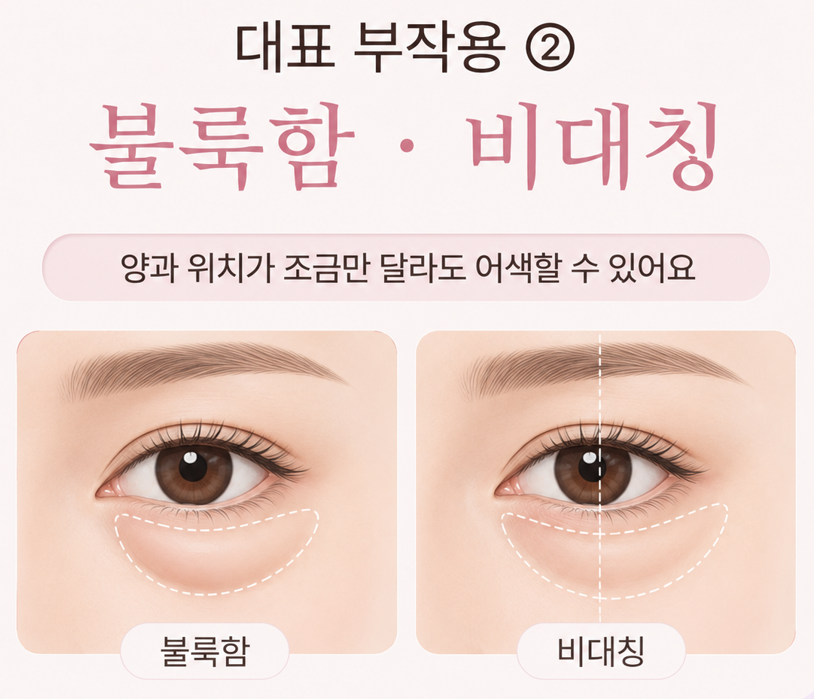
The second issue is bulging.
Because the space under the eyes is naturally narrow and the skin is thin, excessive filler or filler that clumps on one side may make the area look more swollen instead of improving hollowness.
The third issue is asymmetry.
The degree of hollowness, the position of the fat, and the skin thickness can differ between the two sides, so the results may look different even when the same amount is injected.
Finally, fine lines may become more noticeable.
Because fillers primarily add volume, they may not fully smooth fine lines caused by thin skin or reduced elasticity.
- If the area looks unnatural after under-eye filler, be cautious about getting another injection right away
Some people try to correct bluish discoloration or bulging after under-eye filler by immediately adding more filler.
However, if the cause is related to the filler’s position or amount, an additional injection may make the symptoms more noticeable.
In the case of hyaluronic acid fillers, dissolving the filler may be considered depending on the condition.
However, because the under-eye area is delicate, this decision should be made after checking which layer the filler is in, how much remains, and the condition of the skin and fat.
The important point is not to assume, “It will be fine if I fill it again,” but to first determine why it looks unnatural.
- Alternatives to under-eye fillers vary depending on the cause
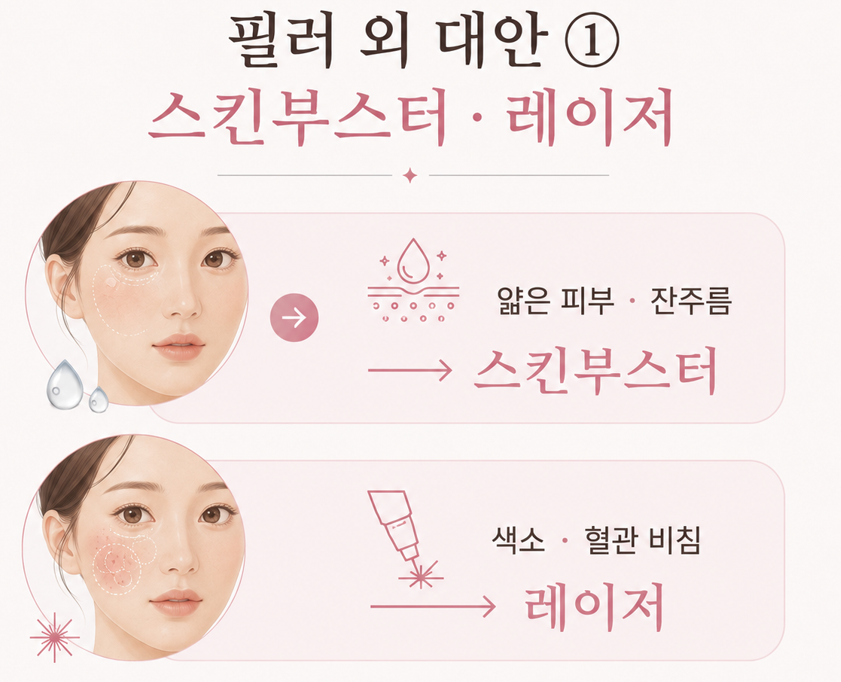
Even when under-eye fillers are not suitable, there is no single predetermined alternative.
If the skin is thin and fine lines are also visible, skin booster treatments such as Rejuran i, Juvelook, and exosomes may be considered.
Rather than significantly adding volume, these treatments are more focused on improving skin texture, fine lines, and the condition of thin skin.
If bluish or brownish dark circles are the main concern, laser treatment may be more suitable.
When the cause is pigmented dark circles, visible blood vessels, or reduced skin tone, an approach that adjusts color and tone may be needed instead of fillers.
Conversely, if the under-eye fat protrudes and hollowness beneath it creates a shadow, lower eyelid fat repositioning may be considered.
Lower eyelid fat repositioning is a surgical procedure that restores the balance between protruding fat and sunken areas, rather than simply removing fat.
When there is a structural cause that is difficult to conceal with fillers, it may be a more fundamental alternative.
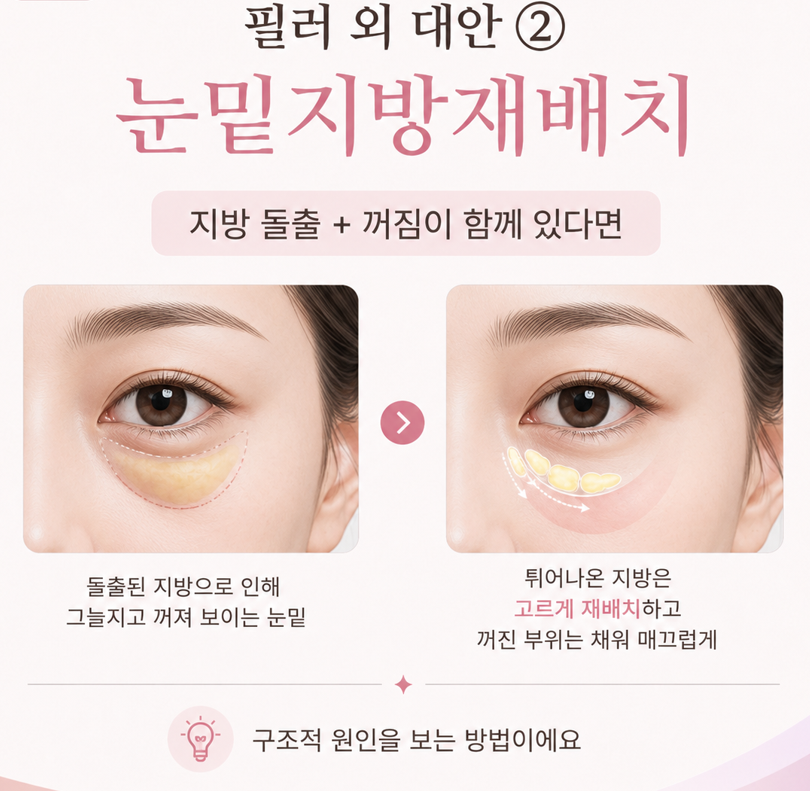
- For under-eye concerns, diagnosing the cause comes before deciding whether to get fillers

Under-Eye Filler Side Effects,
Why Bluish Discoloration and Bulging Occur, and Alternatives
Not all dark-looking areas under the eyes are the same type of dark circle.
In some people, blood vessels show through because the skin is thin; in others, pigmentation is the cause; and in some cases, under-eye fat protrusion and hollowness occur together.
In other cases, lack of sleep, rubbing the eyes, dryness, and sun exposure may make the skin under the eyes look duller and thinner.
Therefore, if you are concerned about under-eye filler side effects in Mok-dong, you should first determine why the area under your eyes looks dark rather than choosing a procedure in advance.
Fillers, skin boosters, lasers, and lower eyelid fat repositioning are not simply interchangeable options; the appropriate choice depends on the cause.
Q&A
Q. If under-eye filler looks bluish, will it disappear naturally?
Unlike temporary swelling, if the filler is showing through thin skin, it may remain for a long time even as time passes.
In this case, the filler’s position and remaining amount should be checked before considering a correction method.
Q. If I have under-eye filler side effects, do I need lower eyelid fat repositioning?
Surgery is not always necessary.
However, if the structure involves both under-eye fat protrusion and hollowness, lower eyelid fat repositioning may be more suitable than fillers, so the decision should be made after a diagnosis.
▼Want to learn more about lower eyelid fat repositioning?▼
▼View it now▼