If your facial contour looks less defined than before or you feel that your jawline has become blurred, you may start looking into lifting procedures.
At this point, Ultherapy and thread lifting are often compared.
Both are intended to improve sagging, but they work in different ways.
That is why the question, “Can Ultherapy and thread lifting be done together?” should be approached by first considering the degree of sagging and the condition of the skin, rather than simply whether it is possible.
Today, we will review the differences between Ultherapy and thread lifting, as well as the situations in which combining them may be considered.
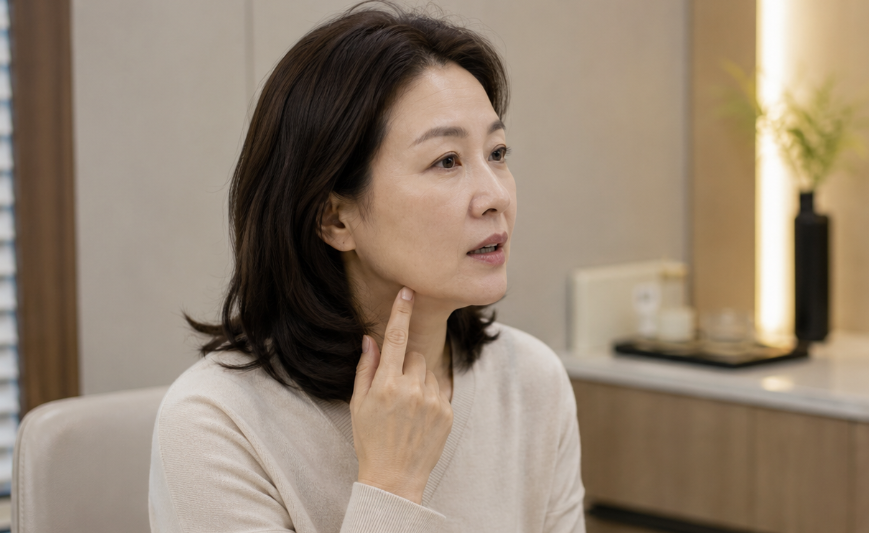
- Ultherapy addresses reduced elasticity in the deeper layers

Ultherapy is a lifting procedure that uses high-intensity focused ultrasound to deliver thermal energy to the desired depth within the skin.
Typically, tips with different depths, such as 1.5 mm, 3.0 mm, and 4.5 mm, are used to target areas ranging from the dermal layer to regions close to the fascial layer.
A depth of 4.5 mm is an especially important consideration when addressing sagging along the facial contour and jawline.
Ultherapy does not directly pull the tissue together like threads.
Instead, it is aimed at stimulating an elasticity response through thermal stimulation within the skin and improving mild sagging and a less defined facial contour.
For this reason, it is often considered when the jawline has become slightly blurred or the face looks heavier due to reduced skin elasticity.
- Thread lifting directly pulls up sagging tissue

Thread lifting is a procedure in which medical threads are inserted beneath the skin to pull up sagging tissue.
It may be considered when there is visible sagging, such as sagging cheeks, a less defined jawline, or sagging around the nasolabial folds.
While Ultherapy focuses on the skin’s elasticity response, thread lifting is more directly focused on adjusting the direction of sagging tissue.
However, inserting more threads does not necessarily produce a natural-looking result.
The type of thread and the insertion direction must be determined according to the amount of facial fat, skin thickness, and direction of sagging to reduce an unnatural appearance.
- When Ultherapy and thread lifting are considered together

Ultherapy and thread lifting are not necessarily substitute procedures; rather, they focus on different aspects.
Ultherapy addresses elasticity within the skin and the lifting response in the deeper layers, while thread lifting focuses on pulling up tissue that has already descended.
For example, if the jawline is only slightly blurred, Ultherapy may be considered first.
On the other hand, if the cheeks have descended and jawline sagging is pronounced, thread lifting may be a more important option.
When reduced skin elasticity and tissue sagging occur together, combining the two procedures may also be considered.
However, whether they should be performed on the same day or spaced apart may vary depending on the condition of the skin and the scope of the procedures.
- In what order should they be performed?

There is no fixed order.
If reduced skin elasticity is the main concern, one approach may be to address the deeper layers with Ultherapy first and then use thread lifting to supplement any remaining sagging.
Conversely, if sagging is pronounced and the facial contour has become significantly less defined, thread lifting may be used to establish the contour first, followed by consideration of Ultherapy.
The important point is not to automatically combine the two procedures.
The first step is to distinguish whether the cause of sagging in your face is reduced skin elasticity or sagging fat and tissue.
In summary
Because Ultherapy and thread lifting have different purposes and target layers, combining them may be considered when reduced skin elasticity and tissue sagging are present together.
However, having them performed together is not necessarily the best choice for everyone.
It is important to determine the necessary method and order after considering the amount of facial fat, skin thickness, direction of sagging, and any previous procedures.
If you are considering Ultherapy and thread lifting, it is advisable to establish a lifting plan with a board-certified plastic surgery specialist who can assess both your facial structure and skin layers.
▼Have other concerns?▼
▼See them now▼