Some people feel that although the area under their eyes looks more refined after lower eyelid surgery, their eyes have become more uncomfortable than before.
Their eyes may keep feeling sensitive, sting whenever exposed to wind, and become dry again soon after applying artificial tears.
At first, it is easy to dismiss these symptoms by thinking, “Maybe this is temporary because I recently had surgery.”
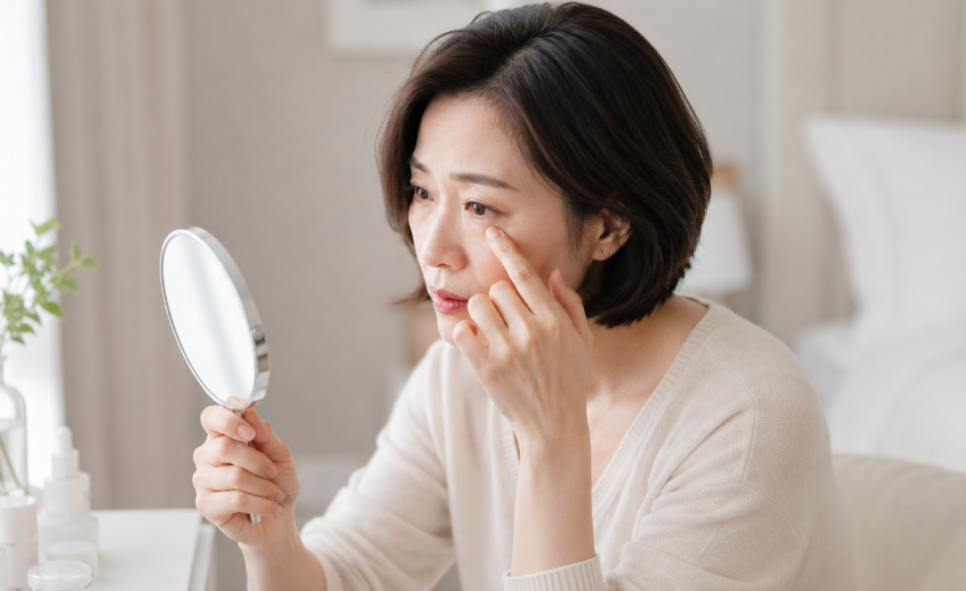
However, if you look in the mirror and notice that the lower eyelid is not closely attached to the eye and that the red conjunctiva on the inside is visible, the situation may be different.
This condition is called ectropion.
When ectropion develops after lower eyelid surgery, it can affect not only the appearance but also the eyelid’s ability to protect the eye, causing discomfort.
Today, I will organize the cases in which ectropion correction may be needed, why the eyelid turns outward, and what needs to be corrected during the procedure.
1. Why does ectropion occur after lower eyelid surgery?

Ectropion refers to a condition in which the lower eyelid cannot remain closely attached to the eye and appears to pull away or turn outward.
There is no single reason why this change occurs after lower eyelid surgery.
Usually, several factors are considered together, including:
-
The lower eyelid is pulled downward because too much skin was removed
-
Scar tissue formed after surgery has hardened and is pulling the eyelid downward
-
The lower eyelid had weak support to begin with
-
The tissues around the outer corner of the eye have become lax
In practice, it is not uncommon for two or three causes to be present at the same time.
Therefore, even if the condition looks similar on the outside, the correction method may differ depending on what caused the ectropion.
2. Ectropion correction is not simply a procedure to pull the eyelid upward

When people hear “ectropion correction,” it is easy to think of it as a procedure that lifts the turned-out eyelid and fixes it in place.
Of course, fixation may be necessary if the eyelid has lost its support.
However, if the cause pulling the eyelid downward remains and the eyelid is only pulled upward, achieving sufficient correction may be difficult.
For example, if the eyelid has been pulled downward by scar tissue and adhesions after surgery, the hardened tissue must first be released.
Conversely, if the eyelid itself has become lax, reinforcing the outer corner of the eye may help the eyelid attach securely to the eye again.
Ultimately, the first question to consider in ectropion correction is not how much to pull the eyelid upward, but what is pulling it downward.
3. Why does the correction approach differ from person to person?

If a significant amount of skin was removed during lower eyelid surgery, there may not be enough remaining skin to lift the eyelid upward.
In such cases, releasing adhesions or fixing the outer corner alone may not be sufficient.
During an examination, the following factors are assessed together:
-
The amount of excess skin remaining on the lower eyelid
-
The direction and degree of traction from the scar tissue
-
How loose the eyelid is horizontally
-
Whether the support structures at the outer corner are stable
If there is an actual shortage of skin, it may be necessary to consider a method to compensate for the deficient area.
Conversely, if there is sufficient skin and another factor is causing the problem, adding skin is not necessary in every case.
4. Postoperative pulling immediately after surgery must be distinguished from ectropion

Immediately after lower eyelid surgery, swelling and tissue tension can make the lower eyelid appear more pulled than usual.
Therefore, if the eyelid appears slightly lifted away from the eye shortly after surgery, this does not necessarily mean that ectropion correction is immediately required.
However, if the following signs persist over time, it is worth having the condition evaluated:
-
The lower eyelid does not properly attach to the eye
-
The red conjunctiva on the inside remains visible
-
Eye sensitivity or redness keeps recurring
-
Tears keep flowing or dryness is severe
-
There is discomfort even when closing the eyes
In particular, if sensitivity and stinging continue, it is difficult to view the issue as merely an appearance-related concern.
It is also necessary to check whether the eyelid is properly protecting the eye and to assess its function as well.
5. The entire eyelid structure must be assessed, especially in revision surgery

An eye that has already undergone lower eyelid surgery has different conditions from one undergoing surgery for the first time.
The available skin may have decreased, and scar tissue or adhesions may have formed internally.
The strength supporting the eyelid or the position of the outer corner may also have changed from before.
Therefore, rather than taking an approach that simply pulls the eyelid upward forcefully during ectropion correction,
✓ Compensate for areas that are lacking
✓ Release areas that are pulling the eyelid downward
✓ Support loosened areas as much as necessary
These three factors must be adjusted according to the current condition of the eye.
It is also important to ensure that the eyelid attaches comfortably to the eye again while maintaining natural movement when opening and closing the eyes.
In conclusion
Ectropion correction is not simply a procedure to improve the appearance of an eyelid that appears turned outward.
Because the skin, scar tissue, and eyelid support structures may have changed after lower eyelid surgery, it is important to first determine precisely what is causing the current problem.
As a board-certified plastic surgeon, when evaluating this type of revision surgery, I focus less on “how much to lift” and more on distinguishing which areas need to be released, which need reinforcement, and which should not be disturbed.
If your eyelid continues to pull away from the eye or discomfort remains after lower eyelid surgery, I recommend thoroughly checking the current condition of the eyelid and the underlying cause before deciding on a surgical method.
▼Have other concerns?▼
▼View them now▼