Hello. I am Im Young-soo, director of Troy Plastic Surgery.
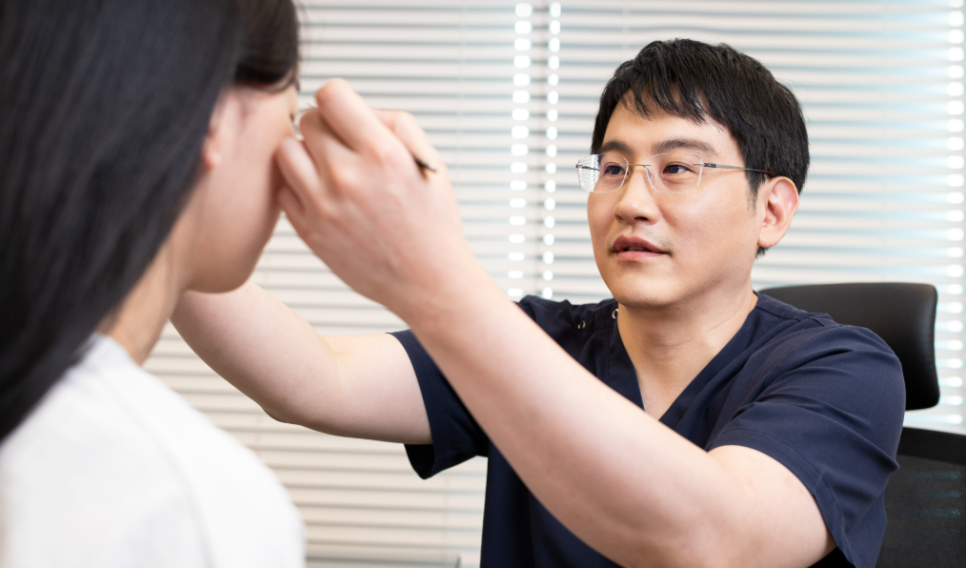
Many people in their late 40s or 50s say that their double-eyelid line has become much more covered than before and that the area above their eyes feels heavy.
As the day progresses, their eyelids may feel even more droopy, and when they try to open their eyes comfortably, they may unconsciously tense their eyebrows or forehead.
However, when looking into procedures for age-related eyelid drooping, the many names—from upper blepharoplasty to brow lift and forehead lift—can make things even more confusing.
The concern I hear most often is this:
“ I don’t want to change the shape of my eyes significantly right now. Can the drooping areas be refined naturally?”
This is an important question when considering eyelid surgery in middle age.
The surgical approach changes completely depending on whether only the drooping skin is removed or the position of the eyebrows is adjusted as well.
- If my eyelids are drooping, do I necessarily need upper blepharoplasty?
Age-related eyelid drooping does not begin in the same way for everyone.
For some people, the upper-eyelid skin becomes loose and covers the double-eyelid line. For others, the eyebrows themselves descend and press down on the eyelids from above.
During a consultation, I first assess the following:
-
The thickness and degree of drooping of the upper-eyelid skin
-
-
The amount of fat in the upper eyelid
-
-
The distance between the eyes and eyebrows
-
-
The current position of the eyebrows
-
-
Whether the forehead is used when opening the eyes
If the drooping skin is removed without distinguishing these differences, the eyes may look clearer, but the overall impression can differ from what was expected.
- Will upper blepharoplasty change the shape of my eyes significantly?

Upper blepharoplasty is a procedure that directly removes loose skin from the upper eyelids.
If loose skin above the double-eyelid line covers the eyes but the eyebrows have not descended significantly, upper blepharoplasty can be a good way to relieve the heavy, obstructed feeling.
It is especially easier to achieve a natural result when the skin is relatively thin and the upper-eyelid area does not feel particularly heavy.
On the other hand, the situation is different if the distance between the eyes and eyebrows is already narrow or the eyebrows have descended considerably.
If too much upper-eyelid skin is removed in such cases, the eyes and eyebrows may appear even closer together, making the overall impression look harsh or heavy.
When deciding on upper blepharoplasty, it is necessary to consider not only ‘how much the skin has drooped’ but also how the eyes will look after the skin is removed.
- If I want to preserve my current eye shape, would a brow lift be better?

There is something I often hear during consultations for eyelid surgery in people in their 50s:
“I like my current double-eyelid line, so I want to keep the shape of my eyes as it is.”
In such cases, a brow lift can be a good option.
Because the drooping skin is removed from beneath the eyebrow, the procedure is closer to revealing the existing eye shape that had been covered by skin than to creating a new double-eyelid line.
It may be particularly suitable for people with thick upper-eyelid skin or outer-corner drooping that covers the eyes, but who want to minimize changes to their existing eye shape.
However, if the distance between the eyes and eyebrows is naturally narrow, pulling up the skin beneath the eyebrows may create a heavy appearance. In that case, the position of the eyebrows themselves must also be assessed.
- How can I tell whether it is my eyebrows, rather than my eyelids, that are drooping?

When evaluating drooping eyes, the forehead is just as important to check as the eyelids.
If you usually raise your eyebrows when opening your eyes, or if deep horizontal forehead lines are visible even when you are at rest, it is worth considering the possibility that the eyebrows have descended.
The following signs may also appear:
-
The distance between the eyes and eyebrows has become narrower than before
-
The skin around the outer corners of the eyes is heavily covering the eyes
-
The eyes open more comfortably when the eyebrows are gently raised by hand
-
The eyes feel heavier when the forehead is relaxed
In such cases, rather than continuing to remove upper-eyelid skin, a forehead lift adjusts the position of the descended forehead and eyebrows upward.
When the eyebrows return to a more appropriate position, the pressure above the eyes is reduced, allowing the eyes to open more comfortably.
- Upper blepharoplasty, brow lift, or forehead lift—which procedure is right for my eyes?
Choosing a procedure for age-related eyelid drooping is not a matter of picking one of three procedures based on popularity.
The criteria become much clearer when you identify where the descent began.
Loose skin on the upper eyelid itself → Upper blepharoplasty
Refining covered skin while preserving the existing eye shape → Brow lift
The eyebrows and forehead have descended and are pressing down on the eyes → Forehead lift
The amount of fat in the upper-eyelid area and the strength used to open the eyes must also be assessed.
In particular, if the muscles used to open the eyes are themselves weak, it is also necessary to determine whether eyelid correction is needed rather than simply removing the drooping skin.
In closing
In eyelid surgery for people in their 40s and 50s, the point I consider most carefully is how naturally the original eye shape can be preserved.
Removing a large amount of skin simply because there is significant drooping, or lifting every descended eyebrow to the same position, can change the impression a person naturally has.
Upper blepharoplasty, brow lift, and forehead lift differ in the location of the procedure itself. Rather than recommending only one method, it is best to determine whether the medical professional carefully examines the eyelids, eyebrows, and forehead together and explains the differences between each option.
▼Have another concern?▼
▼Go see it now▼