Hello. I am Lim Young-soo, Chief Director of Troy Plastic Surgery.
Some people visit us several months or even years after double-eyelid surgery because the line on one side has changed compared with before.
The line may be visible in the morning but become faint in the afternoon, or the double eyelid may appear only when the eyes are opened wide.
Many also worry about why only one side has changed even though both sides were operated on in the same way, and whether the procedure can be done again using the non-incisional method.
In particular, those who have undergone non-incisional double-eyelid surgery may first think, “Has it ultimately come undone?”
However, before deciding on double-eyelid revision surgery, it is important to first distinguish between a lower eyelid crease and an actually weakened fold.
- If the line has become faint, has the double eyelid really come undone?

Immediately after surgery, the double-eyelid crease looks high and pronounced because of swelling.
As the swelling subsides over time, the line becomes lower and its depth looks more natural. Some people mistake this change for the double eyelid coming undone.
However, eyes with genuinely weakened fixation look somewhat different.
-
The line is barely formed when the eyes are opened comfortably
-
The inner or outer line appears to break off midway
-
The double eyelid appears only when the eyes are opened wide
-
The clarity of the line keeps changing throughout the day
In other words, it is necessary to first determine whether the double-eyelid crease has simply become lower or whether the folding force itself has weakened. Only then can the need for revision surgery be accurately assessed.
- Why can a non-incisional double eyelid become faint over time?
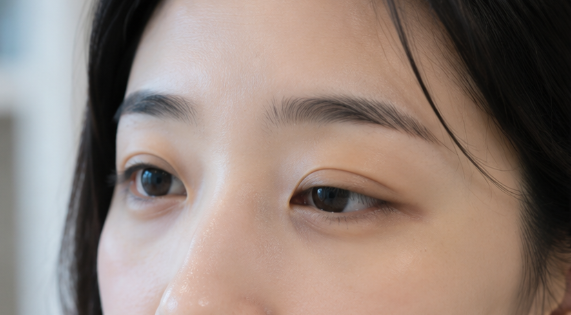
Double-eyelid surgery does not create a line on the skin.
It creates fixation and adhesions so that a particular area of skin folds together when the eyes are opened.
When the eyelid skin is thick and there is a large amount of fat or soft tissue, the tissue that needs to fold is correspondingly heavier.
If the existing fixation or adhesions are insufficient, the line may become shallow over time or appear to have come undone starting in certain areas.
Therefore, it is too simplistic to say that the non-incisional method comes undone easily while the incisional method always lasts a long time.
When assessing durability, it is more important to determine whether the surgical method was selected appropriately for the current eyelid thickness and tissue volume, as well as the desired crease height.
- If both sides were operated on together, why does only one side come undone first?

A person’s two eyes are not originally exactly the same.
There are differences between the two sides not only in skin thickness and fat volume but also in the strength used to open the eyes.
In particular, if the force used to open one eye is relatively weaker, the double-eyelid crease on that side may look less deep and more blurred even if both sides were operated on at the same height.
When examining a double eyelid that has come undone on one side, we therefore check the following together:
-
The force used to open both eyes
-
The height and depth of the lines
-
The point from which the fold has weakened
-
Differences in skin and fat volume between the two sides
Rather than simply adding more fixation to the blurred side, the first step is to distinguish whether the fixation has actually come undone or whether a difference in the force used to open the eyes is making the lines look different.
- If only the front part of the double eyelid has come undone, does the entire line need to be redone?

When a double eyelid comes undone, the entire line does not necessarily disappear all at once.
It may appear as faintness only near the inner corner, a shortened outer line, or a crease that remains only in the middle.
In these cases, we first examine which area has weakened fixation.
If the existing line remains relatively stable, it is more natural to plan correction around the problem area rather than unnecessarily treating every part again from the beginning.
On the other hand, if the fold has weakened at several points or you want to change the existing line itself, an overall redesign is necessary.
In revision surgery, it is important to determine whether the remaining line can be used as much as possible, rather than blindly recreating the same line without identifying where it has come undone.
- Should you undergo the non-incisional method again or choose the incisional method? This is where revision surgery is determined

Just because a double eyelid has come undone once does not mean you must immediately switch to the incisional method.
If the eyelid is relatively thin, there is not much tissue, and the existing line is in good condition, recreating the line with the non-incisional method may be selected.
Conversely, if the non-incisional method has been performed several times but the same area repeatedly comes undone, or if thick tissue interferes with the fold, simply adding more fixation points has limitations.
In revision surgery, the fixation points, adhesions, and scars remaining from the previous surgery must also be examined.
Especially when creating a new double eyelid at a different height from the existing line, residual adhesions from the previous surgery may cause a double line or unexpected creases. Therefore, the plan must include how to manage the existing tissue.
Ultimately, the key to double-eyelid revision surgery is not whether to choose the non-incisional or incisional method, but resolving why the original line did not remain stable.
In closing
When considering revision surgery because a double eyelid has come undone, I do not begin by deciding where to create a new line.
I first check which part of the fold has weakened, whether there is a difference in the force used to open the two eyes, and how the adhesions and fixation from the previous surgery remain.
Because an eye that has already undergone surgery has a different tissue condition from before the initial procedure, it is difficult to achieve the desired balance between the two sides simply by repeating the same method once more.
If only one double-eyelid line has become faint, we recommend confirming whether the plastic surgeon is a specialist who compares both the non-incisional and incisional methods and explains which parts of the existing line can be preserved and which parts need to be corrected again.
▼Have another concern?▼
▼View it now▼