Hello, I’m Young-soo Lim, Medical Director of Troy Plastic Surgery.
From their late 30s onward, many people say that the lines around their eyes after smiling no longer disappear as quickly as they used to.
At first, they may think it is because makeup has settled into the lines. But when, at some point, fine wrinkles begin to appear not only at the outer corners of the eyes but also under the eyes, they start looking into treatment options.
“Botox seems like it would help, but if my under-eye area looks hollow, do I need filler too?”
When searching online, laser lifting often appears alongside these treatments, making it even more confusing to determine which option is right for your eye area.
The choice for improving eye-area wrinkles depends on whether the wrinkles appear with movement, look deeper because of hollowing, or remain because the skin has become thinner.
1. Eye-area wrinkles that deepen when you smile: Is Botox right for you?
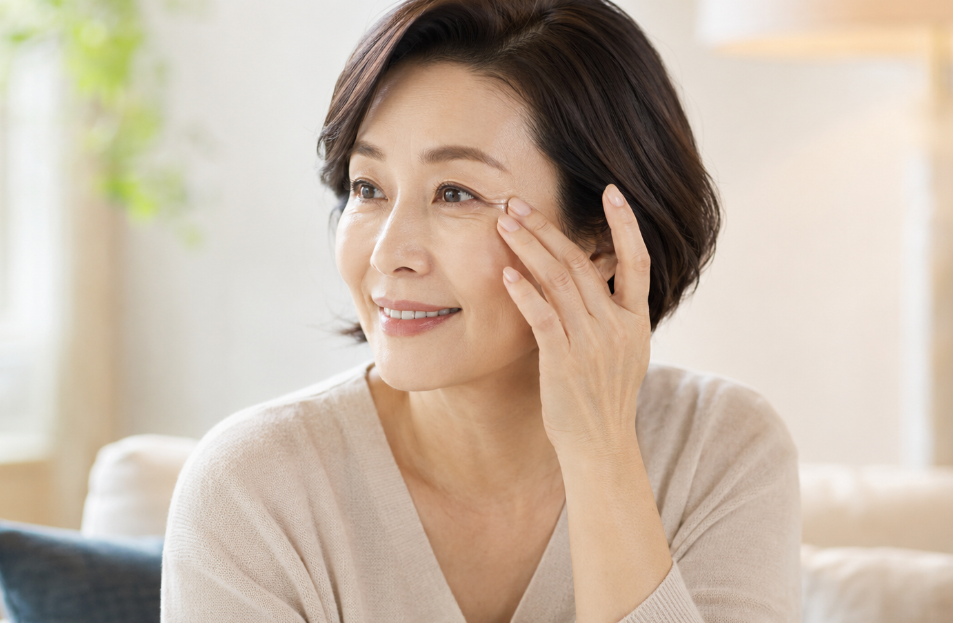
If several lines appear beside the outer corners of your eyes when you smile, even though they are not very noticeable normally, the cause is movement of the facial expression muscles.
For this type of eye-area wrinkle, Botox is the most direct option.
Botox does not add volume. Instead, it regulates excessive movement of the muscles around the eyes, softening the wrinkles that fold when you smile.
However, changes in facial expression are immediately noticeable around the eyes.
If movement is reduced too much in an effort to eliminate wrinkles, your eyes may look unnatural or stiff when you smile.
Reducing wrinkles while preserving your natural expressions—that balance is important when receiving Botox around the eyes.
2. If the under-eye area looks hollow, should filler come first?

If the under-eye area looks sunken even when your face is relaxed and a shadow forms beneath it, wrinkles can appear deeper than they actually are.
In this case, reducing muscle movement with Botox will not eliminate the hollow area.
Under-eye filler works by adding volume to areas that lack it, such as the tear trough, and softening the line that extends from the under-eye area toward the cheek.
However, the skin under the eyes is very thin, so adding more volume is not necessarily the answer.
Adding more volume than necessary can make the under-eye area look puffy or uneven and may make it obvious that you have had a procedure.
Therefore, it is important to first determine whether the eye-area wrinkles themselves are the issue or whether hollowing is emphasizing both the wrinkles and shadows.
3. Fine wrinkles that remain even when your face is relaxed: Do you need lifting?

The situation is different if fine wrinkles remain densely across the under-eye or outer-eye skin even when you are not making an expression.
These wrinkles are influenced more by thinning skin and reduced elasticity than by muscle movement.
In particular, you may notice the following changes:
-
The skin under the eyes looks as thin as paper
-
Makeup settles heavily into the fine lines
-
Fine lines remain around the eyes even when you are not smiling
-
The skin at the outer corners of the eyes has become looser and hangs lower than before
For this type of eye area, it may be preferable to choose laser lifting to improve the skin’s own elasticity rather than adding filler or repeatedly receiving Botox alone.
4. Filler? Botox? Lifting? Check these things first when you look in the mirror

Improving eye-area wrinkles can seem complicated when you start by comparing treatment names, but it is easier than expected to distinguish the options by observing how the wrinkles appear.
-
Outer-eye wrinkles deepen when you smile → Botox
-
The under-eye area looks hollow and shadowed → Filler
-
Fine wrinkles remain even when your face is relaxed → Laser lifting
-
Hollowing, fine wrinkles, and expression lines appear together → Plan by addressing each cause rather than choosing just one treatment
After your 40s, it is common for under-eye hollowing, reduced skin elasticity, and expression wrinkles to overlap rather than appearing separately.
Therefore, rather than deciding on a single treatment based on a general statement such as “Botox is good for eye-area wrinkles,” it is important to determine what should be improved first in your particular eye area.
5. Why can eye-area treatments look noticeable even when only slightly overdone?

In eye-area treatments, naturalness is not determined by how many wrinkles have been removed.
Filler can look puffy if too much is added, and Botox can make your expressions look unnatural if it is applied over a wider area than necessary.
When the skin around the eyes is naturally thin, repeatedly receiving other treatments without improving its elasticity may also leave you feeling that the result is incomplete.
That is why, when assessing eye-area wrinkles, we look at all three of the following together:
Movement of the facial expression muscles / Under-eye volume / Skin thickness and elasticity
Ultimately, what matters is not choosing the most well-known treatment, but distinguishing which areas of your eye area need to be addressed and which do not necessarily need to be treated.
In closing
The eye area is one where even a difference of a few millimeters can change the overall impression of the face.
That is why I do not recommend simply suggesting Botox based on the lines at the outer corners of the eyes or deciding on filler immediately just because the under-eye area looks dark.
It is necessary to distinguish whether the lines appear when you smile, whether they are shadows caused by under-eye hollowing, or whether they are fine wrinkles caused by thinning skin in order to achieve natural-looking improvement of eye-area wrinkles.
We recommend confirming that the plastic surgeon thoroughly compares Botox, filler, and laser lifting and explains why a particular treatment is needed first for your eyes.
▼Do you have other concerns?▼
▼See more now▼