Hello, I’m Lim Young-soo, the medical director of Troy Plastic Surgery.
Many people in their 50s feel that their eyelids have become heavier and more uncomfortable than before.
When they try to open their eyes clearly, they may feel tension in their forehead, and as the afternoon progresses, the area above their eyes may feel increasingly pressed down.

“Has it reached the point where I need ptosis correction? And is it okay to have it done at my age?”
This is a question I often hear during consultations for middle-aged eye surgery.
Eye surgery in your 50s should not be decided based on age alone.
First, it is necessary to determine whether the eyes have become uncomfortable because of reduced eyelid-opening strength, drooping skin, or the position of the eyebrows.
- I’m in my 50s. Is it okay to have ptosis correction surgery?
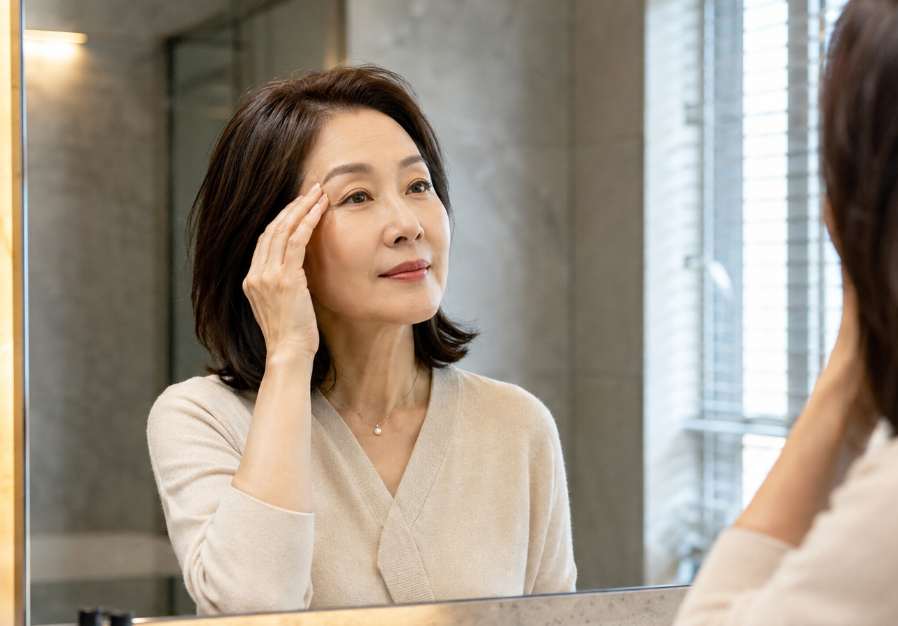
Ptosis correction is not a procedure that removes drooping skin. It is a procedure that adjusts the strength used to open the eyes.
If the pupils are usually significantly covered and the forehead or eyebrows become tense when trying to open the eyes wide, we examine the eye-opening function.
On the other hand, if the eyes open well but loose skin covers the pupils, there is no reason to perform ptosis correction first.
In such cases, a procedure that removes drooping skin, such as upper blepharoplasty, may be more appropriate.
Therefore, rather than deciding whether to have ptosis correction based solely on being in your 50s, the first step is to determine whether the eyes actually have weak opening strength.
- If my eyes have become smaller, should I start with ptosis correction?

In your 50s, the skin of the eyelids becomes looser, and the eyebrows also gradually descend compared with before.
As a result, the eyes may look small and heavy even when the actual strength used to open them is adequate.
Trying to resolve all such cases with ptosis correction may lead to an inappropriate surgical approach.
During a consultation, we generally examine the following points together.
-
Whether the pupils are being covered by drooping skin
-
Whether the actual strength used to open the eyes is weak
-
Whether the eyebrows have descended and are pressing on the eyelids
-
How heavy the skin and fat in the upper eyelid area are
Although the eyes may look similarly uncomfortable on the outside, the surgical area can be completely different depending on the underlying cause.
- When is upper blepharoplasty more appropriate for drooping eyelids?
If the skin above the eyelid crease has become loose and covers the crease, while the eyebrows have not descended significantly, upper blepharoplasty can be used to remove the drooping skin.
It is particularly suitable for people whose eyes open well but whose skin covers the pupils.
If you notice these changes, upper blepharoplasty is considered first.
-
The eyelid crease is hidden by the skin and is difficult to see
-
The outer eyelid has drooped, making the field of vision feel obstructed
-
Multiple creases have increased and the skin above the eyes folds
-
The strength used to open the eyes is adequate, but the skin covers the pupils
Upper blepharoplasty in your 50s is not a procedure that involves removing a large amount of skin.
Rather, it is more important to determine how much skin should be left to maintain the natural appearance of the eyes.
- Why can the eyes still look uncomfortable after only upper blepharoplasty?

For some people, it is not only the eyelid skin that has drooped—the eyebrows themselves have also descended.
If the upper eyelid skin is repeatedly removed in this situation, the distance between the eyes and eyebrows may look narrower, which can make the overall impression appear more constrained.
If you want to remove drooping skin beneath the eyebrows while preserving your existing eyelid crease and eye shape as much as possible, sub-brow lifting may be considered. If the eyebrows and forehead have descended together, a forehead lift may be considered.
Simply put:
Drooping upper eyelid skin → Upper blepharoplasty
Preserve the existing eye shape and remove the overhanging skin → Sub-brow lift
The eyebrows and forehead have descended together → Forehead lift
The actual strength used to open the eyes is weak → Ptosis correction
In eye surgery for people in their 50s, it is more common for two or more of these changes to overlap than for only one to be present.
Therefore, deciding on surgery based on just one area can result in an unnatural outcome.
- Ultimately, which type of middle-aged eye surgery is right for me?

This is ultimately the question I am asked most often.
Rather than deciding on the procedure name first, the appropriate approach becomes much clearer when these four factors are examined:
Strength used to open the eyes / Amount of drooping skin / Eyebrow position / Distance between the eyes and eyebrows
For example, if the strength used to open the eyes is adequate but the skin covers them significantly, there is no need to add ptosis correction unnecessarily.
Conversely, if only the skin is removed while leaving genuinely weak eye-opening strength untreated, the eyes may still look sleepy after surgery.
The purpose of eye surgery in your 50s is not to undergo as many procedures as possible.
The most important thing is to accurately identify the cause of your current discomfort and correct only what is necessary.
In closing
If you ask whether it is okay to have ptosis correction in your 50s, I would say that I first determine whether ptosis correction is truly necessary for your eyes.
Because drooping skin, eyebrow position, and eye-opening strength affect one another in middle-aged eyes, it is difficult to decide on surgery by looking only at the eyelid crease.
Especially if you do not want to significantly change your original appearance, it is advisable to check whether the plastic surgeon understands upper blepharoplasty, sub-brow lifting, forehead lifting, and ptosis correction, and can explain why a particular procedure is necessary for you.
Eye surgery in your 50s is not about recreating the same eyes you had when you were younger. It is important to plan the surgery in a way that addresses the areas that have become uncomfortable while naturally preserving your original eye shape.
▼Have other concerns?▼
▼Go see them now▼