
Have you recently looked in the mirror and felt that your jawline has become less defined than before, or that your skin elasticity has decreased? It is easy to dismiss this as simple aging, but these changes often occur as collagen decreases and the skin structure changes together.
Recently, Oligio lifting has been drawing attention as a way to manage skin elasticity without incisions. Today, we will take a detailed look at how Oligio lifting works, what changes can be expected, and what should be checked to increase its effectiveness.

- Why has the number of people looking for Oligio lifting increased?
When skin elasticity loss starts to bother you, the first changes that stand out are a less defined jawline, sagging cheeks, fine lines, and rougher skin texture. These changes tend to build up gradually rather than appear all at once, so at first they may be hidden by makeup and then suddenly lead to the feeling that things are “different from before.”
As this trend has grown, interest in non-incisional methods for managing skin elasticity has increased, and one of them is Oligio lifting. According to the official brand introduction, Oligio is described as a monopolar RF-based lifting device. In other words, it is a method that delivers radiofrequency energy into the skin to manage areas where reduced elasticity is a concern.

- How does Oligio lifting work?
The core of Oligio lifting is that monopolar RF delivers thermal stimulation to the dermal layer of the skin. Because radiofrequency is current-based energy rather than light, it does not work by being absorbed by epidermal melanin; instead, it acts by generating heat in the deeper skin tissue. This monopolar RF heats the dermis evenly, inducing contraction of existing collagen and the formation of new collagen.
Simply put, it is not a method of pulling the skin from the outside, but an approach that reorganizes the structure responsible for elasticity from within the skin. In addition, since the energy flow and the perceived changes can vary depending on dermal thickness and subcutaneous fat distribution, it is important to note that the approach should differ by area even with the same device.
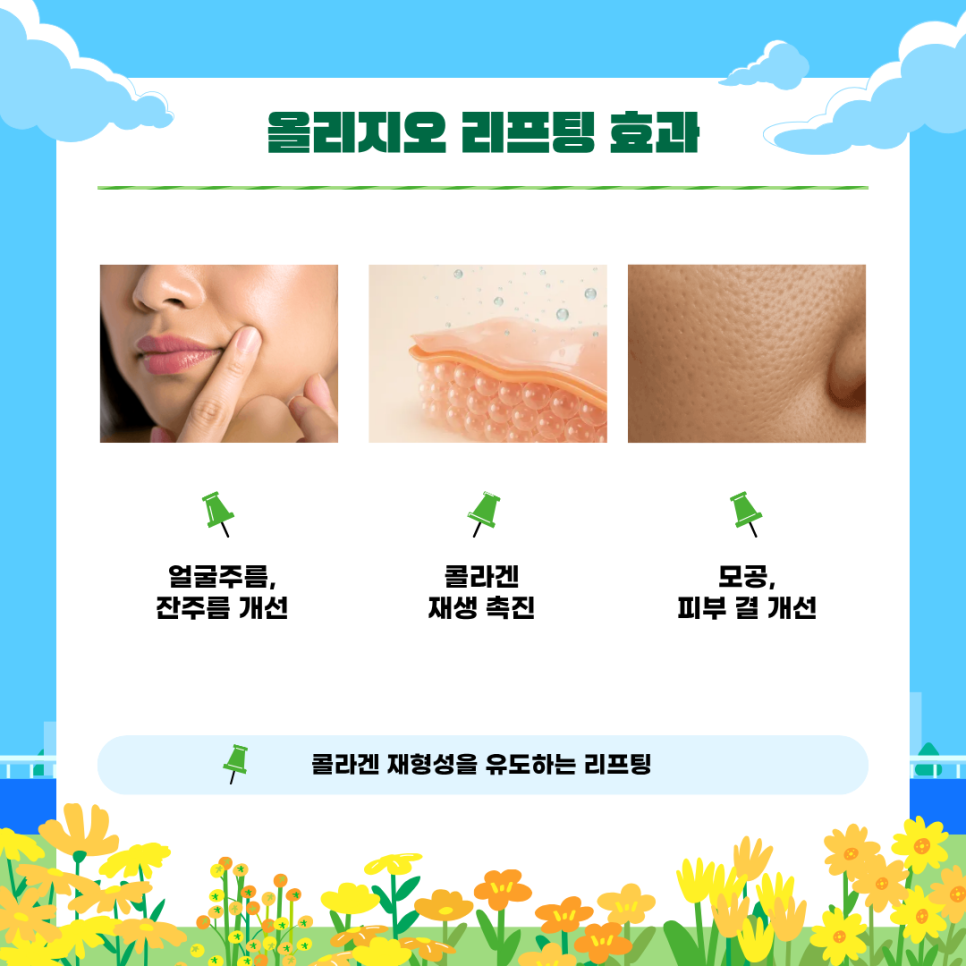
- Changes you can expect from Oligio lifting
The representative changes expected from Oligio lifting can be divided into three main areas. The first is improved skin elasticity, the second is a more refined lower-face line, and the third is changes in fine lines and skin texture. After a single treatment, sagging around the jawline and decreased elasticity in the nasolabial area were significantly improved at 12 weeks, and these changes continued through 24 weeks. In addition, skin firmness in the cheek area increased starting at 4 weeks and continued to improve throughout the follow-up period.
Pore appearance, fine lines, and skin tone showed improvement trends in some cases, but not all items changed by the same degree as elasticity or the lower-face line. Looking at this, it is more realistic to understand Oligio lifting not as a treatment that changes all concerns at once, but as one that focuses on elasticity and contour, while skin texture changes should be judged with individual differences in mind.
- The reason results differ ultimately comes down to skin condition
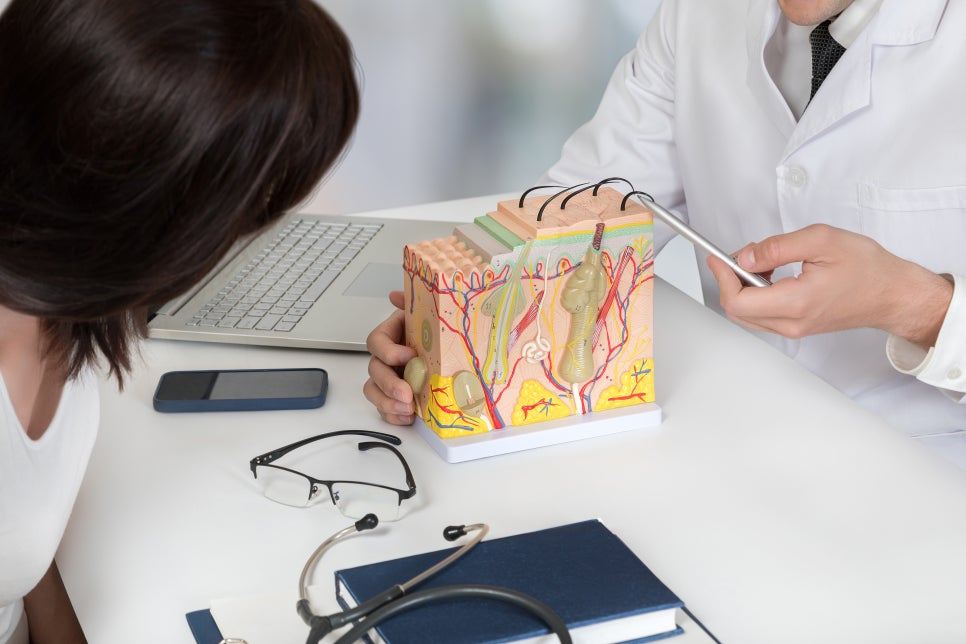
Even with the same Oligio lifting treatment, some people notice more noticeable changes around the jawline, while others feel more satisfied with the overall elasticity. The reason is that each person's current skin condition is different. Monopolar RF works by generating heat in the dermis and the structures below it, and dermal thickness and the amount of subcutaneous fat affect energy distribution and differences in results.
Therefore, rather than treating thin-skinned areas, areas with more volume, and areas where wrinkles stand out early in the same way, it is important to design the approach differently for each area. In other words, to increase the effectiveness of Oligio lifting, it is not simply about increasing the number of shots, but about precisely determining which area to approach, at what intensity, which line should be prioritized, and which concern should be the top goal. Depending on whether you most want to improve elasticity, contour, fine lines, or skin texture, the treatment direction can also change.
- Key points for increasing the effectiveness of Oligio lifting
The first thing to look at to improve results is the selection of the candidate. If the skin is very saggy, it may be difficult to feel the desired level of change with a non-incisional lifting treatment alone, whereas if the sagging is not severe but elasticity has declined and fine lines have increased, monopolar RF may be relatively well suited.
The second point is understanding when to expect results. Because monopolar RF depends on collagen remodeling that occurs after thermal stimulation, it is better to observe not just the immediate day-of feeling but also the changes over several weeks. Skin firmness tends to become more apparent starting at 4 weeks, while evaluation of the lower-face line and nasolabial area becomes more detailed after 12 weeks.
The third is area-specific planning. The approach points differ for thin areas like around the eyes, areas like the cheeks where decreased elasticity is more visible, and areas like the jawline where changes in contour are important. In the end, Oligio lifting is important not only because of the device itself, but because satisfaction improves when the skin condition is read accurately, the goals are clearly defined, and the treatment is tailored accordingly.

- Results are easier to interpret when post-treatment care is included
Oligio lifting is closer to a form of care in which the skin's response over the following weeks is observed together with the treatment itself, rather than something that ends with the procedure alone. Since skin that has received thermal stimulation may temporarily feel dry or sensitive, it is better to include moisturizing care and sun protection as part of the routine. Also, rather than immediately layering strong scrubs or intensive home care that can irritate the skin, it is better to adjust based on the skin's condition, which also helps interpret the results.
Above all, what matters most is not “one treatment and done,” but “knowing what type of skin I have, deciding which concern to address first, and understanding the timing of changes while observing them.” Oligio lifting is one of the representative monopolar RF methods for elasticity management, but the key to better results lies less in the device name and more in assessing skin condition, designing by area, setting realistic expectations, and post-treatment care. When these four factors work together, changes in elasticity and contour can be read more precisely.

Here is the clinic hours information for Bangbae Station Dermatology Clinic.









Previous image
Next image
These are the interior facilities of Bangbae Station Dermatology Clinic.









Previous image
Next image
These are the interior facilities of Bangbae Station Dermatology Clinic.









Previous image
Next image
These are the interior facilities of Bangbae Station Dermatology Clinic.









Previous image
Next image
These are the interior facilities of Bangbae Station Dermatology Clinic.
#Bangbae Station Dermatology Clinic
#Bangbae Station Oligio
#Bangbae Station Lifting