Hello.
I’m Ahn Young-seok, the chief director of Make Dental Clinic.
In the early stage after laminate veneer treatment,
some patients say,
“My teeth feel a little thicker than before,” or “It feels like my front teeth touch before my molars do.”
This is one of the reactions that may be experienced depending on the individual immediately after treatment.
If the prosthetic restoration is made slightly thicker or longer than the existing tooth, you may feel as if the front teeth touch first when closing your jaw.
This initial feeling of foreign body sensation is one of the sensations that can be relatively commonly experienced right after treatment.
 Comparison photos before and after treatment,
this is Make Dental Clinic’s confidence, shown through results rather than words.
Comparison photos before and after treatment,
this is Make Dental Clinic’s confidence, shown through results rather than words.
- Understanding the body’s delicate sensory system, “occlusal sensation”
The tissues around our teeth contain
very sensitive sensory receptors,
so they can respond even to tiny changes in contact.
This sensation is called “occlusal sensation,”
and when there is a small change in the tooth contact pattern
that you have been used to for a long time,
the brain immediately recognizes it.
When a new laminate restoration
is placed in the oral cavity, the brain and chewing system
may need a certain amount of time
to adapt to it.
However, the unfamiliar sensation felt during the adaptation process
may lessen over time depending on the individual,
but if there is interference to the extent that you feel discomfort when chewing
or repeated impact,
it may be a condition that requires the medical team’s examination.

- Check for signs that fine occlusal adjustment may be needed
There are cases where, beyond simple awkwardness, a check by the medical team is recommended.
A representative example is when, while chewing food,
you feel impact first in a specific area of the front teeth before the molars make contact.
Also, if there is no major discomfort when still,
but you continue to feel as if the restoration catches on the lower teeth
when speaking or moving the jaw side to side,
a check of the occlusion may be needed.
These changes can be understood as signals from the body,
and rather than forcing yourself to endure the discomfort,
it is helpful to note what kind of sensation you feel and in what situation,
and then tell the medical team during your visit.
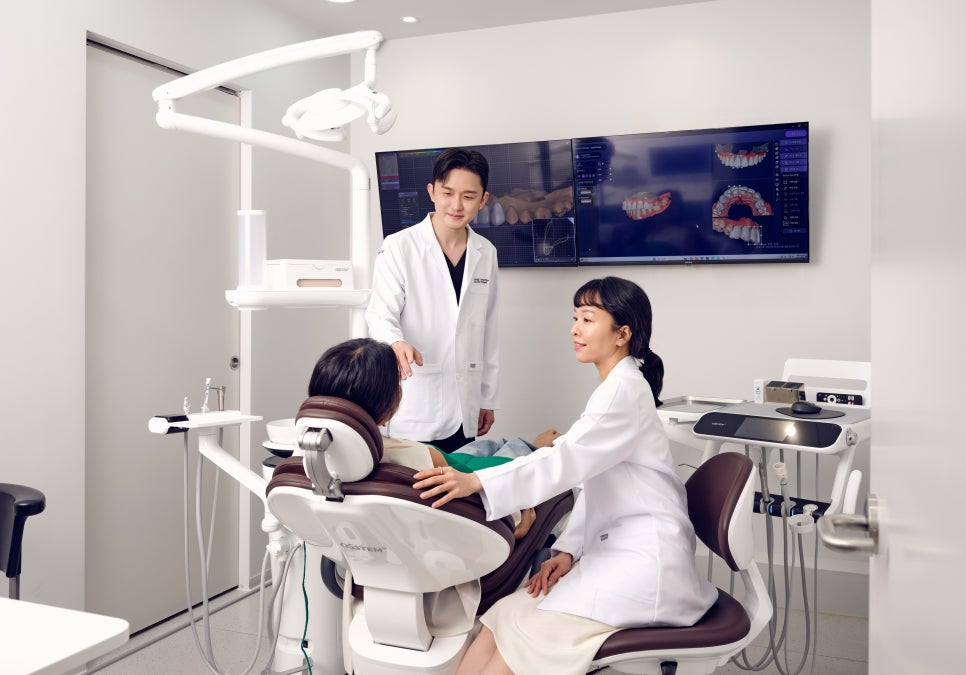 Make Dental Clinic shows you the result in advance
and designs it by fully reflecting the patient’s opinion.
Make Dental Clinic shows you the result in advance
and designs it by fully reflecting the patient’s opinion.
- What process does the dental clinic follow to check the occlusion?
If you visit because you feel discomfort after treatment,
the first step is to check the tooth contact areas that are not easily visible.
In general, you will be asked to bite on a thin colored paper called “articulating paper”
and move your teeth up, down, left, and right.
Using the darkness and shape of the color remaining on the tooth surface as reference,
the team identifies areas where contact is relatively strong
and directions where interference occurs during movement.
If needed, digital equipment may also be used
to check the sequence in which the teeth touch
or the distribution of pressure.
This can help objectively examine subtle differences
that are difficult to identify by visual inspection or the patient’s sensation alone.

- Fine adjustment,
how far can it be polished?
“Will adjusting an already completed restoration
reduce its lifespan or cause it to break?”
Some people worry about this.
Laminate restorations are generally
made from reinforced ceramic materials,
and a slight surface polishing itself does not necessarily affect
the overall strength of the restoration.
The range in which adjustments can be made
is limited to the functional area that actually contacts the teeth
within the restoration’s overall thickness.
Rather than indiscriminate trimming,
it is important to proceed carefully,
focusing on the parts directly related to occlusion.
 Make Dental Clinic provides treatment with the hope
that no patient will suffer from indiscriminate trimming.
Make Dental Clinic provides treatment with the hope
that no patient will suffer from indiscriminate trimming.
In general, micro-adjustments on the scale of microns are carried out step by step,
mainly on the edge or inner surface of the restoration
where it contacts the lower teeth.
Rather than adjusting a large amount at once,
the process is repeated by trimming a small amount
and then checking the occlusal sensation together.
Through this process, if the contact areas are distributed more evenly,
the pressure concentrated on the front teeth can be relieved,
and adjustment can be made while considering the overall balance of the occlusion.
- In some cases, there may be limits to the adjustment range
For example, if the position of the restoration is formed relatively forward,
or if the overall angle does not match the oral structure well
and the adjustment range exceeds the design limits of the restoration,
a situation may arise in which remaking it must be considered.
Since ceramic restorations need to maintain a certain thickness,
if excessive trimming is required,
additional consideration may be needed from a durability standpoint.
Also, if occlusal adjustment could affect the aesthetic balance,
it may be preferable to re-establish the overall plan.
In the end, the direction of treatment
begins not with excessive trimming,
but with checking whether adjustment is sufficient in the current state
or whether it is better to plan from the beginning again.
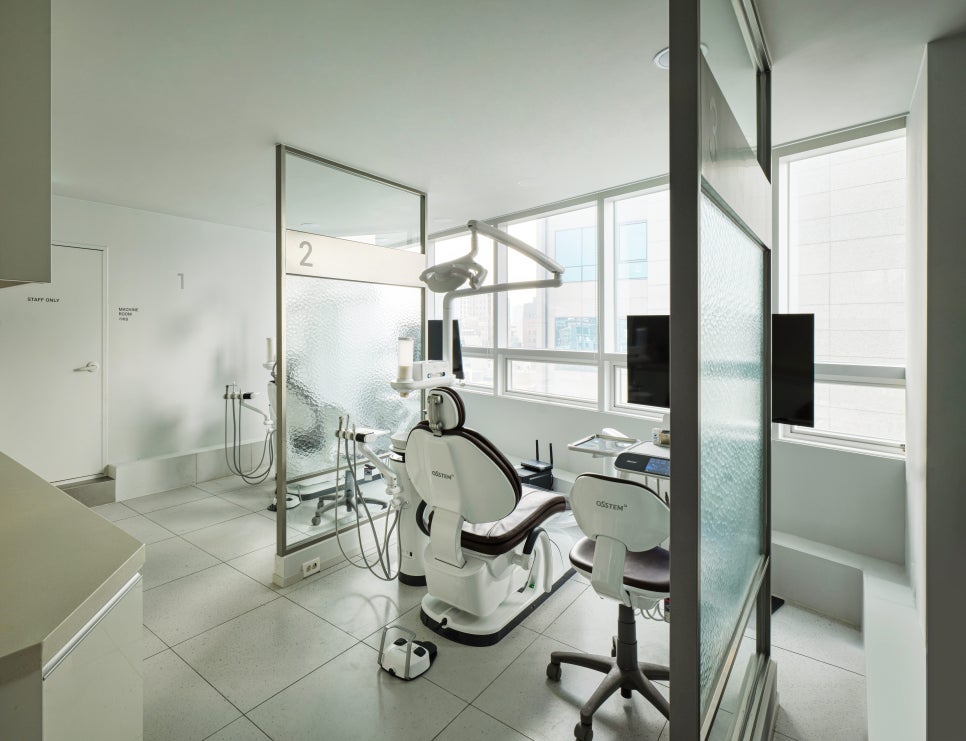 You can directly check the treatment process with your own eyes
and receive treatment with peace of mind.
You can directly check the treatment process with your own eyes
and receive treatment with peace of mind.
In laminate veneer treatment, as much as the smile seen in the mirror,
it is important to consider how the molars fit together when chewing food
and whether the jaw moves comfortably.
If these functional aspects are not sufficiently supported,
the aesthetic results may also be difficult to maintain for long,
and in some cases, they may lead to discomfort related to oral health.
We hope today’s information helps you understand
occlusion and the adaptation process after laminate veneer treatment.
Thank you.









 Previous image
Next image
Previous image
Next image
Dental clinic near Sinsa Station: After laminate veneers, is it okay if the front teeth touch first?
Dental clinic near Sinsa Station: After laminate veneers, is it okay if the front teeth touch first?
Dental clinic near Sinsa Station: After laminate veneers, is it okay if the front teeth touch first?
Dental clinic near Sinsa Station: After laminate veneers, is it okay if the front teeth touch first?
Dental clinic near Sinsa Station: After laminate veneers, is it okay if the front teeth touch first?