Gangnam dermotoxin,
why the plan varies depending on your condition

When looking into Gangnam dermotoxin,
you may find that even procedures with similar names
are described differently:
some people talk about fine lines,
while others mention pores, sebum, or skin texture.
It is easy to assume that
if it is the same dermotoxin procedure,
the treatment method will also be similar.
In reality, the areas that require attention may differ
depending on which area is of concern,
whether the skin is relatively thin or thick,
and how the muscles move when you make facial expressions.
For example, concerns about fine lines on the forehead
and concerns about prominent pores on the cheeks
can differ from the very causes of those concerns.
Therefore, rather than deciding first
“how many dermotoxin treatments are needed”
or “how many injection points will be used,”
the priority should be to determine
what changes are needed in your current skin.
If you are considering Gangnam dermotoxin,
it is helpful to first understand step by step
how it differs from conventional Botox
and why the treatment plan may vary
depending on the area and skin condition. 😊

How does dermotoxin differ
from conventional Botox?
Botox and dermotoxin
both use botulinum toxin,
but the areas emphasized and the purposes of treatment
may differ.
1️⃣ Conventional Botox
is often used with the muscles that create facial expressions
or are involved in specific movements
as the main targets,
with the aim of controlling excessive muscle movement.
Approaching areas that repeatedly crease
when making facial expressions,
such as the forehead, glabella, or eye area,
while considering muscle movement
is a representative example.
2️⃣ Dermotoxin
can be described as a method of injecting the product
more broadly and precisely in divided areas,
primarily into the relatively superficial layers of the skin.
Therefore, rather than focusing intensively
on one specific muscle,
the treatment may be planned by considering together
concerns such as fine lines visible on the skin’s surface,
skin texture, and issues related to sebum production.
However, it is not appropriate to understand dermotoxin
as a treatment that is “always injected superficially”
using only one fixed method.
The actual plan may vary depending on
the characteristics and dilution of the product used,
the area to be treated, the injection spacing and depth,
and the amount applied at each point.
Therefore, when looking into Gangnam dermotoxin,
it is important not to assume
that all procedures are performed in the same way
simply because they have the same treatment name.
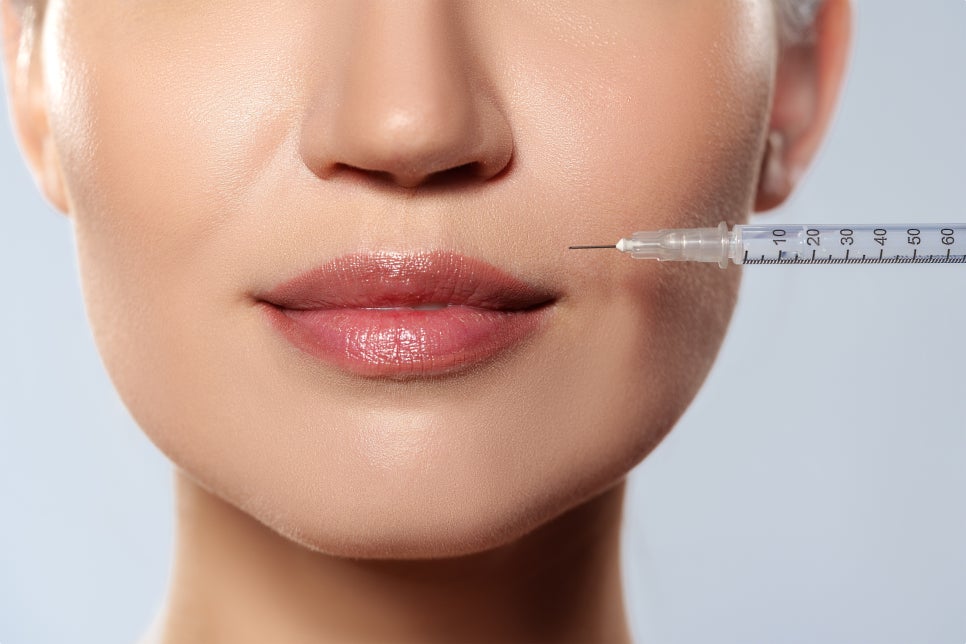
If fine lines and skin texture are concerns,
what should be assessed?
Dermotoxin may be considered
for fine lines around the eyes or on the forehead,
or when skin texture appears more prominent.
However, the approach may vary depending on
whether the lines appear only when making facial expressions
or remain even when the face is at rest,
as well as whether the skin is thin or dry.
In particular, because the eye area and forehead
are areas with frequent facial movement,
it is necessary to consider not only the location of the lines
but also your usual facial-expression habits.
If the lines have already become deeply established,
dermotoxin alone may differ from the changes you hope to see,
so it is important to assess the current condition of the lines first.
In addition, the method of applying botulinum toxin
precisely to the superficial skin layers
may also be used while considering sebum production
and the condition of the skin’s surface.
At Transparent Dermatology,
we believe it is important to examine different skin concerns
such as acne, scars, pores, pigmentation, and redness
in detail and to determine the care approach
based on each individual’s skin type and condition.
Dermotoxin likewise should not be applied uniformly
simply because it is known as “an injection that is good for pores.”
It is necessary first to examine why the pores actually appear prominent
and the degree of sebum production.

Even in the same area,
whether it is appropriate may vary depending on the skin condition
Even among people in the same age group
or in the same treatment area,
skin conditions may differ depending on
skin thickness and elasticity, the degree of sebum production,
the depth of fine lines, and facial-expression habits.
Therefore, when planning Gangnam dermotoxin,
it is important not to consider only one concern,
but to determine the treatment approach
by also examining your current skin type and lifestyle habits.
For example, even if the skin texture appears rough,
the cause may be sebum, acne marks, changes in elasticity, or something else,
so it is necessary to first determine
whether dermotoxin is appropriate.

Gangnam dermotoxin
may be considered for various skin concerns,
including fine lines, skin texture, sebum, and pores,
but it is not applied in the same way
to every type of skin change.
When deep wrinkles or sagging are the primary concerns,
or when something that looks like pores is actually closer to acne scarring,
a different approach may be necessary.
Even skin concerns that appear similar
may have different causes and conditions,
so it is important to distinguish and assess
the current condition of the skin.
At Transparent Dermatology,
we examine various skin concerns separately,
including not only Botox and fillers
but also acne, scars, wrinkles, pores, pigmentation, and redness,
and focus on finding a care approach
suited to each individual’s skin type and lifestyle.
Even with the same dermotoxin procedure,
if the skin condition and desired changes differ,
the treatment area and scope, depth, and spacing
may also vary.
Ultimately, rather than comparing
the number of treatments or injection points first,
we recommend sufficiently assessing
which aspects of your current skin need attention
and then determining an approach suited to that condition.