Bad breath that doesn’t go away even after brushing
Causes of halitosis
How it is addressed at the dentist
When meeting someone face to face,
the factors that shape the first impression
are clearly not limited to appearance alone,
but also depend on that person’s body odor.
Body odor matters, of course,
but especially bad breath is a smell that is
conveyed directly through breathing when facing someone.
So if you have bad breath that does not go away even after brushing,
it is difficult to expect a good first impression.
If you are worried about bad breath
but have only tried various brushing methods,
I will explain the causes of halitosis that can be addressed at the dentist.
Types of bad breath
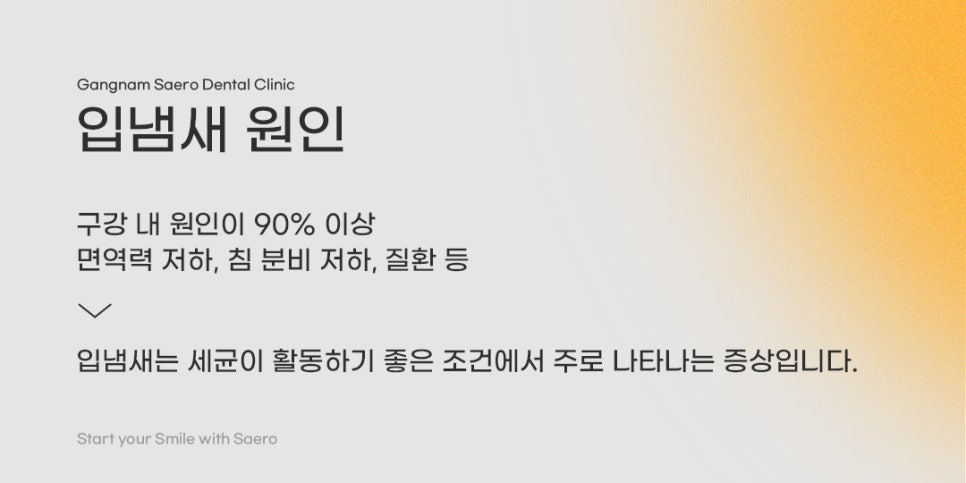
The causes of bad breath are divided into oral causes and extraoral causes.
More than 90% are oral causes.
Because bad breath is a symptom that mainly appears
under conditions that are favorable for bacteria to become active,
the key is how well bacteria are being removed.
In addition, if immunity is lowered,
saliva secretion is reduced,
or there is an illness,
these become conditions that make bad breath more likely.
Brushing
Because bacterial activity is the main cause of bad breath,
if you neglect brushing,
bad breath will naturally occur.
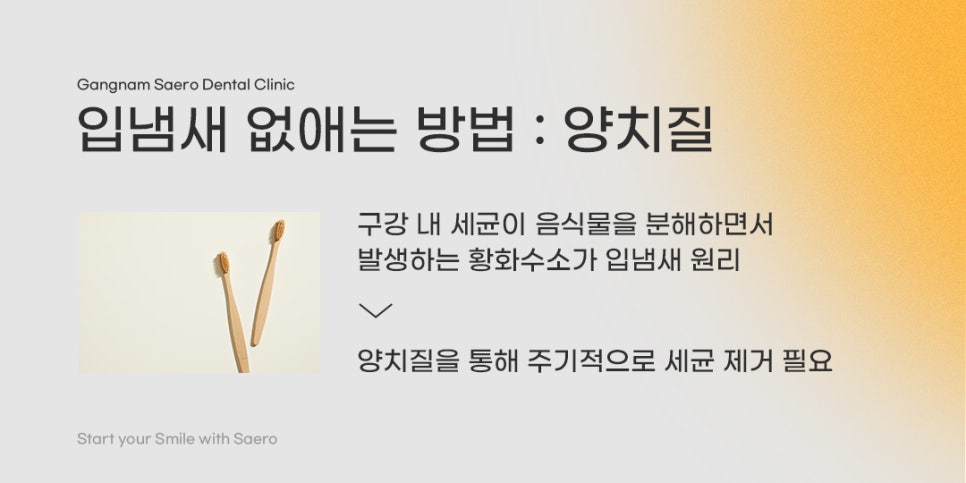
The principle by which bacteria become a cause of bad breath here
is hydrogen sulfide.
As bacteria live in the oral cavity,
they break down food,
and during this process they release hydrogen sulfide.
Since hydrogen sulfide is a compound famous for the smell of rotten eggs,
if bacteria are not removed regularly through brushing,
bad breath will occur.
Tongue coating
When you stick out your tongue,
if there is a white or yellow deposit that does not go away with normal brushing,
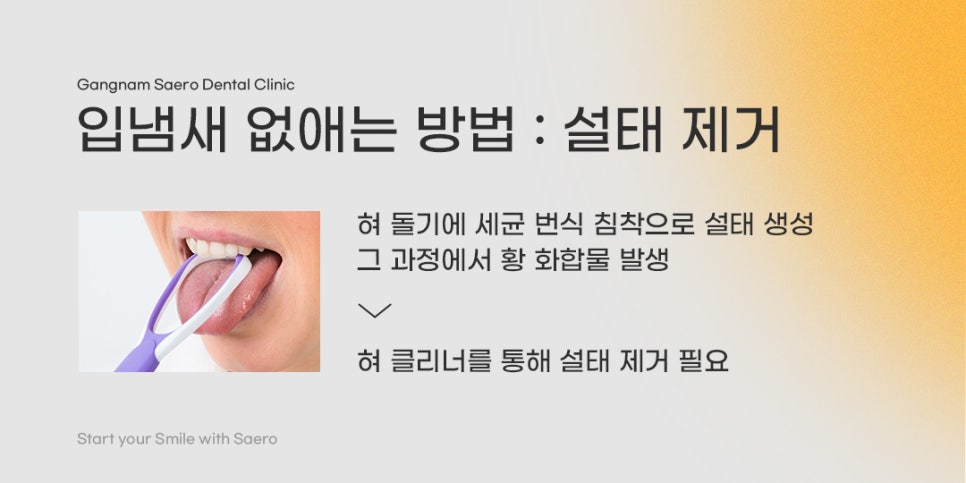
it is often white coating, also called tongue coating, and can be a cause of bad breath.
Tongue coating is formed when bacteria accumulate on the small papillae of the tongue,
and sulfur compounds are also generated in this process.
When brushing, the entire surface of the tongue should be cleaned,
and tongue coating should be removed with a tongue cleaner designed to remove white coating.
Tonsil stones
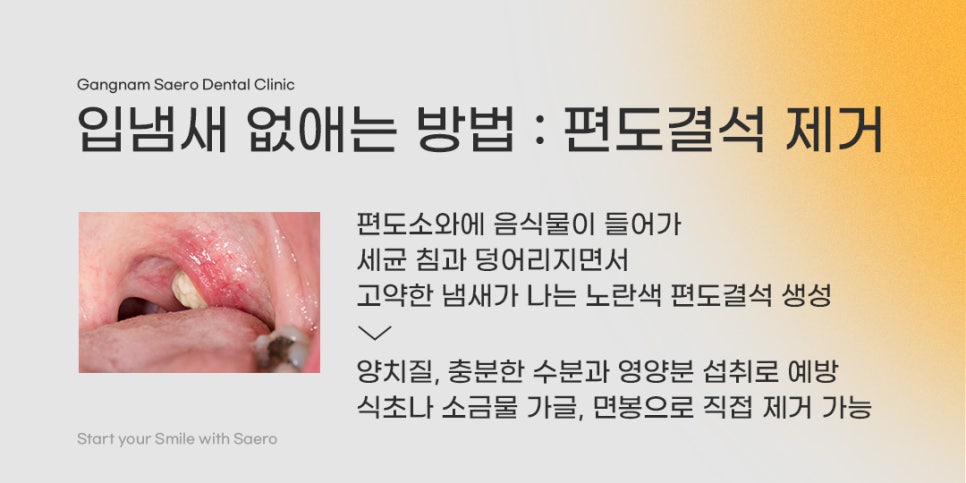
If you have ever coughed up a tonsil stone from the back of your throat,
bad breath can occur due to tonsil stones located in the tonsillar crypts.
The tonsillar crypts are small openings in the tonsils,
and when food debris enters these openings and decays,
bacteria mix with saliva and form clumps.
Therefore, brushing must be done especially carefully so that food does not remain in the mouth,
prevention should be done by getting enough fluids and nutrients,
and if it is visible, you can gargle with vinegar or salt water,
remove it directly with a cotton swab,
or cough it out.
Periodontal disease
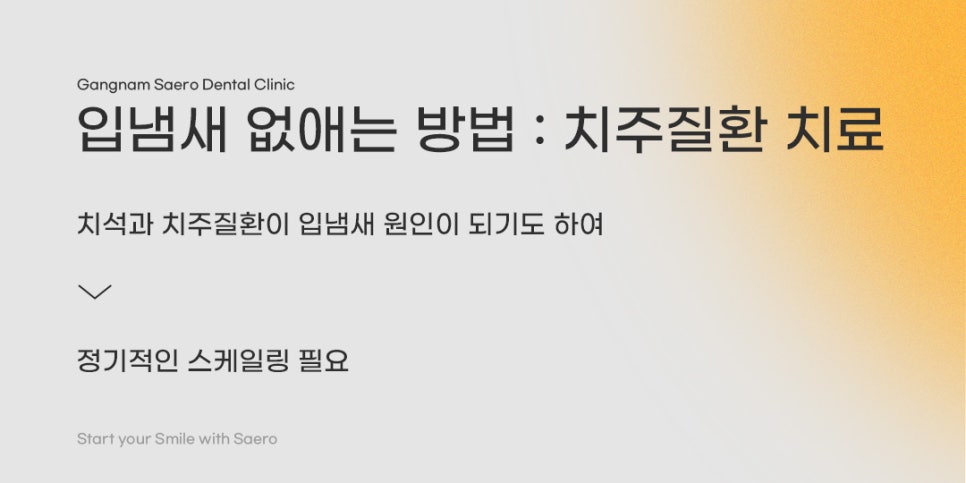
Periodontal disease can occur due to tartar that attaches to the teeth in white or yellow form
and cannot be removed with normal brushing,
and this tartar and periodontal disease can also be causes of bad breath.
Tartar is a substance that hardens when lime components secreted in saliva
attach to the inner base of the teeth,
and it forms as plaque continuously settles in place.
Even if you brush thoroughly,
tartar inevitably forms for everyone,
and it must be removed at a dental clinic
through scaling.
Scaling
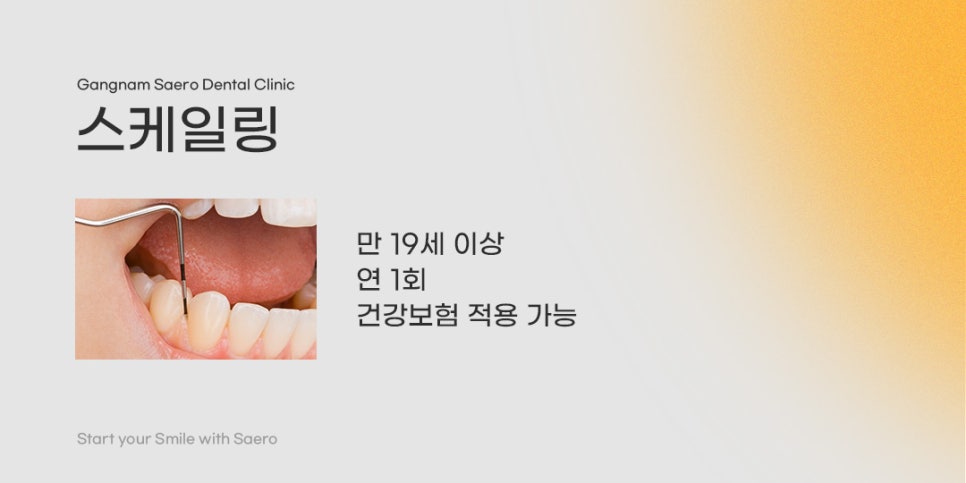
Scaling
is covered by health insurance
once a year
for adults aged 19 and older
(during each year from January 1 to December 31),
and it is an easy way to remove bad breath
at a cost of around 10,000 KRW.
For people who have never had scaling in their lives,
you can find reviews saying that bad breath clearly disappears after scaling.
If you do not get scaling consistently,
periodontal disease can become severe,
and surgical approaches such as root planing, periodontal curettage,
and flap curettage may be performed.
For prevention and treatment,
scaling is one of the procedures that must be received.
Various misconceptions about scaling,
such as “it wears down the teeth,”
“it makes teeth sensitive,”
and “it creates gaps between the teeth,”
are not true, so there is no need to worry.
Malocclusion
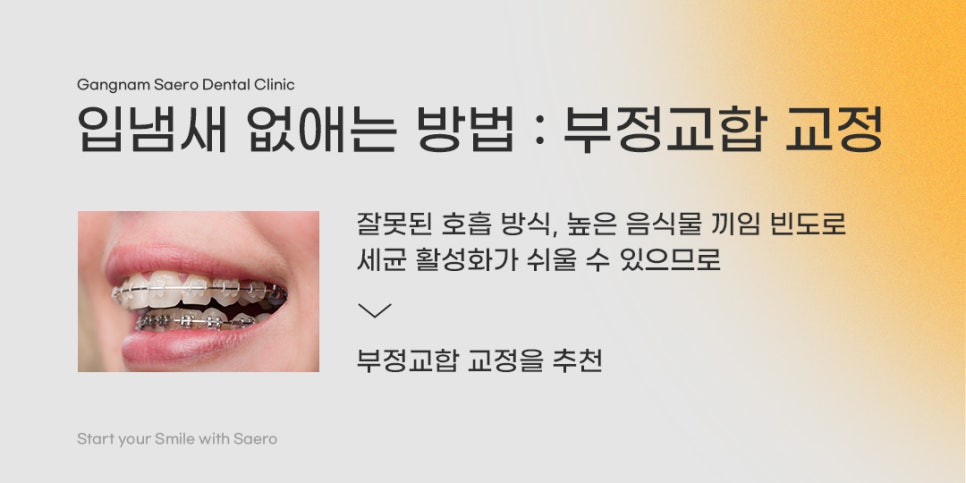
Protruding mouth, receding chin, underbite, excessive overbite that prevents the mouth from closing,
open bite, and other Class 1 to 3 malocclusions
can also create causes of bad breath.
These malocclusions
change the breathing pattern in the wrong way,
causing dry mouth,
and create an environment where food gets stuck more easily.
Not only malocclusion but also crooked teeth
create conditions in which bad breath can occur,
so you can visit a dental clinic
and improve it through orthodontic treatment.
Clear aligners
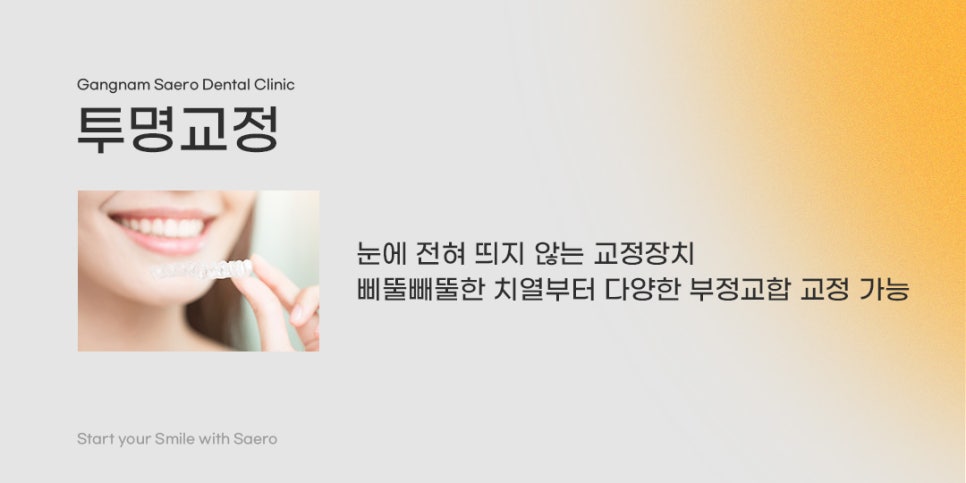
Orthodontic appliances
are basically divided into standard bracket braces,
self-ligating braces,
and clear aligners,
and although they take a long time,
they can remove bad breath caused by malocclusion.
If you want to address the aesthetic drawbacks of standard bracket braces or self-ligating braces,
you can choose clear aligners.
Clear aligners
are divided into Invisalign, Nanonliner,
MagicAlign, Serafin, and Didiheim.
If you choose a relatively less recognized appliance,
you can take advantage of the cost benefit,
and if you want the stability that comes from long-term clinical data
or fast and precise orthodontic treatment,
you have options such as Invisalign and Nanonliner.
Various misconceptions about clear aligners,
such as “malocclusion cannot be corrected”
and “correction of crooked teeth is insufficient,”
are not true, so there is no need to worry.
Dental clinic for bad breath removal
I have explained how to remove bad breath according to its cause.
If the bad breath does not go away even after visiting the dentist,
it may fall under the 10% of extraoral causes.
Therefore, before treatment,
an accurate diagnosis by a medical professional is necessary.
If you want not only general treatment but also a clinic that has all types of clear aligner systems available,
Gangnam Saero Dental Clinic, the only one near Gangnam Station,
can provide an accurate diagnosis tailored to the patient.
Treatment with honesty only
A new smile
A new beginning
I hope you continue natural conversations at Gangnam Saero Dental Clinic.