How should you take care of your teeth?
A look at care methods by age
Information on implants, bridges, and dentures
Compared with the past, a more abundant environment has slowed aging.
Even though we may still look young on the outside,
signs of aging inevitably begin to appear one by one.
Among them, aging of the gums, which is closely related to appetite, one of a person’s basic needs,
affects tooth loss,
so even if gum recession is a natural part of aging,
it is important to take the best possible care of them
and keep them healthy, which also helps prevent dementia.
Age when dental aging begins
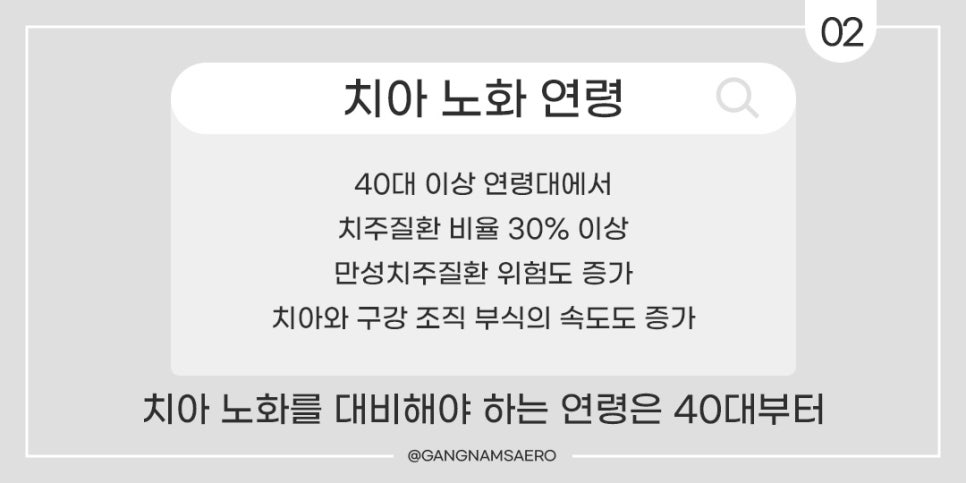
The age at which you need to start preparing for dental aging
is from your 40s onward.
According to statistics from the Health Insurance Review and Assessment Service,
in age groups 40 and older,
the proportion of people suffering from periodontal disease is over 30%,
which increases the risk of chronic periodontal disease
and speeds up the deterioration of teeth and oral tissues,
so from your 40s onward, you should not neglect dental care.
Care methods for your 40s
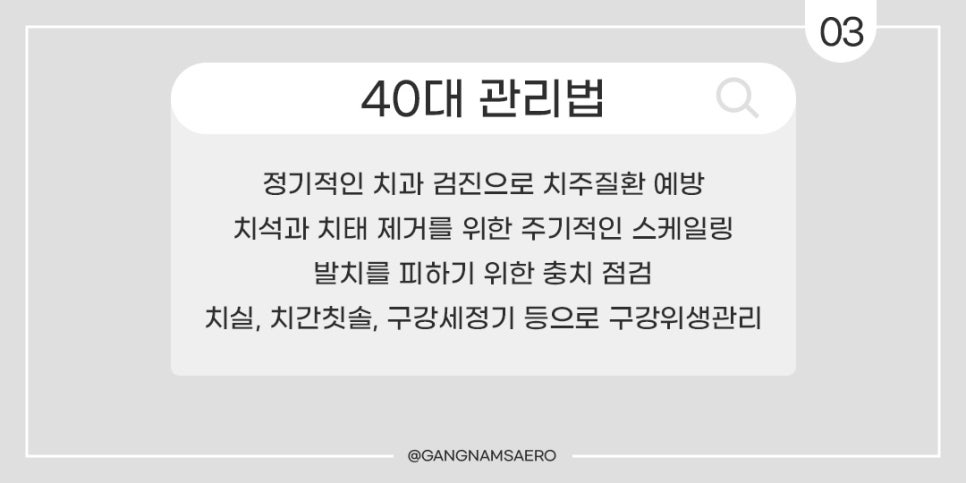
Since tooth loss is not common in your 40s,
even if it is not yet a case for implant recommendation,
please help prevent periodontal disease
through regular dental checkups.
Periodic scaling to remove tartar and plaque
and cavity checks to avoid tooth extraction
are necessary.
Even if you do not have regular dental checkups,
in addition to brushing,
you should also make an effort to manage oral hygiene
with floss, interdental brushes, and oral irrigators.
Care methods for your 50s and 60s
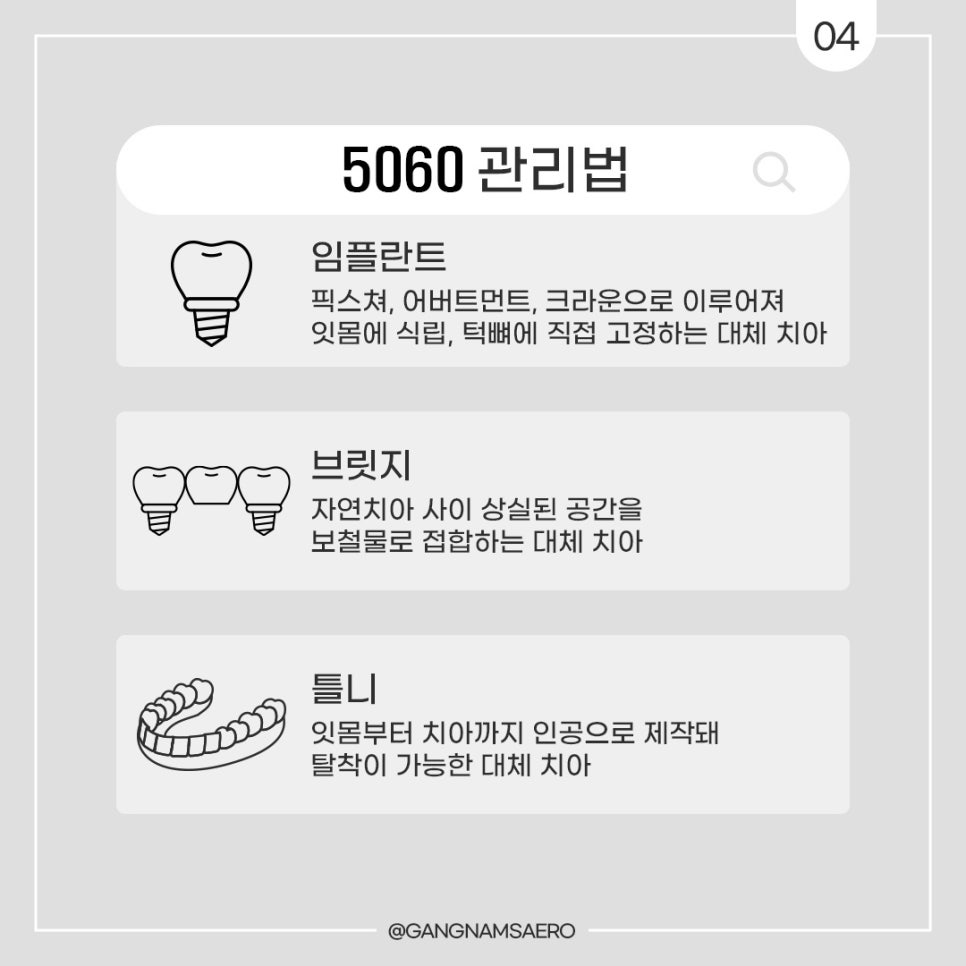
In your 50s and 60s, gum recession and loss of jawbone gradually occur,
so implants may be recommended.
An implant, modeled after the shape of a tooth,
is composed of a fixture, abutment, and crown,
and is placed into the gums and fixed directly to the jawbone,
where it functions as a replacement tooth.
In addition to implant recommendations,
there is a bridge, which connects the lost tooth space between natural teeth with a prosthesis,
and there are dentures, which are artificially made from the gums to the teeth and are removable.
Care methods for your 70s
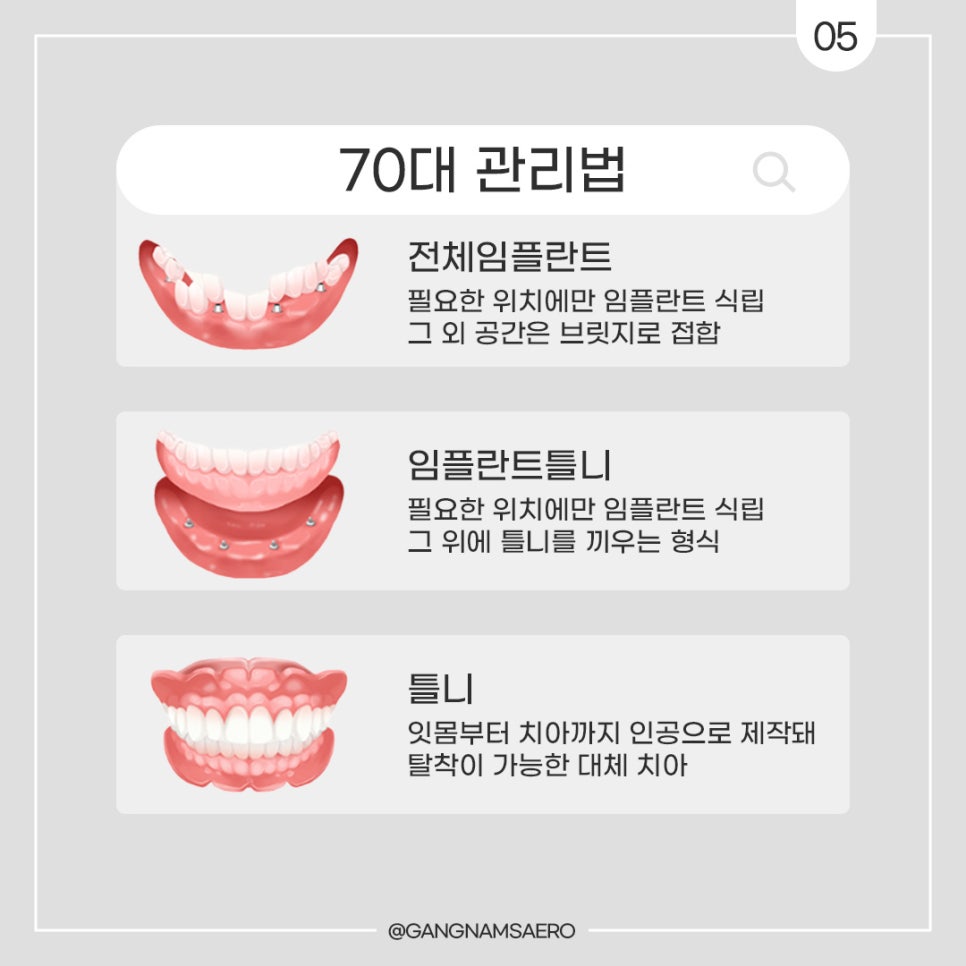
In your 70s, gum recession and loss of jawbone are greater,
so the number of missing teeth may be high,
and implants or dentures may be recommended.
Full-mouth implants, in which implants are placed only in the necessary positions
and the other missing tooth spaces are connected with bridges,
Implant dentures, in which only the implant fixtures are placed in the necessary positions
and dentures are fitted on top of them instead of crowns or bridges,
There are also dentures, which are artificially made from the gums to the teeth and are removable.
If regeneration is possible through gum bone grafting
and you want fixation that is no different from natural teeth,
full-mouth implants may be chosen.
If implant fixture placement is possible,
but crowns and bridges feel burdensome,
implant dentures may be an option.
If the gums and jawbone are in such poor condition that
implant placement is completely impossible,
dentures can be chosen.
Prevent disease through dental care
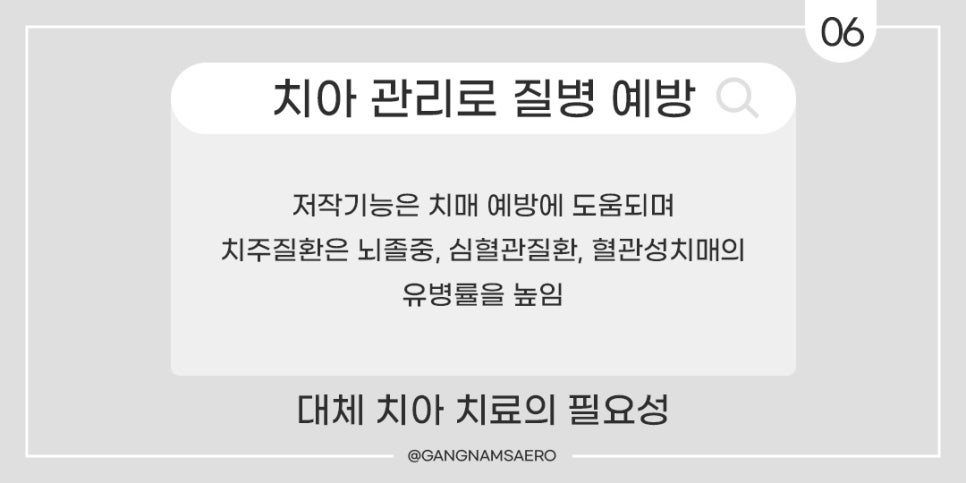
There are research findings showing that chewing function continuously stimulates brain cells
and helps prevent dementia.
It has also been found that periodontal disease
increases the prevalence of stroke by 2.8 times,
cardiovascular disease by 2.2 times,
and vascular dementia by 1.7 times,
so dental care methods are essential for preventing other diseases as well.
If lost natural teeth are left untreated,
the risk of periodontal disease increases
and problems with chewing function also occur,
so the need for replacement tooth treatments such as implant recommendations
can only be emphasized even more.
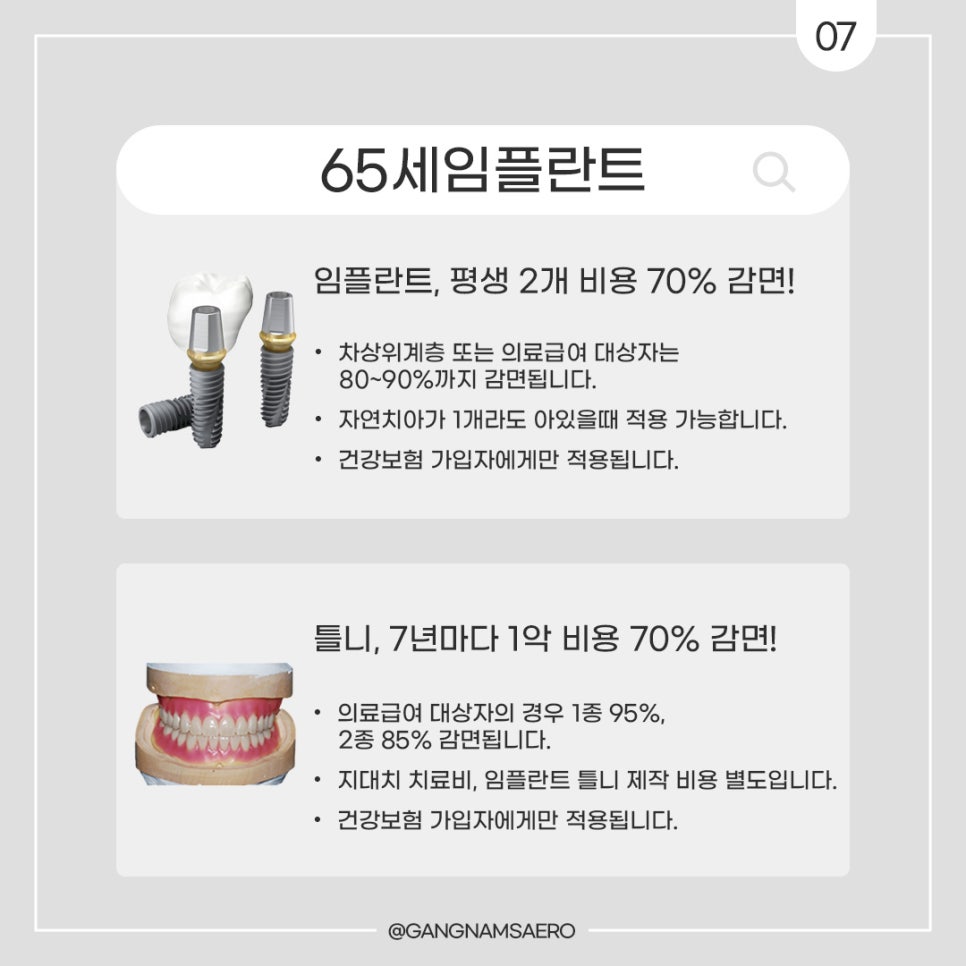
If you are 65 or older,
dental insurance coverage for implants and dentures is also available,
so do not leave missing teeth untreated;
receive treatment and help prevent other diseases.
Implants at age 65 Gangnam Station Dental Clinic
With numerous full-mouth implant treatment cases,
not only full-mouth implants but also
implant recommendations,
implant dentures,
implant reoperation, and more,
Gangnamsaero Dental Clinic is a hospital specialized in implants near Gangnam Station.
A dental clinic good at implants for people in their 40s
A dental clinic good at implants for people in their 50s
A dental clinic good at implants for people in their 60s
A dental clinic good at full-mouth implants for people in their 70s
3 minutes straight on foot from Gangnam Station
5 minutes straight on foot from Sinnonhyeon Station
Please visit Gangnamsaero Dental Clinic
for a consultation on dental insurance coverage for implants at age 65.