Types of Orthodontic Treatment
Differences Between Clear Aligners and Traditional Braces
Reasons to Recommend Clear Aligners
When people think of orthodontic treatment, the image that usually comes to mind is traditional wire braces attached to the teeth like railroad tracks. Because they look very unaesthetic, they inevitably draw attention to the appliance itself. Since they must be worn continuously for about two years without being removable, it is not easy to choose a device that will be visible every time you open your mouth for such a long period of time. So when a doctor recommends orthodontic treatment, some people delay their decision because they only have negative thoughts about braces.
For those people, clear aligners are recommended. If you have just decided to get braces, clear aligners may be something you have only just learned about. If you have been considering orthodontic treatment, it is an appliance worth learning about in more detail. If you want to know exactly what clear aligners are,
I hope this post on types of orthodontic treatment, the differences between clear aligners and traditional braces, that is, a clear aligner comparison, and the reasons clear aligners are recommended, will help you make the best choice.
About the Types of Orthodontic Treatment
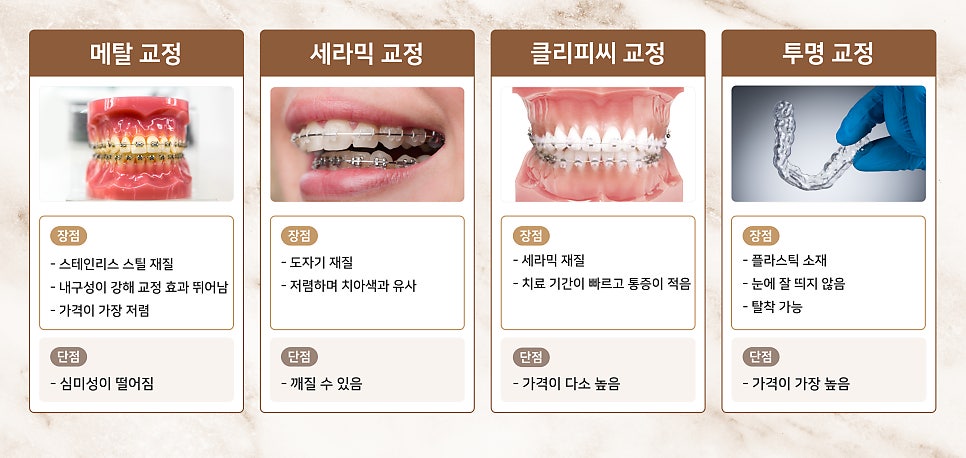
Orthodontic appliances can be broadly divided into four types: metal, ceramic, self-ligating, and clear. Let’s look at a clear aligner comparison based on the pros and cons of each appliance.
Metal braces are made of stainless steel, so there is no risk of discoloration.
They are also highly durable, with no risk of deformation, so their orthodontic effectiveness is excellent.
In addition, they have the major advantage of being the least expensive.
However, they have the major drawback of having the worst aesthetics among orthodontic appliances.
Ceramic braces are made of porcelain and are similar in color to teeth.
Because they are similar in color to teeth, they are more aesthetic than metal braces.
They are slightly more expensive than metal braces, but they have the advantage of being affordable.
However, their aesthetics are still lacking, and because they are made of porcelain, there is a risk of breakage.
Self-ligating braces are made of ceramic and are similar in color to teeth.
Like ceramic braces, they are more aesthetic than metal braces.
Because there are no thin wires or rubber bands, they are convenient, and the orthodontic effect is fast and strong.
However, their aesthetics are still not very good, and they are somewhat more expensive than metal and ceramic braces.
Clear aligners are transparent and made of a special plastic material.
Because they are transparent, they are not visible at all and are difficult for others to notice.
They are removable, making them convenient, and they can be temporarily taken out on important days.
However, the downside is that they are the most expensive.
About the Features of Clear Aligners
If you have looked at the clear aligner comparison, you may already know how attractive clear aligners are. If you look more closely at their features, you will likely become even more drawn to the appeal of clear aligners.
| Process | Scan the tooth structure using digital equipment > Create a treatment plan > Manufacture the digital appliance > Receive the appliance > Replace it about every 2 weeks on average, with visits once every 4–8 weeks |
|---|
| Types | Invisalign, NanoLiner, MagicAlign, Serafin, Didiheim |
| Advantages | Excellent aesthetics, easy oral hygiene management, no time burden |
| Disadvantages | Inconvenient to remove and reinsert, risk of loss, sensitive to extreme temperatures |
About Clear Aligner Recommendations
The people for whom clear aligners are recommended, as seen through the clear aligner comparison, are as follows.
-
People who want to effectively correct various types of crowding and malocclusion
-
People who are reluctant to have braces visible (actors, idols, announcers, models, office workers who interact with many people, etc.)
-
People who feel time pressure from treatment duration or clinic visits (study abroad, military service members, residents of rural areas, etc.)
-
People who are not concerned about drawbacks such as the inconvenience of removal or the risk of loss
At Gangnam Sero Dental Clinic,
2013.2 > 2014.9
2021.9 > 2023. 12
In terms of effectiveness when comparing traditional wire braces and clear aligners, clear aligners are sufficiently effective for correcting many cases of crowding and malocclusion. To achieve that, a detailed treatment plan from the medical staff is necessary, and if there are clinical limitations that cannot be corrected with clear aligners, the medical staff must also be able to create an additional treatment plan later. Only then can the desired result be achieved without inadequate treatment.

NanoLiner Advisory Committee Member
Doctor for Famous Celebrities
I hope you achieve the most beautiful orthodontic results at Gangnam Sero Dental Clinic.