Implant swelling, implant bleeding, implant pain
For a faster recovery and more accurate results
Navigation implant
If the reasons you hesitate to have implant surgery are implant swelling, implant bleeding, and implant pain, one option to consider is a navigation implant. This is a procedure in which, before implant surgery, the expected placement path is predicted in advance and a guide is created for the surgery. Because it determines the most appropriate implant position and direction in advance according to each person’s different teeth alignment, gum condition, and bone structure, it can help minimize implant swelling, implant bleeding, and implant pain.
It can also minimize implant complications. Just as a natural tooth that grows abnormally can lose chewing function and have a higher risk of inflammation because of its abnormal position and direction, implants also require the correct position and direction.
So if you use a navigation implant, you can minimize not only implant swelling, implant bleeding, and implant pain, but also complications.
About navigation implants
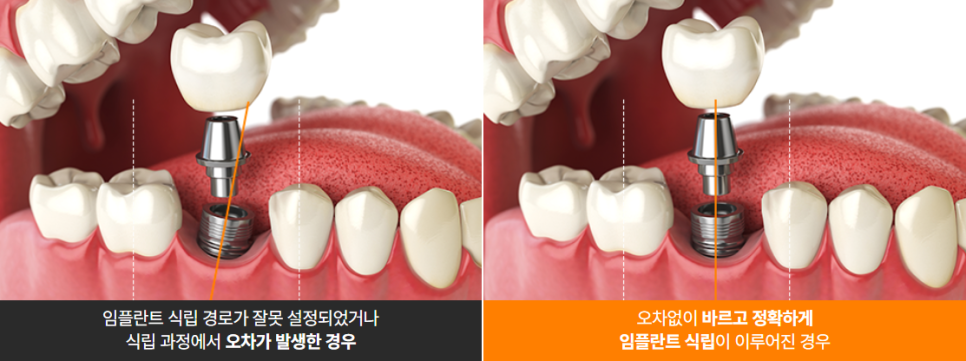
A navigation implant uses 3D digital modeling and virtual reality technology to perform a simulation before surgery, so it accurately identifies and sets the treatment plan for the implant placement position and direction that vary from person to person. This leads to a surgical process and results that minimize complications, including implant swelling, implant bleeding, and implant pain.
About navigation implant comparison
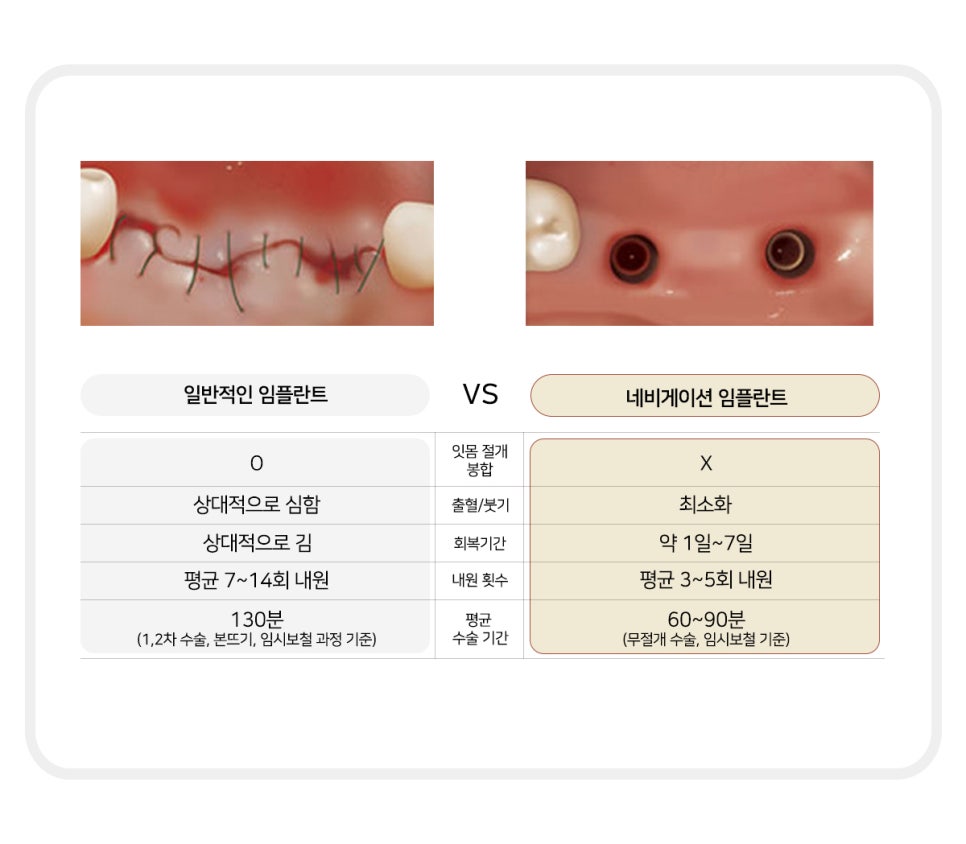
Navigation implants differ from regular implants in the following ways.
-
Method: Regular implants are based on the patient’s data, but the dentist approaches them visually. Navigation implants are based on the patient’s data and approached using simulation software.
-
Prediction: With regular implants, it is not possible to predict the implant surgery process and results in advance. With navigation implants, the implant surgery process and results can be predicted in advance.
-
Time: Regular implants may take some time for surgery because of incision, suturing, and re-incision. Navigation implants are performed without incisions, which shortens the surgery time.
About the advantages of navigation implants
-
Improved accuracy: Because the approach uses simulation software, accuracy improves. This improved accuracy helps with diagnosis and treatment planning and leads to good prognosis.
-
Handling variables: Because the surgery process and results can be predicted in advance, unexpected variables can also be checked beforehand, allowing response to any variables that arise.
-
Minimizing complications: Improved accuracy and predicted results help prevent unnecessary additional treatment, and because complications are minimized, this also leads to saving time and cost.
-
Smooth communication: Because the patient and the dentist can directly review the expected surgery before the implant procedure, smooth communication is possible.
About the navigation implant process
Gangnam Saero Dental Clinic’s navigation implant digitally scans the patient’s oral structure through an oral scanner.
After that, Gangnam Saero Dental Clinic uses RAY FACE, a hospital-grade device, to analyze the condition of the gum bone and jawbone, tooth spacing, and arrangement in 3D, which are difficult for the dentist to see with the naked eye, and presents them in a way that is easy to understand at a glance.
A scene of virtual implant surgery
Gangnam Saero Dental Clinic’s navigation implant uses simulation software with the patient information obtained from the oral scanner and RAY FACE to perform virtual surgery. The position, size, and angle of implant placement can be checked in advance. After that, a customized surgical guide is produced for each individual.
A scene of a customized surgical guide being made based on the virtual surgery results
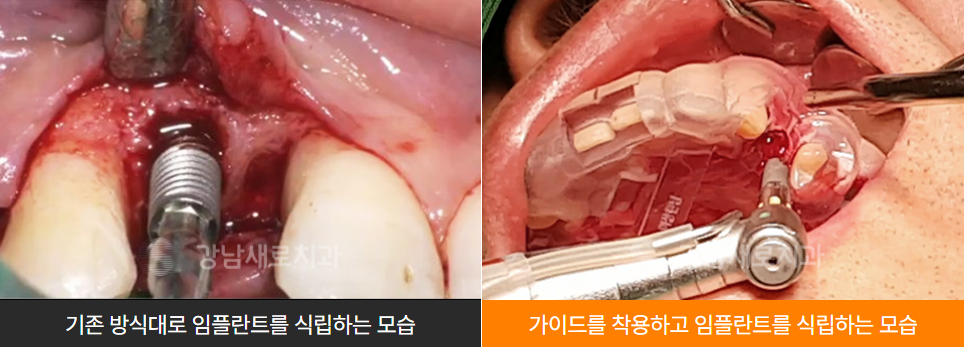
Once the guide is made, the implant is placed without incision using that guide. Because there is no incision, implant swelling, implant bleeding, and implant pain are minimized, and therefore the recovery period is also faster.
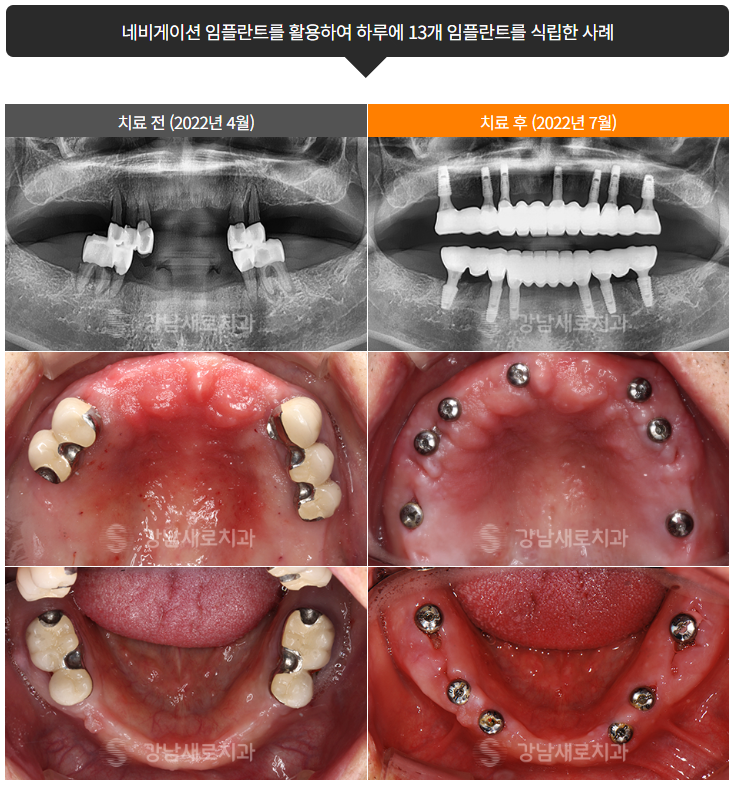
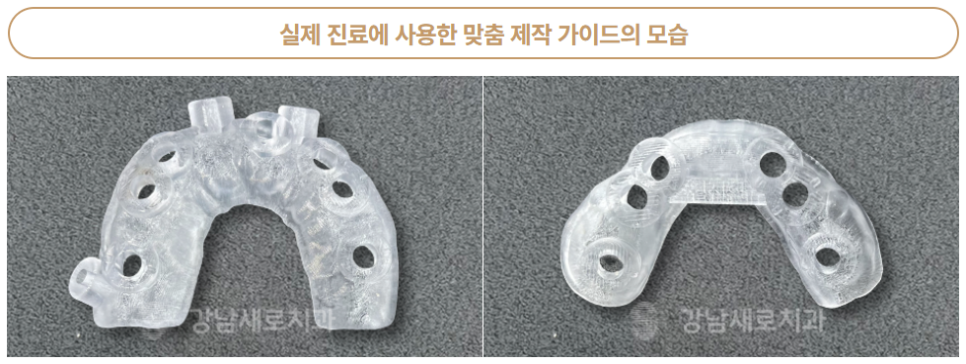
At Gangnam Saero Dental Clinic

At Gangnam Saero Dental Clinic, navigation implants are possible with advanced hospital-grade system equipment.
At Gangnam Saero Dental Clinic, implant-focused treatment is available, backed by its record of receiving the award in the implant-specialized hospital category and being selected as an excellent implant institution.
At Gangnam Saero Dental Clinic, complications are minimized to help prevent reoperation, and long-term implant use of 20 to 30 years or more is ensured.