Implant side effects, pain, treatment period
Can be minimized
Navigation implant
The implant process consists of
the first surgery: gum incision, implant placement, and suturing
After osseointegration has taken place,
the second surgery: incision again and abutment placement
Once the final prosthesis is completed,
treatment ends when it is attached to the abutment.
Because an incision is made,
swelling, bleeding, and pain due to the incision are unavoidable.
As a result, recovery to daily life takes longer,
and if there is any error in position, direction, or angle
during the implant surgery process,
the return to everyday life becomes even slower.
Navigation implant process
An implant that allows fast recovery in daily life
Let us introduce the navigation implant.
It reduces errors in position, direction, and angle,
and minimizes swelling, bleeding, and pain through a flapless procedure.
The treatment process for a navigation implant
begins with advanced diagnosis using high-performance, low-radiation 3D CT,
RAY FACE, a 3D precision analysis device,
and oral scanners, Trios and iTero,
followed by virtual simulation based on the comprehensive patient information obtained.
Through virtual simulation,
possible variables are identified in advance and prepared for,
and the placement location, direction, and angle of the implant fixture are checked beforehand.
After that, a surgical guide is created,
and the implant fixture is placed without incision according to that guide.
Because there is no incision,
it is possible to minimize swelling, bleeding, and pain
and also minimize side effects,
making implant surgery possible.
State-of-the-art device: 3D CT
Conventional 2D CT is in panorama format,
showing the skeleton, tooth shape, and nerve position
in a flat, two-dimensional way,
but 3D CT shows the bone structure, oral structure, and tooth shape
in three dimensions.
This helps make
a more accurate diagnosis for the navigation implant.
State-of-the-art device: RAY FACE
RAY FACE
uses six cameras
to scan the patient's face in 3D
and obtain facial data.
It is possible to match
the data obtained from the 3D CT and oral scanner
with this facial data.
This allows the outcome after treatment to be predicted in advance
and helps identify the midline and occlusal plane.
State-of-the-art device: oral scanner
The conventional impression-taking method used a rubber-like material
to make a mold by placing impression material in the mouth.
This conventional impression-taking method
could induce vomiting and cause discomfort due to foreign-body sensation and odor,
and it also took a long time and carried a risk of distortion,
but the Trios and iTero oral scanners, as the latest digital system,
allow for a comfortable and fast impression-taking process by placing a small digital device in the mouth
that does not cause discomfort from foreign-body sensation or odor.
This increases the precision of
the diagnosis for the navigation implant.
Advantages of navigation implant
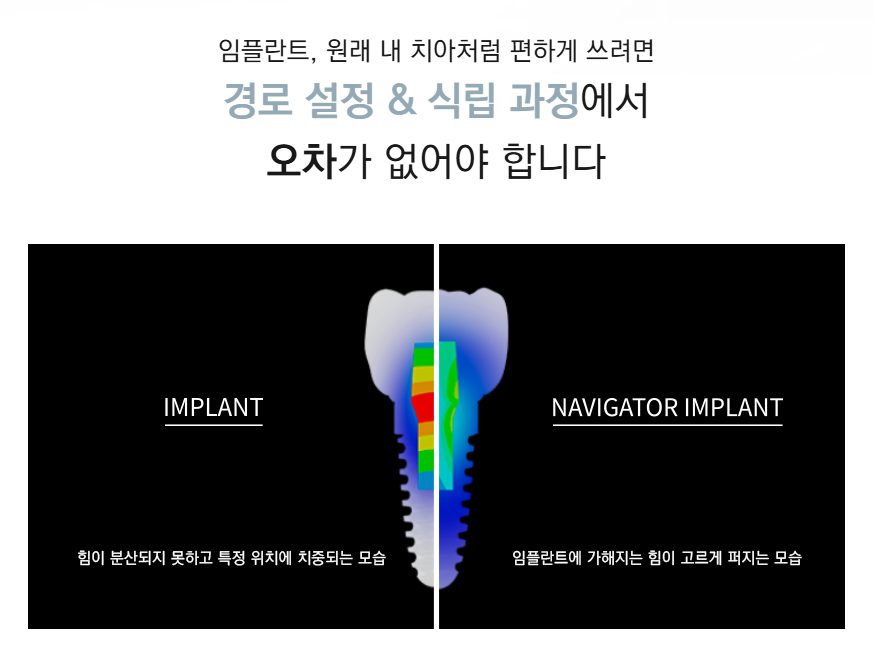
Using state-of-the-art devices,
3D CT, RAY FACE, and an oral scanner,
and performing virtual simulation to create a surgical guide,
the navigation implant offers several advantages.
Virtual surgery and the surgical guide
reduce errors in implant path planning and placement,
thereby significantly lowering the chance of implant failure.
- Reduced bleeding, swelling, and pain
Virtual surgery and the surgical guide
eliminate the incision process in implant surgery
and require only a small opening,
significantly reducing bleeding, swelling, and pain.
Conventional implant surgery
takes about 4 to 6 months,
but virtual surgery and the surgical guide
reduce the implant surgery process,
so it takes only about 2 to 3 months.
Implant success rate
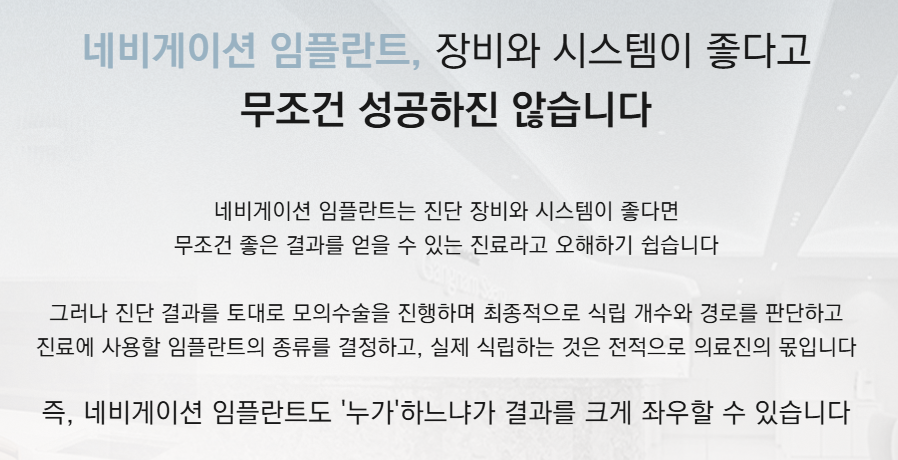
If you are worried about implant success rate,
virtual surgery and surgical guides,
the navigation of implants,
with state-of-the-art equipment on the level of a university hospital
and medical staff from university hospitals,
provide university-hospital-level diagnosis.
Gangnam Saero Dental Clinic
works to help patients recover quickly to daily life.
A new smile
A new beginning