Early treatment is key for underbite
To make it possible without surgery
Children’s non-surgical underbite treatment
If your child is starting to show a symptom commonly called an “underbite,” where the lower jaw protrudes beyond the upper jaw,
it is necessary to get a dental diagnosis as soon as possible.
If the child is still growing, improvement may be possible with non-surgical orthodontic treatment,
but once adulthood is reached and bone growth is complete,
surgical treatment may become unavoidable.
Causes and types of underbite in children
An underbite
is not simply an issue of the jaw looking protruded,
and the treatment method changes depending on the cause and type.
The idea that “it will get better on its own when the permanent teeth come in”
is a mistaken expectation.
Because the permanent teeth erupt in the spaces left by the baby teeth,
early orthodontic treatment is definitely necessary.
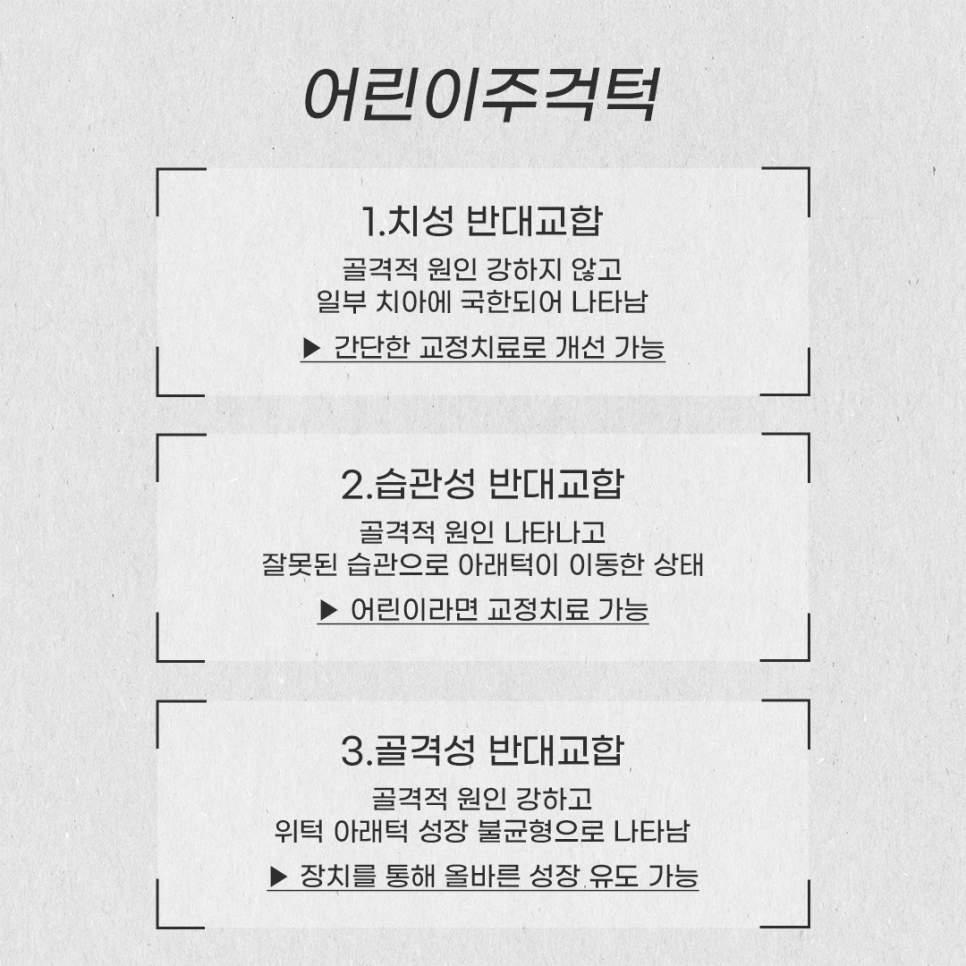
Dental underbite:
A case where the skeletal problem is not severe and the issue appears as a tooth alignment problem. Improvement is possible with relatively simple orthodontic treatment.
Habitual underbite:
Caused by habits such as pushing the jaw forward. If the child is young, orthodontic treatment alone can be enough to correct it.
Skeletal underbite:
Originates from an imbalance in upper and lower jaw growth. It is important to guide jawbone growth in the right direction through orthodontic appliances.
Children’s underbite correction methods
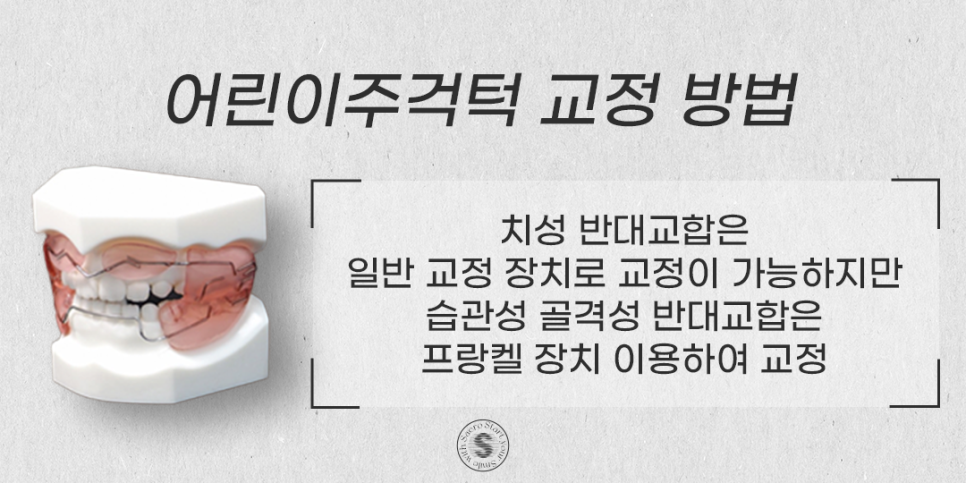
Dental underbite can be improved with ordinary orthodontic appliances alone,
but habitual underbite and skeletal underbite
require additional appliances.
A representative example is the Fränkel appliance,
which blocks pressure from soft tissues such as the lips and cheeks
and guides jawbone growth in the proper direction.
It can be worn from ages 3 to 12,
and the appropriate timing is determined through growth plate testing to create a treatment plan.
Why early treatment for children’s underbite matters
An underbite is not just a matter of jaw position
but a complex issue involving occlusion, how the teeth fit together, and growth patterns.
Therefore, it does not improve through massage or habit correction.
Once the growth plates close and the child becomes an adult,
non-surgical orthodontic treatment may no longer be possible,
so starting during childhood is the most important thing.
Through early diagnosis and treatment,
it is best to begin children’s underbite treatment with the goal of preventing the need for surgery in adulthood.
Differences before and after children’s underbite treatment
You can check the before-and-after treatment photos directly on the website!
If diagnosis is made and orthodontic treatment is started at the right time,
the lower jaw can be guided into the correct position,
and noticeable improvement can be expected.
The reason the difference before and after correction of a child’s underbite
appears so clear is precisely because the skeletal structure can be adjusted during the growth stage.
Choosing a clinic for children’s underbite treatment
If you are considering underbite correction for your child,
it is essential to find medical staff with specialized orthodontic expertise.
Gangnam Saero Dental Clinic
Experience as the primary orthodontic doctor for celebrities
Publication in the only U.S. clinical orthodontic journal in Korea
Presentation of research papers on non-extraction orthodontic treatment
NanoLiner advisory committee activity
Based on this expertise and experience,
we provide customized treatment for each child.
Your precious child’s underbite,
if detected and treated early,
can be sufficiently improved with non-surgical orthodontic treatment without surgery.
A new smile, a new beginning.
For children’s underbite correction, choose Gangnam Saero Dental Clinic.
- This post is provided by a medical institution as medical information due to a third-party contractual relationship.