Dental hospital vs. dental clinic
Implant hospital dental clinic
Where should you go for implant surgery?
When you start looking into dental clinics before getting an implant,
Even the names on the signboards can start to feel confusing.
Names such as ‘○○ Clinic, Department of Dentistry,’ ‘○○ Dental Clinic,’ and ‘○○ Dental Hospital’
are used differently,
so you may end up wondering:
Should a major procedure like an implant
be done at a hospital rather than a clinic?
Today, I’ll summarize the differences between a dental clinic and a dental hospital,
and the key points you should know when choosing an implant hospital.
The concept of a clinic
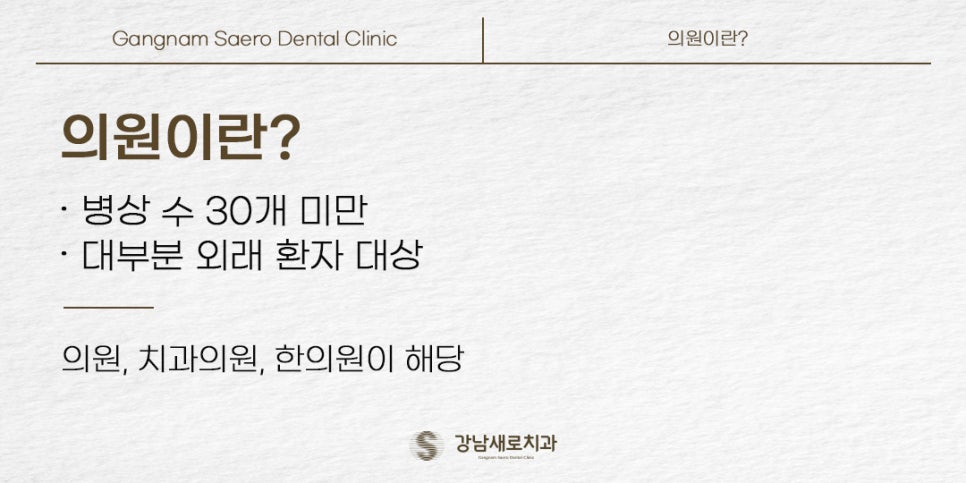
A clinic refers to a medical institution that meets the following conditions.
Fewer than 30 beds
Mostly treats outpatients
If it meets these conditions, it is called a “clinic,”
and this includes not only dental clinics but also Korean medicine clinics and general clinics.
Clinics are classified as primary medical institutions,
and they have the advantage of relatively good accessibility and reasonable treatment costs.
The difference between a general practitioner and a specialist
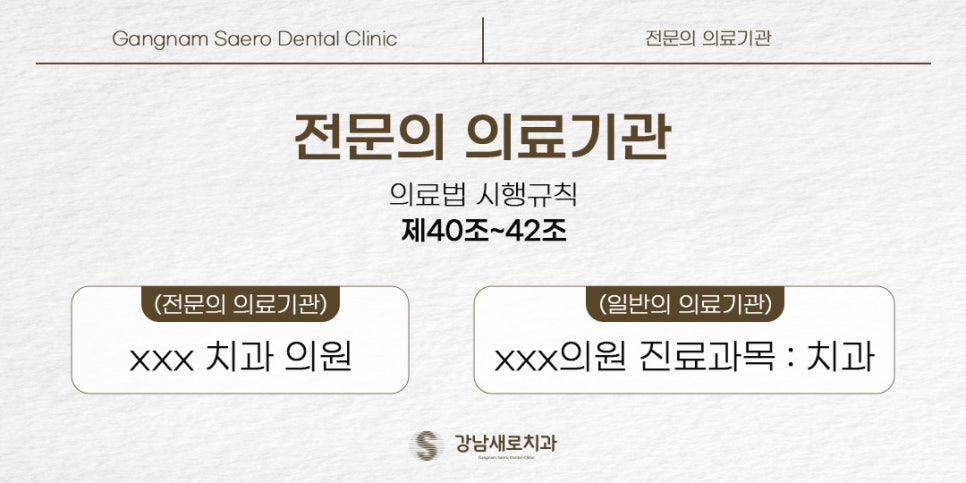
This is the part that is most confusing on clinic signboards.
○○ Clinic, Department of Dentistry: general practitioner
○○ Dental Clinic: specialist
In other words, whether the word “dental” can be attached to the medical institution name
depends on the doctor’s qualifications.
General practitioner: a doctor who graduates from medical school or a graduate medical school and obtains a medical license
Specialist: a doctor who, after obtaining a medical license, completes 1 year of internship and 4 years of residency, then passes the specialist exam
But there is something you should not misunderstand here.
It does not mean that a general practitioner is less specialized than a specialist, or
that a specialist is always superior.
It simply means that the training process is different.
The concept of a hospital
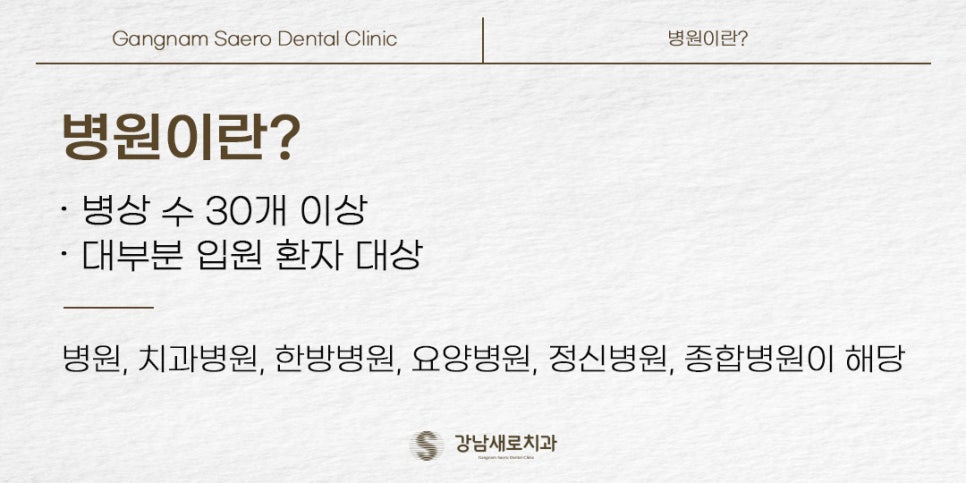
A hospital refers to a medical institution larger than a clinic.
30 beds or more
Mainly treats inpatients
If it meets these conditions, it is called a “hospital,”
and this includes dental hospitals, Korean medicine hospitals, long-term care hospitals, psychiatric hospitals, and general hospitals.
Hospitals correspond to secondary medical institutions.
General hospitals and tertiary general hospitals
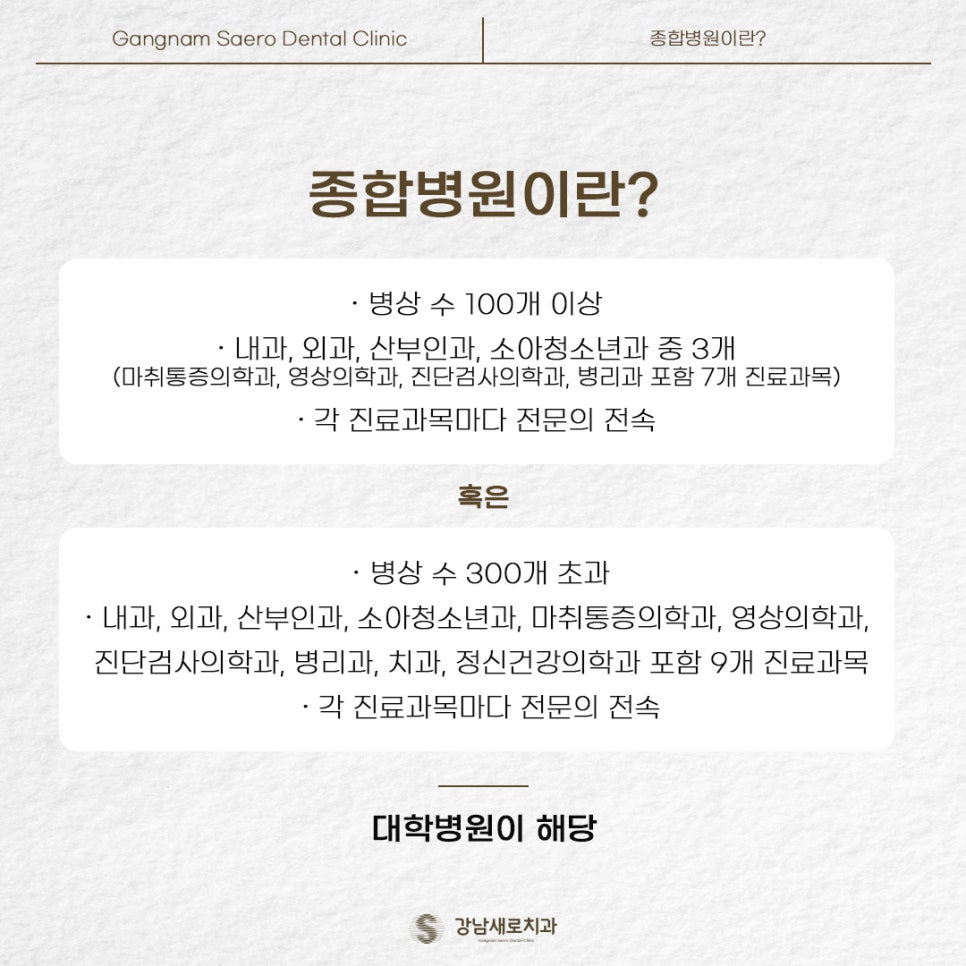
Larger-scale hospitals are classified as follows.
General hospital:
100 beds or more
Operates at least 7 departments, including essential departments
Each department has full-time specialists
Usually refers to university hospitals
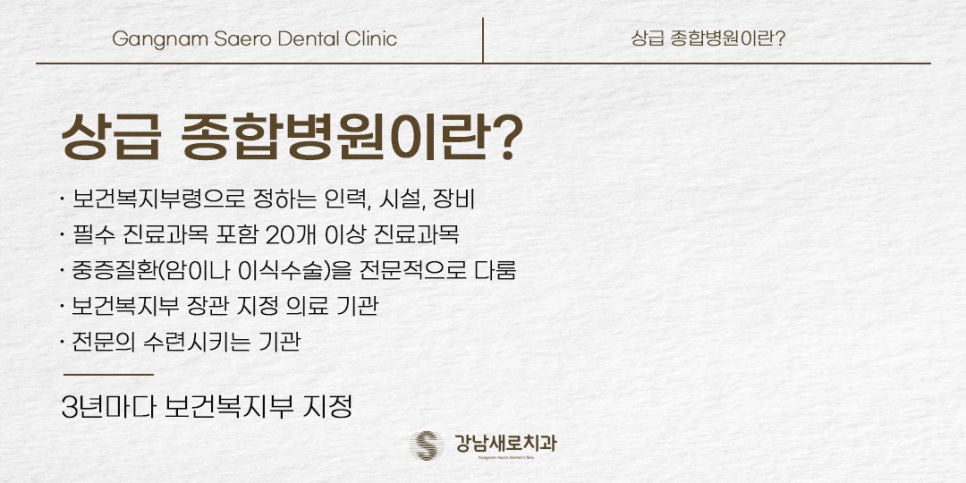
Tertiary general hospital:
Designated by the Ministry of Health and Welfare
Has 20 or more essential departments and equipped with specialized equipment, personnel, and facilities
Able to perform highly difficult treatments such as cancer and transplant surgery
Serves as a specialist training institution
In other words, a tertiary general hospital is a level 3 medical institution and can be considered the highest level of medical institution.
Dental clinic vs. dental hospital
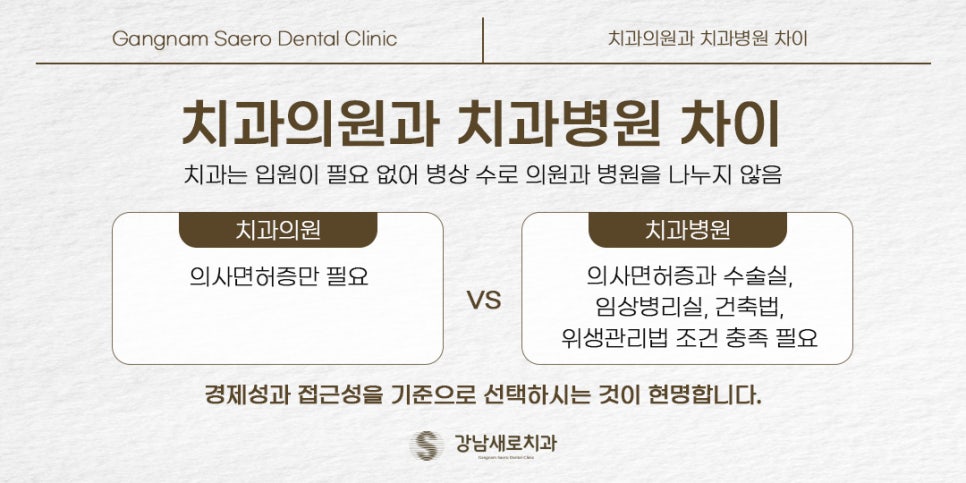
So what is the difference between a “dental clinic” and a “dental hospital”?
Simply put, it is only a difference in the number of beds and facility requirements,
not a standard that guarantees the quality of treatment.
A dental clinic does not necessarily lack equipment,
and a dental hospital does not necessarily have superior technical skill.
In the end, the more important points are the medical staff’s experience and know-how, the equipment used, and the patient management system.
Checklist when choosing an implant hospital
If you are preparing for an implant,
it is much wiser to look at the following rather than whether the signboard says “clinic” or “hospital.”
The medical staff’s experience
Check whether they are specialists from a university hospital and whether they have extensive implant surgery experience.
Whether advanced equipment is available
Check whether they have 3D CT, a digital intraoral scanner, a guided surgery system, and so on.
Surgical experience and number of cases
The more implant cases a clinic has handled, the better the prognosis tends to be.
Aftercare system
Check the warranty system, regular checkups, and their ability to respond to bone grafting and reoperation cases.
Reasonableness of cost
Larger facilities naturally tend to cost more, so you should consider both appropriate cost and reasonable treatment.
Why Gangnam Sero Dental Clinic is recommended for implant surgery
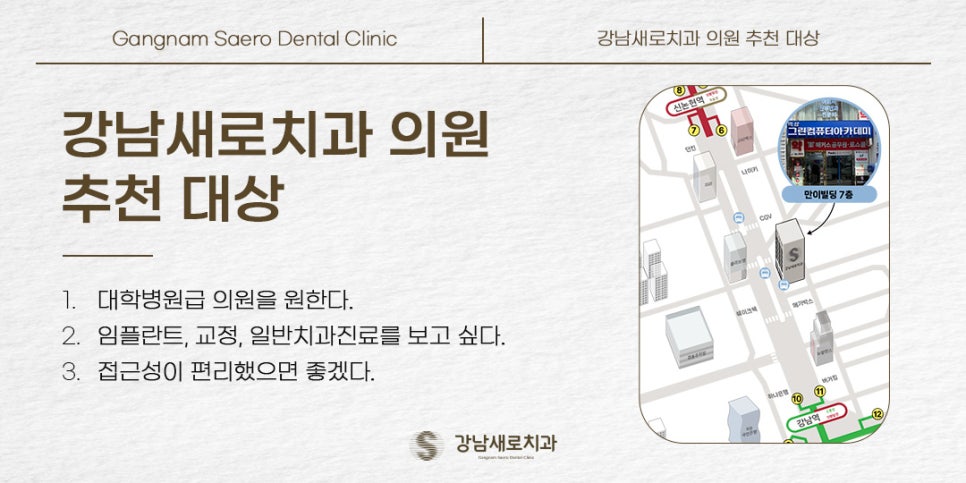
Many people looking for a nearby dental clinic choose
Gangnam Sero Dental Clinic, which is a clinic-level medical institution,
but it has a high-level treatment system.
Full-time specialists who previously served as professors
(Prosthodontics, Orthodontics, Oral and Maxillofacial Surgery, Conservative Dentistry, Integrated Dentistry)
Equipped with university-hospital-level state-of-the-art devices
Independently performs university-hospital-style bone grafting i-GBR
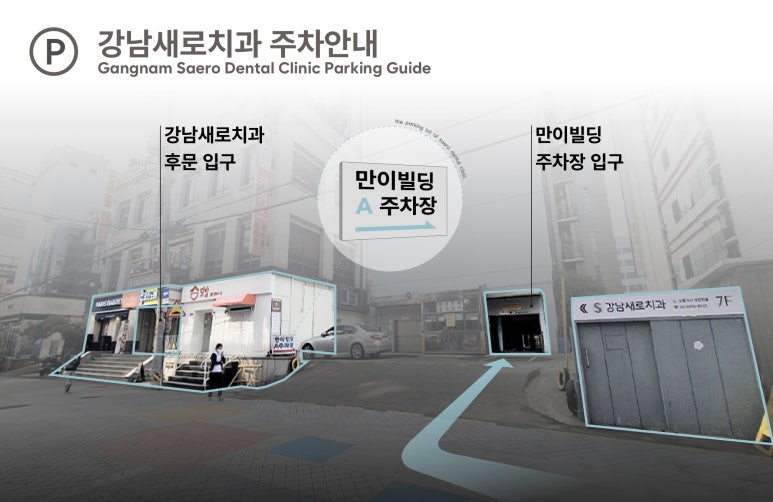
It is also conveniently located within a 5-minute walk from the station,
and parking is available.
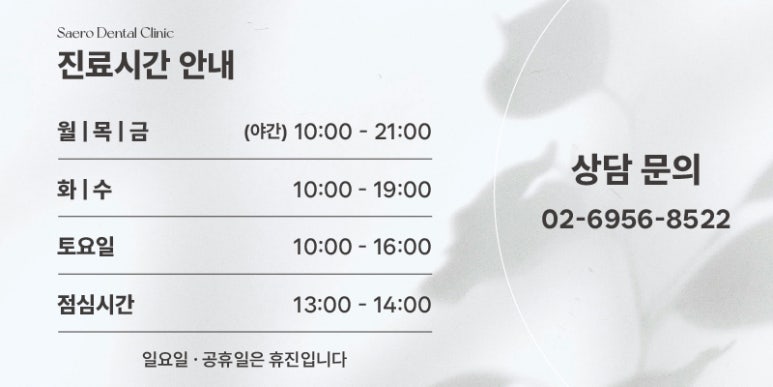
The clinic hours are also flexible,
so both office workers and students can visit conveniently.
Mon/Thu/Fri: evening treatment until 9:00 PM
Tue/Wed: evening treatment until 7:00 PM
Saturday: 10:00 AM to 4:00 PM
The difference between a dental clinic and a dental hospital
ultimately comes down to the scale of the facility,
and the key to implant surgery success rates is
the medical staff’s skill, equipment, and management system.
Because Gangnam Sero Dental Clinic provides both reasonable costs
and a high-level treatment system,
it can be a trustworthy option for choosing an implant hospital and implant surgery.
A new smile, a new beginning
- This post was provided by a medical institution as medical information due to a third-party contractual relationship.