How to reduce implant pain
Implant pain
Minimizing pain, swelling, and bleeding
An implant is not simply a procedure to place a tooth.
Because it requires the gums to be incised and sutured,
some degree of pain, swelling, and bleeding is unavoidable.
That is why many people preparing for an implant
often worry, “How much will it hurt?” and “Will it be hard to go about daily life?”
If you have experienced wisdom tooth extraction,
you may be able to roughly imagine
how you might feel after implant surgery.
The difference, however, is that an implant involves a more precise and longer process,
and post-surgery recovery management determines the success of the treatment.
So let’s take a look at how painful implant surgery actually is,
and how to reduce implant pain.
The implant surgery process and causes of pain
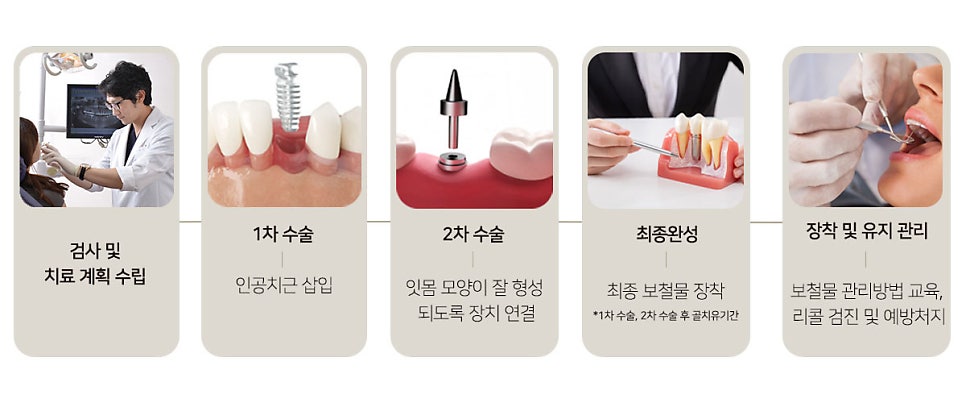
Implant surgery is carried out in stages.
Consultation and treatment planning
Extraction
First surgery (fixture placement)
Second surgery (abutment connection)
Placement of the final prosthetic
Aftercare
The issue is that extraction, first surgery, and second surgery
all require gum incision.
The gums are opened, the artificial root is placed into the bone, and then the site is sutured again,
so swelling, bleeding, and pain naturally accompany the process.
In other words, an implant is not simply a prosthetic procedure,
but a surgical operation involving the gums and bone,
and that must be understood before starting.
How to reduce implant pain 1. One-step implant
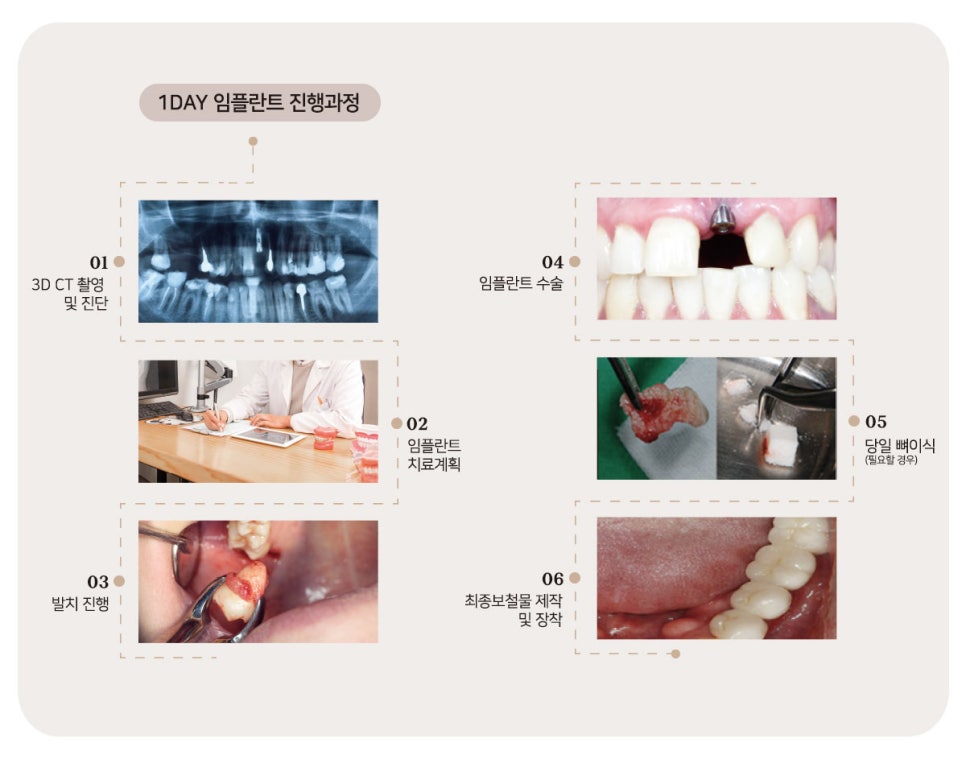
The most direct way to reduce discomfort in implants
is to shorten the treatment period.
The conventional method
follows several stages such as extraction → recovery → first surgery → recovery → second surgery,
so incision and suturing had to be repeated each time.
However, when conditions are suitable, a one-step implant allows
the implant to be placed at the same time as extraction,
finishing a large part of the process in a very short period.
By reducing the number of surgeries,
the incision itself is reduced,
which naturally minimizes pain, swelling, and bleeding.
In addition, because the surrounding tissue is preserved while placing the implant immediately after extraction, recovery tends to be faster.
However, this is only possible when the amount and shape of the alveolar bone (jawbone) are sufficiently healthy, so a precise pre-examination is essential.
How to reduce implant pain 2. Navigation implant
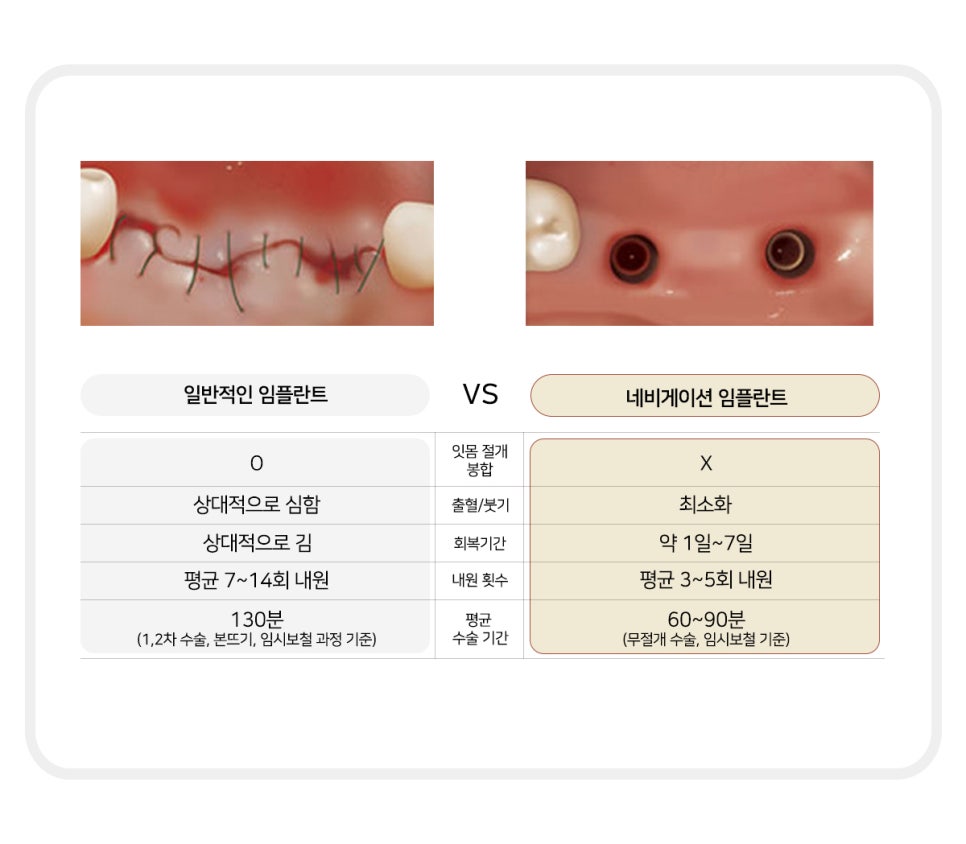
If same-day implant placement is not possible,
a navigation implant can be another option.
A navigation implant
analyzes the patient's oral cavity in 3D
to design the surgical path in advance.
Based on this, the incision can be minimized,
and the artificial root can be placed at the correct depth, angle, and direction.
This method shortens the implant process,
which normally takes more than six months,
to about 2 to 3 months.
Because the incision area is reduced and tissue damage is minimized,
it is characterized by less bleeding, less swelling, and faster recovery.
It is especially suitable for office workers and business owners who want to reduce the number of clinic visits amid a busy daily schedule.
How to reduce implant pain 3. Anesthesia techniques
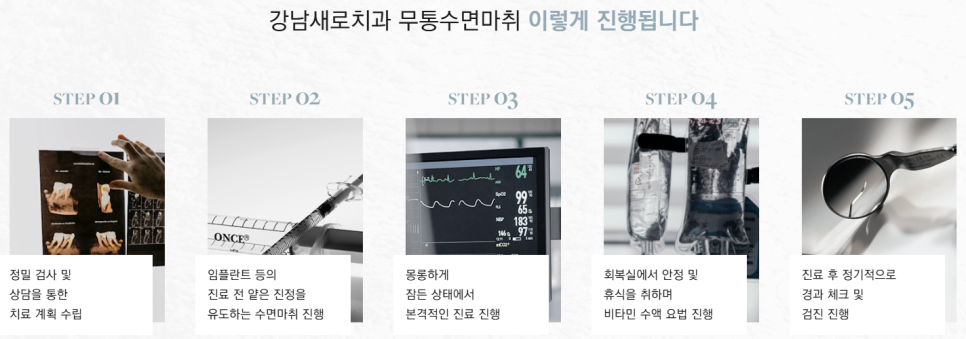
The part most directly felt in reducing implant pain is anesthesia.
Sleep anesthesia (sedation under conscious sedation)
The patient enters a light sleep state, but can breathe on their own and have simple conversations.
They feel little to no pain throughout the procedure, and can wake up quickly afterward, making it safe and comfortable.
PF-72 pain-relief injection
A medication that reduces pain for about three days starting immediately after surgery, clearly reducing discomfort in the early recovery period.
Topical anesthetic
This also reduces the pain of the anesthesia injection itself, minimizing burden from start to finish.
By combining various anesthesia methods according to the patient's condition and the scope of surgery,
the pain before and after surgery can be greatly reduced.
Gangnam Saero Dental Clinic's approach to pain management
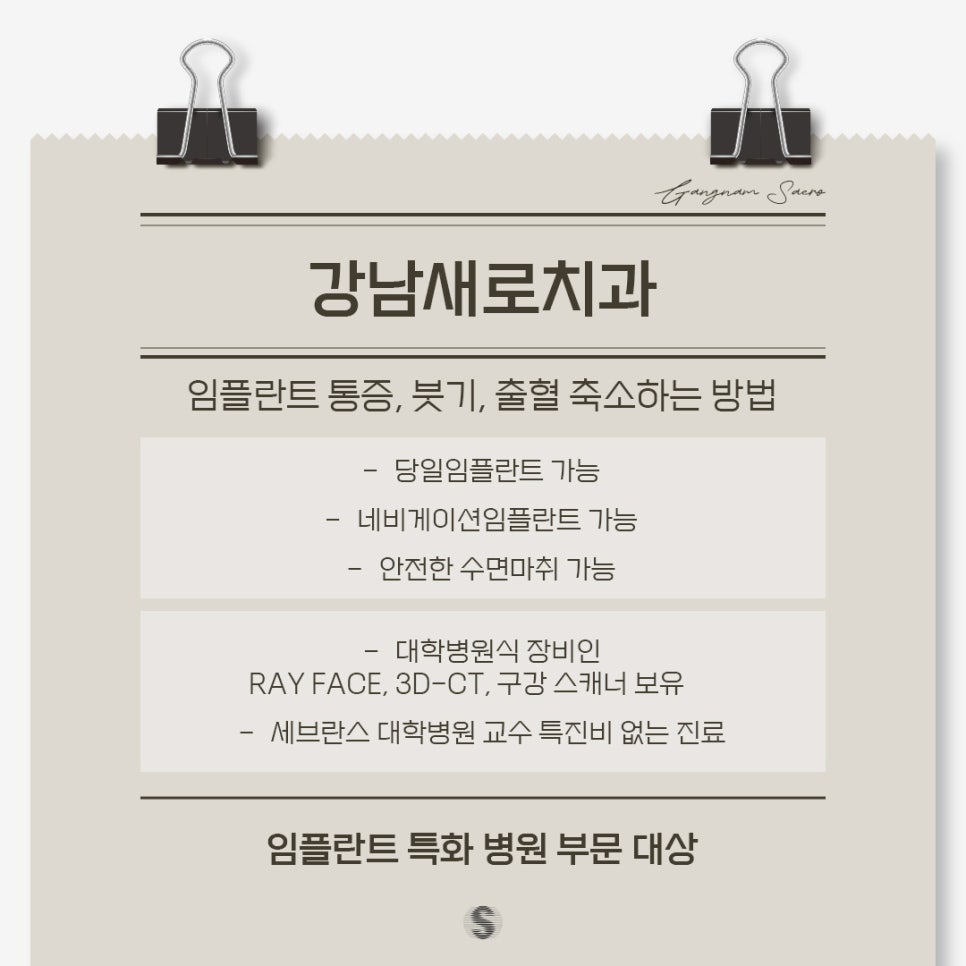
Gangnam Saero Dental Clinic
does not view implants simply as a "procedure to place a tooth."
We believe that a successful implant must also take into account
the patient's psychological anxiety, post-surgical recovery,
and the speed of returning to daily life.
That is why, depending on each patient's situation,
we minimize discomfort through
one-step implants,
navigation implants,
and systematic anesthesia management.
In particular, even after surgery, we stay with the patient until the end with ongoing checks and care so they can feel at ease.
Because implant surgery requires incisions and sutures,
pain, swelling, and bleeding cannot be completely absent.
However, the degree can vary greatly depending on
how the surgery method is chosen
and which anesthesia techniques are used.
Because each patient has different conditions, rather than simply worrying, "Will it hurt?"
it is important to consult with a specialist and make the best choice for your situation.
A new smile, a new beginning,
Gangnam Saero Dental Clinic.
- This post was provided by a medical institution due to a third-party contractual relationship and contains medical information.