Do all cavities need treatment?
Some cavities do not.
Arrested caries
When receiving dental care, there is a moment that is the most confusing.
That is when you receive different diagnoses about whether cavity treatment is needed.
At one clinic, they may say, “You need treatment,”
but at another, they may say, “It is still okay,”
and then we become confused about whose words to trust.
This difference is not simply a matter of opinion,
but can depend on the stage of the cavity and whether bacteria are active.
Today, I will explain the 기준 for deciding on cavity treatment without overtreatment
based on an honest treatment philosophy.
What is a cavity?
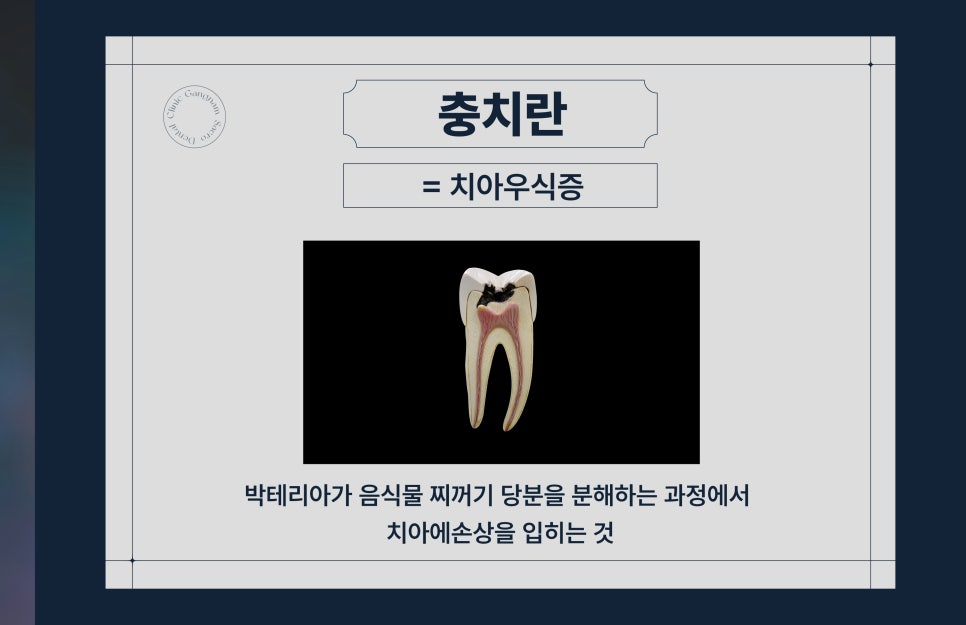
A cavity refers to the process in which acids produced when bacteria attached to the tooth surface break down sugars in food erode the tooth.
When this process is repeated, the tooth gradually weakens and eventually leads to pain or infection.
Cavities are divided into four stages depending on how far they have progressed.
Stage 1 (enamel cavity): an early cavity in which only the outer part of the tooth is damaged
Stage 2 (dentin cavity): the stage when pain begins to be felt
Stage 3 (pulpitis stage): inflammation has spread to the nerve, causing severe toothache
Stage 4 (pulp necrosis): the nerve has died, and extraction may be necessary
Cavities can progress quickly,
but some may stop on their own.
This is called arrested caries.
What is arrested caries?
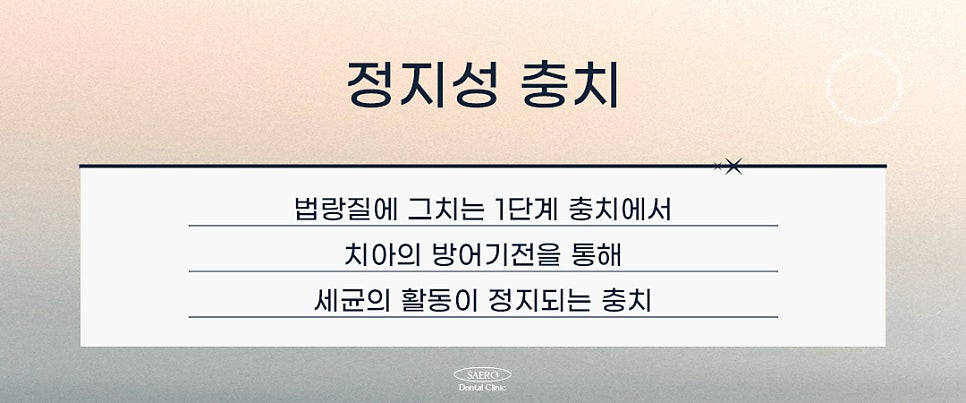
Cavities progress while bacteria are actively working,
but under certain conditions, bacterial activity stops and the cavity no longer progresses.
This is arrested caries (inactive caries).
It usually appears in stage 1 cavities where only the enamel has been damaged,
and it is characterized by the tooth’s own defensive function
preventing further spread of erosion.
Arrested caries may look dark on the surface,
but the surface is hard, shiny, and often painless.
In this case, there is no need to remove the cavity or perform prosthetic treatment.
Distinguishing arrested caries from active caries

The way to distinguish arrested caries from active caries is
to use a specialized instrument called an explorer.
If the surface is hard and does not scratch when probed, it is arrested caries.
If the surface is soft and scratches or feels sticky, it is active caries.
Because active caries still have bacteria at work,
treatment is needed as soon as possible.
On the other hand, arrested caries can remain stable without separate treatment
if lifestyle habits and oral hygiene are well maintained.
Because this distinction can be unclear or judged differently depending on the patient’s oral environment,
different clinics may have different opinions about whether treatment is needed.
Criteria for choosing a dental clinic without overtreatment
Cavity treatment is better the earlier it is done,
but a blanket recommendation for treatment is not always the right answer.
To avoid overtreatment, be sure to check the following three things.
Is the degree of cavity progression diagnosed clearly?
(Confirmed with X-ray or explorer examination)
Is follow-up observation suggested after regular checkups?
(A clinic that looks at the possibility of progression and prevents unnecessary treatment)
Are the patient’s condition and lifestyle habits considered together?
(Treatment that looks at overall oral health, not just a single lesion)
Gangnamsaero Dental Clinic believes that “protecting the patient’s oral health” is the essence of treatment.
That is why, in cavity care as well, we thoroughly distinguish between arrested caries and active caries,
and never recommend unnecessary treatment.
맞춤형으로 each patient’s condition
we carry out only the necessary treatment accurately,
which is Gangnamsaero Dental Clinic’s treatment philosophy.
The trustworthiness of dental care is judged less by how often treatment is recommended
and more by whether a clinic knows when to stop when treatment is not needed.
If it is arrested caries, management takes priority over treatment,
and healthy teeth can be maintained sufficiently through lifestyle improvements and regular checkups alone.
Through this kind of sincere care,
Gangnamsaero Dental Clinic provides an environment where patients can receive treatment with peace of mind.
With no unnecessary treatment, only the treatment that is truly needed,
we will protect your smile.
- This post is a post presented by a medical institution due to a third-party contractual relationship and includes medical information.