Exploring dental search terms
Bridge
Restoring lost teeth with a bridge
We chew food, talk, and smile dozens of times a day without thinking.
But only those who have lost even one tooth
know how inconvenient daily life can become.
In today’s Dental Search Term Exploration from Gangnam Saero Dental Clinic,
we will talk about a treatment called a “bridge.”
Many people think only of dentures or implants,
but in fact, tooth bridges, dental bridges, and implant bridges
exist as another alternative tooth treatment.
In this article, we will look in detail at the concept of these three types of bridges,
the differences between them and other treatments,
and when each one may be appropriate.
What is a bridge?
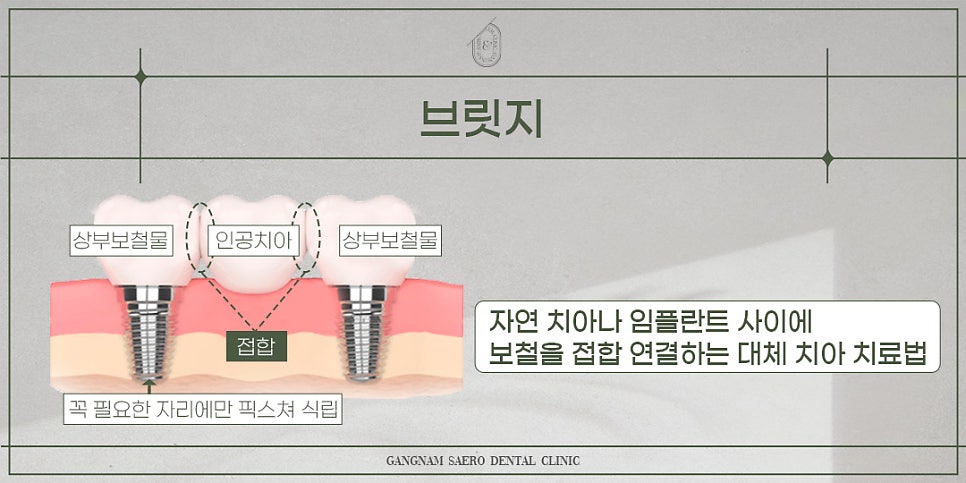
A “bridge” is
exactly what the name suggests: a prosthesis that acts as a bridge.
It is a method of replacing a missing area by connecting an artificial tooth
between natural teeth,
or between a natural tooth and an implant.
Tooth bridges, dental bridges, and implant bridges
use the remaining teeth in this way
as supports to restore function and shape.
The biggest advantage of a bridge is
that it can restore aesthetics and chewing ability similar to natural teeth.
However, in some cases, adjacent natural teeth may need to be reduced,
so the clinician’s detailed diagnosis and procedural experience are very important.
Differences between bridges, dentures, and implants
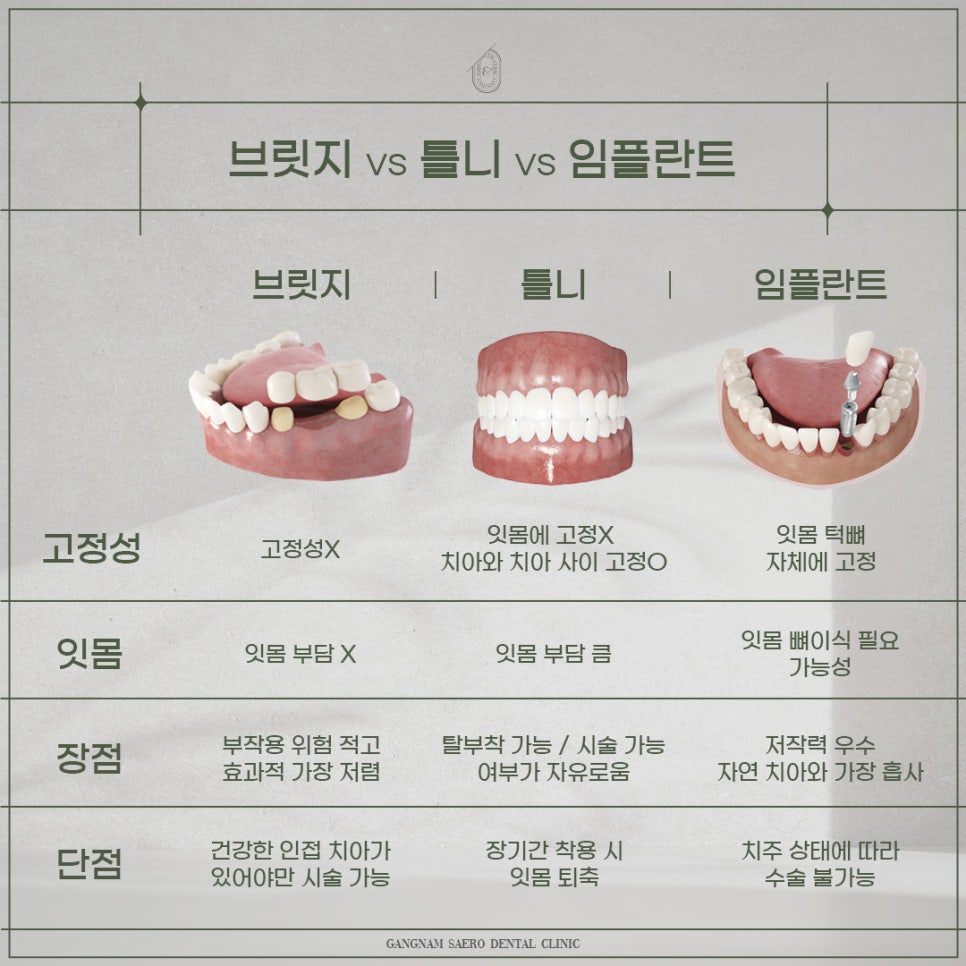
The main treatment options when a tooth is lost are
bridges, dentures, and implants.
So what are the differences among these three?
Fixation
A bridge is not a completely independent structure because the prosthesis is connected to adjacent teeth or implants, but it provides enough stability for everyday chewing.
Dentures are removable, so they move more, while implants are placed directly into the jawbone and are the most stable of the three.
Burden on the gums
Bridges place no direct pressure on the gums, so the burden is relatively low.
Dentures can cause gum recession due to continuous stimulation, and implants require surgery, so bone grafting may be necessary in some cases.
Advantages and disadvantages
Bridge: fewer side effects, more economical, and can achieve natural-looking aesthetics
Dentures: removable, making hygiene management easier, but less stable
Implants: the most durable, but with cost and surgical burden
A drawback of bridges is that they can only be placed when the adjacent teeth are healthy, and part of those teeth must be reduced.
Still, overall, they are a well-balanced treatment in terms of function, appearance, and cost.
When bridge treatment is appropriate

When sudden tooth loss has occurred but the adjacent teeth are healthy
When implant surgery is difficult or burdensome
Cases in which the minimum number of implants is needed for a full-mouth implant treatment
When gum health is maintained and function needs to be restored quickly
In other words, a tooth bridge or dental bridge can be an ideal choice when the teeth are in relatively good condition and both quick aesthetic recovery and cost-effectiveness are being considered.
Care after bridge treatment
Because a bridge is closely fitted to the gums and adjacent teeth,
after treatment, regular scaling, flossing, and interdental brush care are essential.
Also, in the case of an implant bridge,
gum-bone health must be maintained,
so it is advisable to check the condition of the alveolar bone through regular X-ray examinations.
The importance of choosing the right clinic for bridge treatment
Bridge treatment must consider both aesthetics and function.
If the shape of the prosthesis is even slightly poorly designed,
an occlusal imbalance or jaw joint pain may occur,
so the experience and clinical skill of a prosthodontic specialist greatly affect the treatment outcome.
Gangnam Saero Dental Clinic
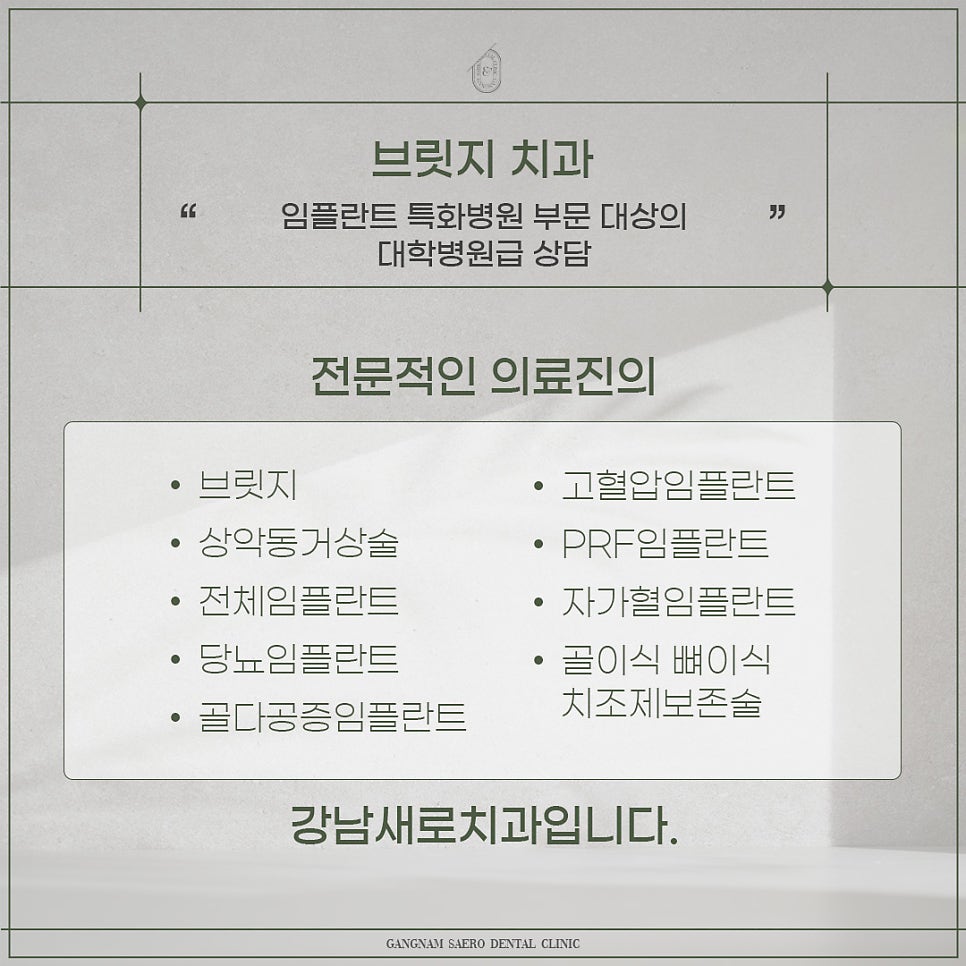
is an institution that received an award in the implant-specialized hospital category,
and Chief Director Jeong Jae-wook, a prosthodontic specialist, treats patients directly,
providing a variety of treatments including bridges
through accurate diagnosis and safe procedures.
In particular,
full-mouth implants
diabetes implants
hypertension implants
oSTEOPOROSIS implants
PRF implants
autologous blood implants
ridge preservation, bone grafting, and sinus lifting
we have advanced expertise in complex cases as well.
Losing a single tooth is
not just a simple inconvenience, but an issue that affects quality of life.
But not every treatment needs to lead to surgery.
A way to preserve natural teeth as much as possible
while restoring function and a smile,
one of the answers is a bridge.
Tooth bridges, dental bridges, and implant bridges
remain important alternative treatments
in the midst of advances in dental technology.
For the most reasonable choice that fits your oral condition and lifestyle,
please consult a specialist.
- This post is a medical-information post provided by a medical institution due to a third-party contractual relationship.