Implant Companies, Implant Types, Implant Brands (2)
Osstem
What is Osstem?
The history of implants began in Sweden in 1965.
Because of that, there was long-standing awareness that "foreign implants are more stable," but as Korea's medical technology has greatly advanced, it has become widely recognized that domestic implants are not inferior to imported ones.
A representative example is Osstem Implant.
It can be said to be the standard for domestic implants, combining popularity, stability, and innovative technology.
What is the implant brand Osstem?
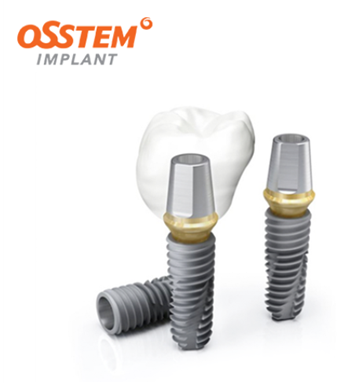
Osstem is the leading implant specialist company in domestic market share and is already a global brand supplied to more than 90 countries worldwide, not just in Korea. In particular, it has excellent precision connection structures and surface treatment technology, which are important factors in the implant procedure, and has stable clinical data that can be trusted.
Features of the implant brand Osstem
Surface treatment methods: Various methods such as SA / CA / HA / BA / SOI
Strengths: Enables customized surgical solutions tailored to various cases
Suitable areas: Can handle everything from basic cases to highly difficult cases
Based on a corporate culture that quickly introduces new technologies, Osstem has a diverse lineup that can be selected according to the patient's condition.
However, because new technologies are introduced quickly, it is important to know and choose with the understanding that not all technologies have long-term clinical data.
Strengths of Osstem's design
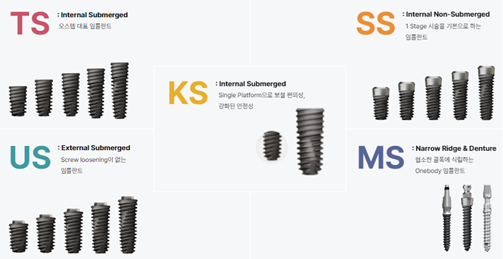
Osstem implants allow case-specific structural selection as shown below.
TS / KS: Internal submerged structure, suitable for stable osseointegration
SS: Internal non-submerged structure, suitable for aesthetic cases
US: External structure, applicable to highly difficult cases
MS: For narrow alveolar bone & denture-linked cases
Key advantages
Excellent initial stability → sense of stability immediately after surgery
Promotes osseointegration → higher long-term survival rate
Guaranteed for use for more than 10 years
High reliability based on precision manufacturing technology
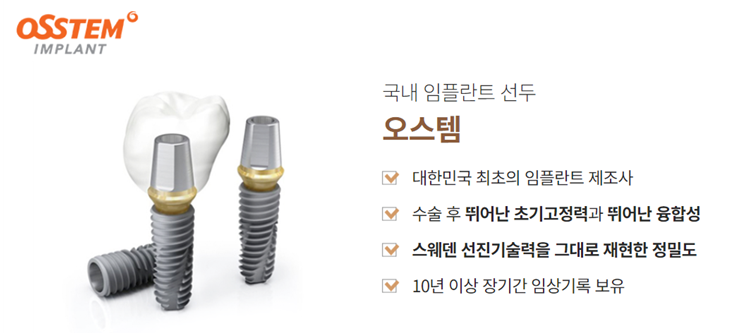
Cost of the implant brand Osstem
Osstem implants have sufficient domestic manufacturing technology and accumulated clinical data, so the biggest advantage is that they offer a high success rate at a reasonable cost compared to imported products.
Average cost range for Osstem implants
In general, for one implant, it is often priced at around 800,000 to 1,300,000 KRW.
However, detailed costs may vary depending on the following factors.
Surface treatment method (SA / CA / HA / BA / SOI, etc.)
Placement site (front teeth vs. molars)
Whether bone grafting and sinus lifting are needed
Choice of abutment and crown materials
The clinic's system and the medical team's level of experience
For example, in the case of a simple placement, it may be possible at a relatively lower price of around 800,000 to 1,100,000 KRW,
but if bone grafting is involved or sinus surgery is required, it can rise to over 1,300,000 KRW.
Why choosing an Osstem dental clinic matters

Osstem is a very good implant, but comprehensive medical judgment from the clinician is essential, including selecting the appropriate surface method for the case, determining the surgical difficulty according to the alveolar bone condition, and developing a long-term maintenance strategy.
Only when surgical experience, understanding of prosthetic design, and a post-treatment care system are in place can the advantages of Osstem be fully utilized.
Gangnam Saero Dental Clinic, based on its long-accumulated clinical experience and technology, including a history of being selected as an excellent implant institution and receiving an award in the implant-specialized hospital category, provides precise diagnosis, customized surgical planning, and follow-up care tailored to the patient's condition.
The most important point is not simply choosing a hospital that uses a good implant, but choosing a hospital that can properly handle implants.
- This post is a medical information post provided by a medical institution due to a third-party contractual relationship.