Key procedure at Gangnam Saero Dental to reduce the risk of inflammation
How to improve upper tooth implant stability
Understanding sinus lifting properly
There are times when you hear something unexpected at the dentist’s office. “For your upper tooth implant, you’ll need a sinus lifting procedure.” For a moment, you may feel stunned, thinking, “Wasn’t it supposed to be just an implant?”
But this is less about a scary or complicated story and more about being guided through a process that is essential to improving the success rate of upper tooth implants. The upper jaw is structurally different from the lower jaw because it is adjacent to a space called the “maxillary sinus,” so a special environment is needed to ensure implant stability.
From here on, we’ll explain why sinus lifting is necessary, how it is performed, and what you should know to receive treatment safely while minimizing inflammation, bleeding, and failure.
What is the maxillary sinus?
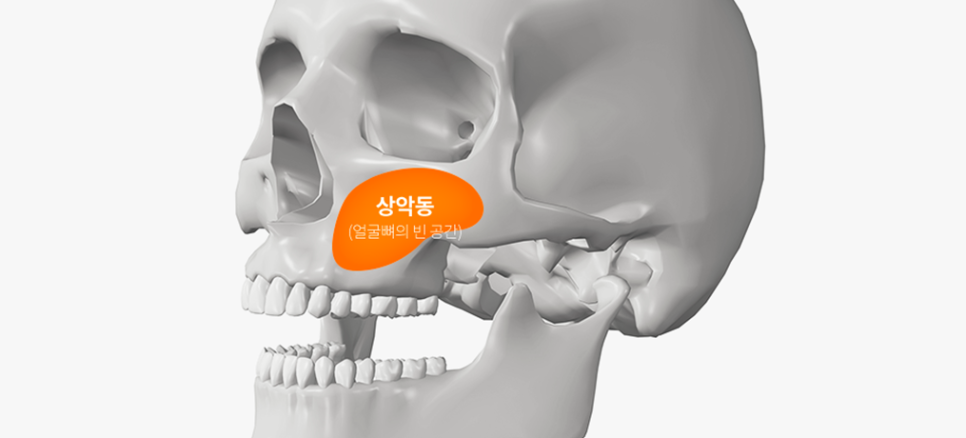
The maxillary sinus is a space we usually never consciously notice because it is so familiar.
It is an air-filled cavity that extends from the upper jawbone to the inside of the nose, and it acts as a cushion that helps reduce the load the jawbone must bear.
However, the problem is that if a missing upper tooth is left untreated for a long time, the maxillary sinus descends, causing the alveolar bone (the jawbone that supports the teeth) to become thinner and begin to resorb.
If an implant is placed in this condition without sinus lifting?
The implant fixture may penetrate into the maxillary sinus
The risk of chronic inflammation, rhinitis, and sinusitis increases
Implant fixation failure may lead to loss
The long-term risks become very large
In other words, if an implant is placed forcefully when there is not enough bone,
the side effects are almost predictable.
That is why the process of safely lifting the sinus,
namely sinus lifting, becomes necessary.
Sinus lifting: a procedure to raise a sunken maxillary sinus
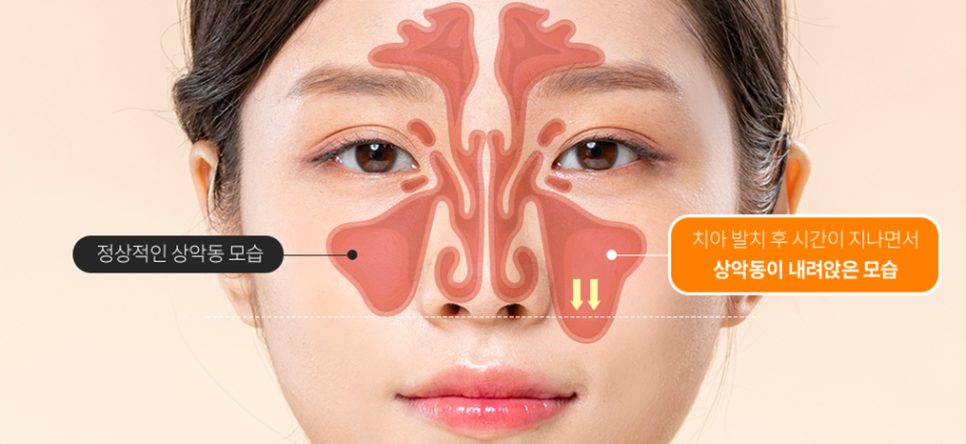
Sinus lifting is, as the name suggests, a process that raises a sagging maxillary sinus back to its original height and creates new bone in the space below it. This procedure is divided into two methods depending on how far the maxillary sinus has descended and how much alveolar bone remains.
Crestal Approach
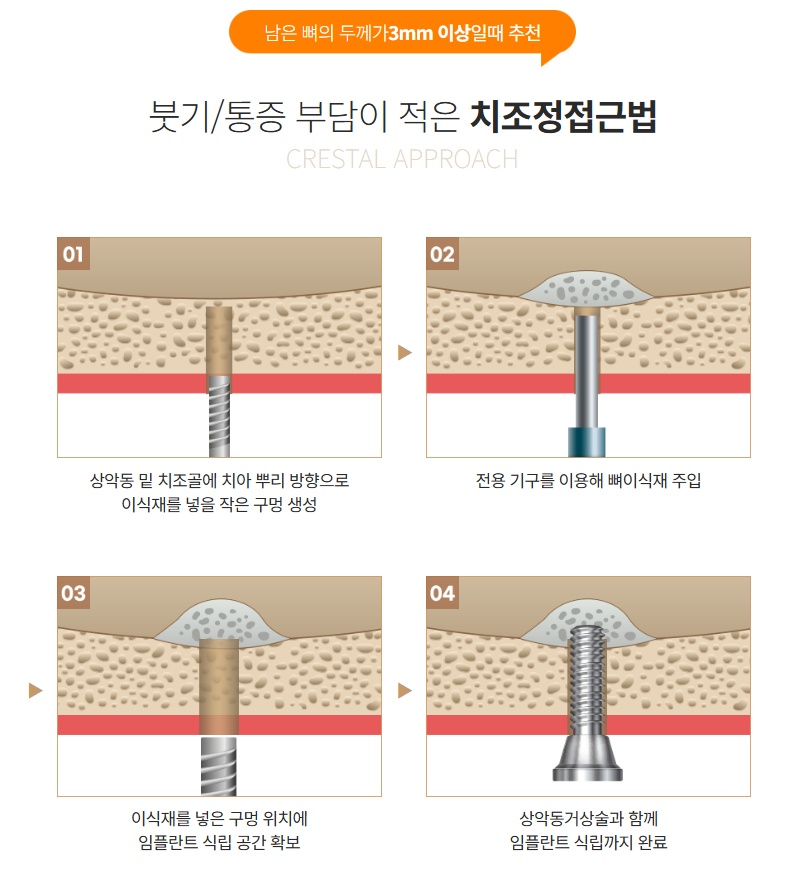
When the remaining bone is at least 3 mm
The method with the least swelling and pain burden
The sinus is gently lifted upward, and bone graft material is placed underneath.
The implant can then be placed on the same day.
The surgery time and recovery period are short, so the burden is low.
It is recommended when the period of neglect after upper tooth extraction is short
and the maxillary sinus has not descended significantly.
Lateral Approach
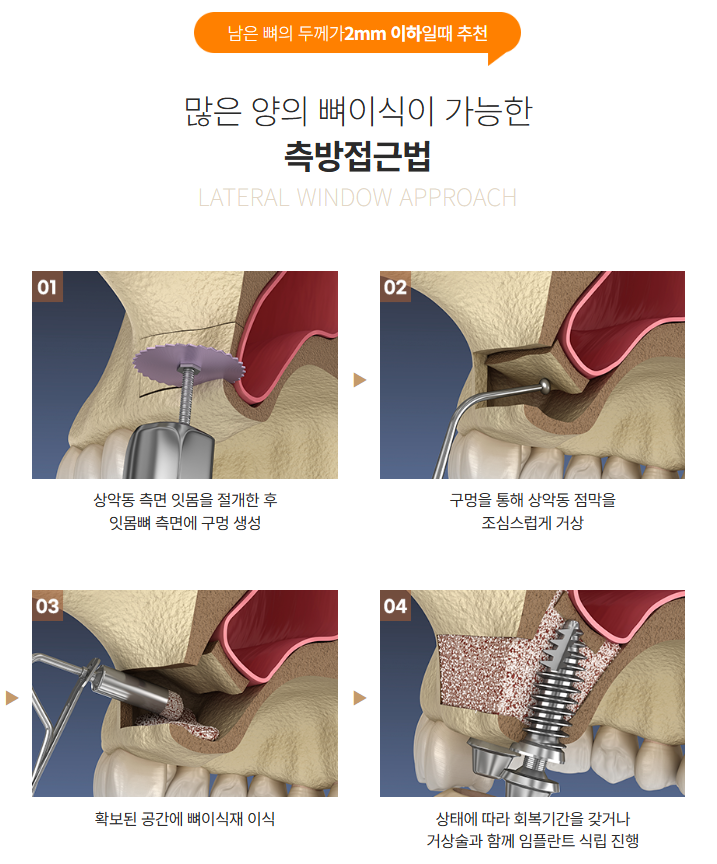
When the remaining bone is 2 mm or less
When a large amount of bone augmentation is needed
A more advanced and delicate procedure
The side of the jawbone is opened to directly lift the sinus membrane.
After sufficient bone grafting, the implant is placed once the recovery period (bone formation) has passed.
It is needed in moderate to high-difficulty cases where the maxillary sinus has descended significantly and the jawbone has become thin.
Benefits of sinus lifting
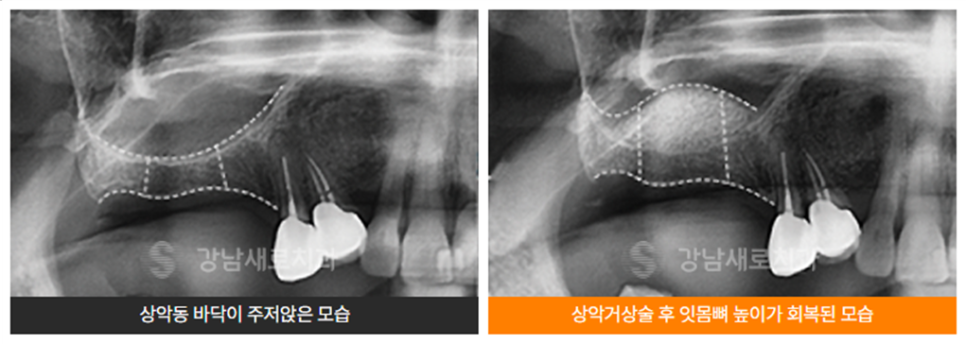
It is not just about “filling in bone,”
it has a major impact on the stability, longevity, and side effects of upper tooth implants.
Adequately restores the height of the thinned upper alveolar bone
Greatly improves implant fixation and success rates
Makes implants possible even when the jawbone is insufficient
(even in cases where the bone is thin, soft, or severely resorbed)
Helps prevent sinus-related complications such as inflammation, rhinitis, and sinusitis
The reason sinus lifting is important in upper tooth implants is
not because it is something to do only when necessary,
but because it is a process that must be done to ensure safety.
Criteria for choosing a hospital for sinus lifting

Sinus lifting is a surgery that requires a high level of expertise throughout the entire process, from precise diagnosis to advanced technique to recovery management, more so than a standard implant procedure.
The skills especially needed are as follows.
Equipment capable of precisely analyzing the sinus diameter, thickness, and membrane condition
Medical staff experienced in a variety of cases and skilled in advanced procedures
Standards for using bone graft materials and a systematic procedural plan
A treatment plan that takes the recovery stage into account
Gangnam Saero Dental performs sinus lifting by precisely analyzing the alveolar bone condition, the thickness of the maxillary sinus membrane, and whether safe placement is possible, based on highly skilled clinicians and state-of-the-art equipment capable of advanced procedures.
Precise diagnosis, delicate surgery, stable recovery—all of this is possible at a dental clinic-level cost, which is why it is Gangnam Saero Dental.
This post is medical information presented by a medical institution due to a third-party contractual relationship.