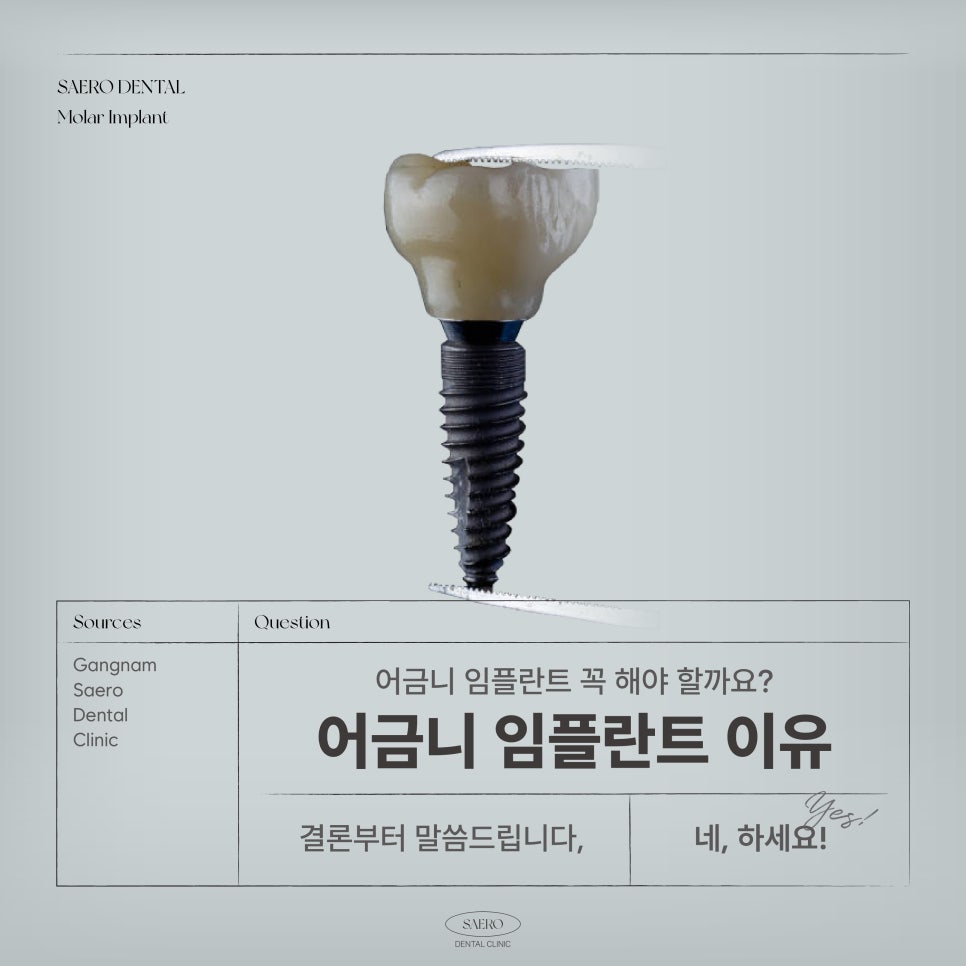
Molar implant
Molar implant after extraction
Why molar implants are needed
Molars are teeth at the center of chewing force,
but because they are located in a less visible area,
many people tend to think,
“Maybe it’s not that big of a problem”
even after losing one.
In particular, when the rearmost molar is extracted,
you may have heard things like,
“Can’t I just chew with the molar in front?”
,
“Apparently you don’t really need an implant for a molar.”
However, if you properly understand the role of molars
and the changes in oral structure after extraction,
the reason molar implants are recommended
becomes clear naturally.
The role of molars as seen in the permanent tooth structure
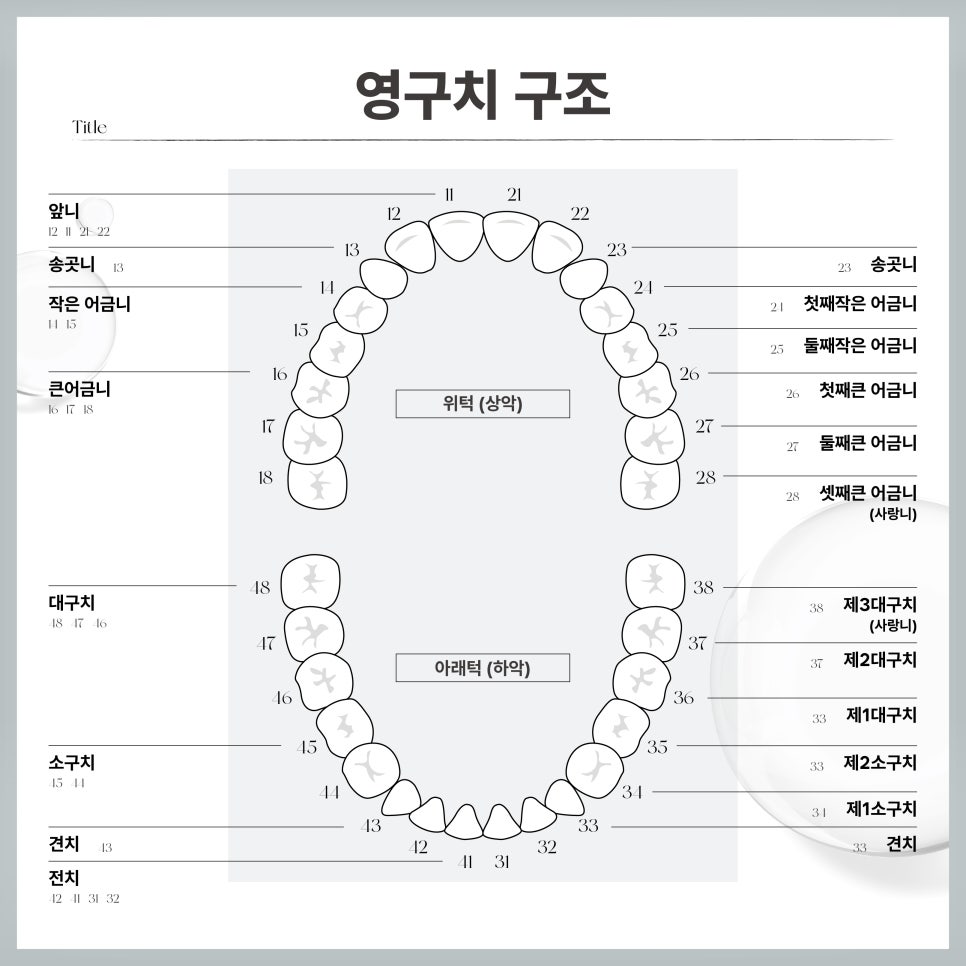
Looking at the permanent tooth structure,
next to the second molar, which is located on the outermost side,
is the first molar.
So when the second molar is extracted,
it may seem possible at first to let the first molar
temporarily take over chewing.
Also, there is a premolar in front of it,
so the change may not feel very noticeable on the outside.
Because of this structural reason,
the loss of a molar is more easily underestimated
than the loss of a front tooth.
But the issue is not whether you can chew right now,
but the changes that occur as time passes.
Why diagnoses for molar implants differ by clinic

Sometimes one clinic may diagnose,
“You don’t really need an implant for a molar,”
while another may say,
“You should get an implant.”
So which one is correct?
This difference can be understood by looking at
when dental implants became popular in Korea
and how that process unfolded.
Dental implants in Korea
began in the 1980s, mainly at university hospitals,
and at the time they were a high-difficulty, high-cost treatment
that only a very small number of patients could receive.
The price was also much higher than it is now,
so it was regarded as a somewhat symbolic treatment.
But after the early 2000s,
as implant technology became more widely used,
accessibility, stability, and cost structures changed significantly,
and the long-term side effects of not receiving an implant after tooth loss
began to be considered more important.

As a result,
a molar implant, which used to be considered a treatment
that “didn’t really need to be done” under older standards,
has changed into a recommended treatment under current standards.
Changes that occur if you do not get a molar implant
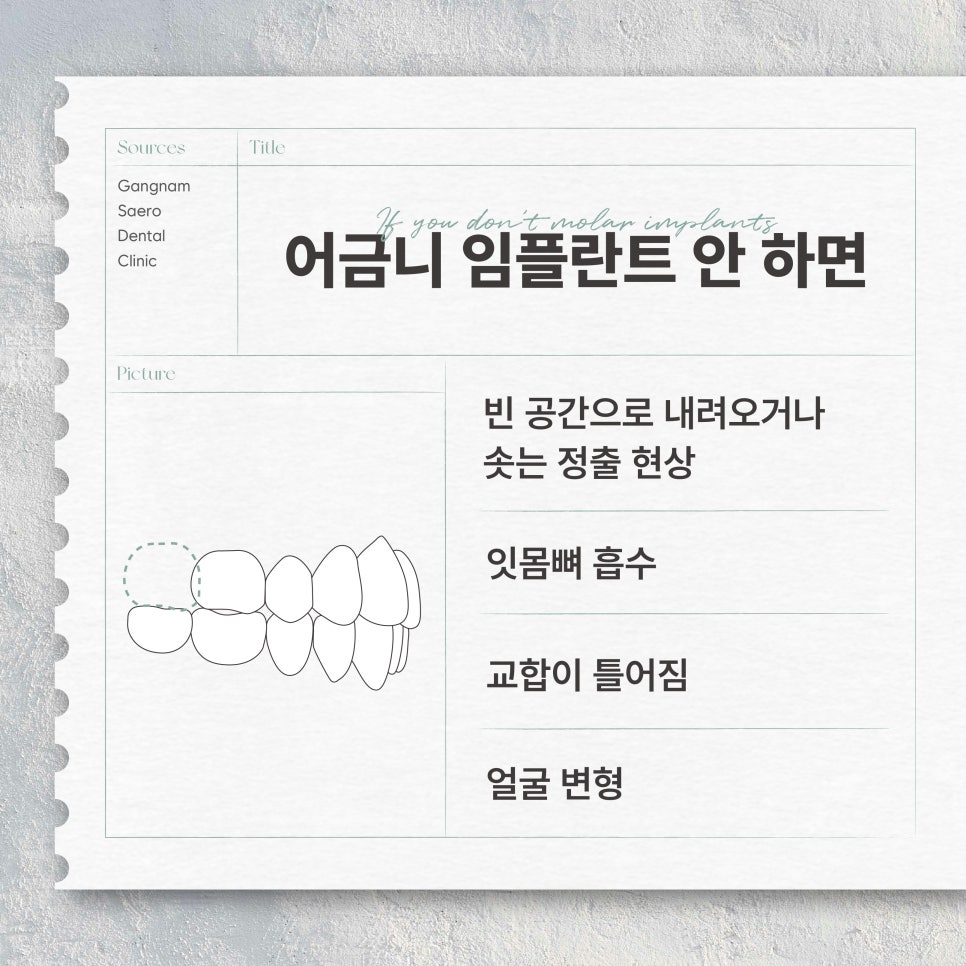
If you leave the gap after molar extraction without getting an implant,
many changes occur in the mouth that are greater than expected.
First,
adjacent teeth gradually move toward the empty space left by extraction.
They may shift left or right, erupt upward or sink downward,
and in severe cases, teeth may tilt and collapse.
During this process,
the bite becomes misaligned,
chewing force becomes biased to one side,
and bone loss in the jawbone accelerates.
In addition, loss of jawbone and changes in tooth alignment can lead to
malocclusion, changes in facial contour,
and increased strain on the temporomandibular joint,
while also making it easier for food to get stuck,
raising the risk of cavities and periodontal disease.
In other words,
judging that “it’s fine because it can’t be seen”
can become the cause of needing more extensive treatment
as time goes on.
Why are molar implants recommended?

A molar implant is not simply treatment that fills one missing tooth.
It is treatment to maintain the balance of chewing force,
protect tooth alignment and jawbone,
and preserve the stability of the entire oral structure.
In particular, because molars are the area that handles most of the chewing force,
implant treatment, which can restore function most similar to natural teeth,
becomes the most reasonable long-term choice.
Molar implant treatment is highly dependent on the placement position,
angle, and depth,
which greatly affect its lifespan and stability.
So it is not simply a matter of whether you “should or should not” do it;
what matters most is an accurate diagnosis that considers
both the current oral condition and future changes.
The condition of the jawbone,
the balance of the bite,
distribution of chewing force,
and lifestyle habits
all need to be considered in the treatment plan,
and these factors determine the success of the implant.
A molar implant is treatment that solves current discomfort,
but it is also preparation for a more comfortable future.
When the goal is not just a simple replacement,
but restoring function as close to natural teeth as possible,
an accurate diagnosis and a stable treatment plan
bring out the true value of the implant.
A new smile,
a new beginning.
Gangnam Saero Dental Clinic.
- This post is a post provided by a medical institution due to a contractual relationship with a third party and includes medical information.