Navigation Implant
Minimizing implant side effects
A way to reduce implant pain and implant treatment time
The concerns people most often have before implant surgery are
implant pain, swelling, and recovery time.
An implant is not simply a procedure to place a tooth
because it is a surgery that involves the gums and bone,
so temporary discomfort after surgery is unavoidable.
A typical implant process is
first surgery (incision and placement of the artificial root) →
osseointegration period →
second surgery (abutment connection) →
final prosthesis placement
in that order.
If an incision is made during this process,
swelling, bleeding, and implant pain can occur,
and if there is an error in the placement position or angle,
recovery may take longer or discomfort may increase.
That is why, recently,
a digital implant method designed to reduce recovery burden,
namely the navigation implant,
has been attracting attention.
What is a navigation implant?
A navigation implant is
a method in which, before surgery,
the location, direction, angle, and depth for implant placement are planned in advance through 3D digital analysis,
and surgery is performed using a guide made according to that plan.
In other words, it is not a surgery based on intuition,
but rather a planned procedure carried out after precise design.
Navigation implant process
- Precise diagnosis stage
Low-dose 3D-CT imaging
Facial scanning equipment
Digital intraoral scanner
These three data sources are combined
to analyze the teeth, jawbone, nerve position, and even facial proportions
in three dimensions.
- Virtual simulation
A virtual surgery is performed on a computer,
where the implant is placed in advance.
At this stage, the safest and most stable path is designed
while considering bone thickness, nerve position, and prosthetic direction.
- Surgical guide fabrication
Based on the simulation data,
a patient-specific guide is made.
This guide helps direct the implant so that it is placed in the correct position.
- Precise placement
The implant is placed according to the planned position
in a way that minimizes gum damage.
Why can implant pain and swelling be reduced?
A navigation implant
reduces unnecessary incisions
and allows rapid placement along an accurate path,
which can reduce tissue damage.
As a result,
it may help with
reduced swelling after surgery
reduced bleeding
relief of pain
shorter return-to-daily-life time
(It may vary depending on the individual condition)
Summary of the advantages of navigation implants
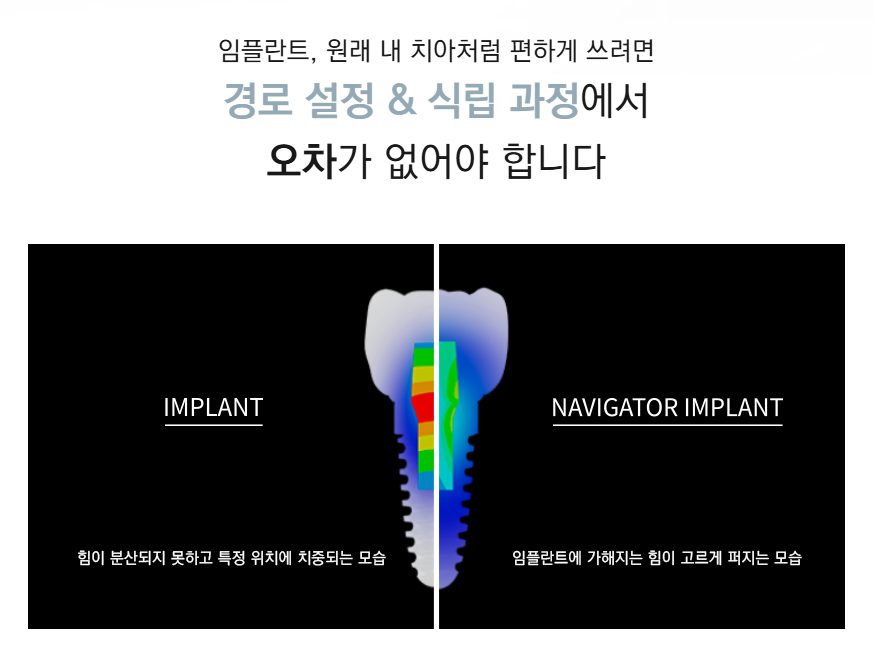
Improved accuracy
Reduces placement error through pre-surgical simulation
Reduced recovery burden
Helps relieve post-surgical discomfort by reducing tissue damage
Shorter surgery time
Minimizes unnecessary steps with a planned procedure
Improved safety
A safe approach that considers nerves and anatomical structures
For implants, design matters

No matter how good the equipment is,
the experience and judgment of the medical team
who interpret the data and establish the surgical plan are the most important.
A navigation implant is
not just another advanced surgery,
but something that only makes sense when precise diagnosis + digital design + skilled surgical experience
are all combined.
An implant is not simply a treatment to place a tooth,
but a process of creating a tooth that will be used for a long time.
So rather than the size of the surgery,
what matters is how accurately and how stably it is performed.
An implant with a comfortable recovery,
a treatment that considers both function and stability,
I hope you choose based on those standards.
A new smile,
A new beginning.
- This post is provided by a medical institution with medical information due to a third-party contractual relationship.