After orthodontic treatment ends
Do I really need
a retainer?
When considering orthodontic treatment, one of the
most burdensome factors for many people is
its “duration.”
Orthodontic treatment itself usually takes 1 to 2 years,
and in some cases nearly 3 years.
When people hear that they may need to wear a retainer for life even after that,
it can become difficult to make a decision.
Even if it is not visible,
the fact that something must be continuously maintained on the teeth
can itself feel psychologically burdensome.
However, the completion of orthodontic treatment
is not determined at the moment the appliance is removed,
but rather at the retainer stage.
Why a retainer is necessary
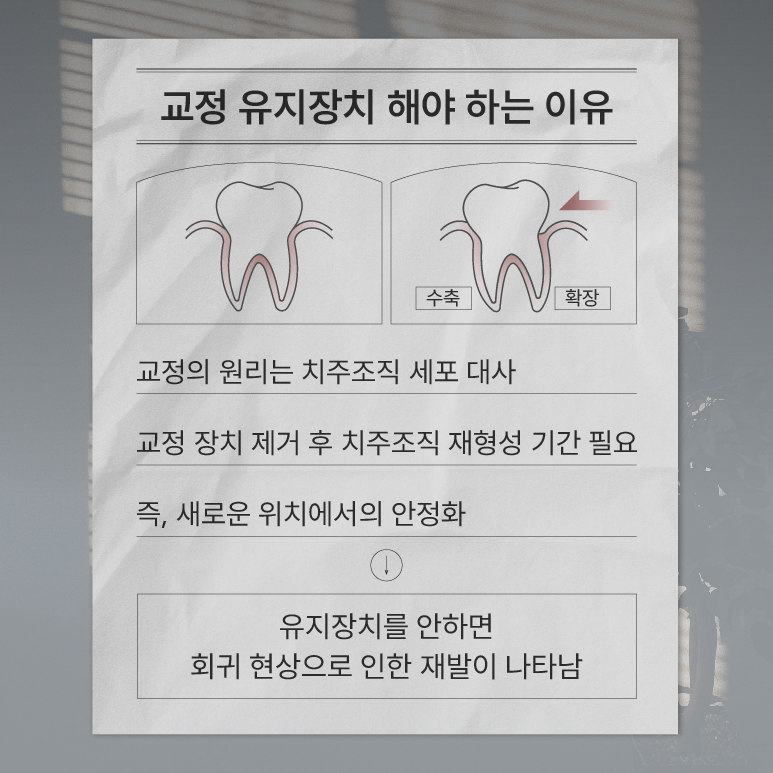
Orthodontic treatment is not simply the process of moving teeth.
When a constant force is applied through orthodontic appliances,
the alveolar bone repeatedly undergoes resorption and regeneration in that direction,
allowing the teeth to settle into a new position.
The problem comes after the orthodontic appliance is removed.
The gum bone tissue supporting the moved teeth
has not yet fully stabilized,
so over time it tends to
return to its original position.
In other words, if you do not wear a retainer,
“relapse,” one of the side effects of orthodontic treatment, can occur.
The straight teeth that were achieved with difficulty
may gradually become misaligned again.
Retainer wearing period
Then the natural question arises:
“Once the gum bone has settled, can’t it be removed?”
Teeth do not only move during the stabilization period after orthodontic treatment;
they also have a tendency to keep shifting over time.
As people get older in particular,
teeth tend to drift more and more in one direction.
The front teeth gradually crowd forward,
and teeth that are spread outward tend to spread even more.
These changes can appear more quickly
in cases where orthodontic treatment has been performed.
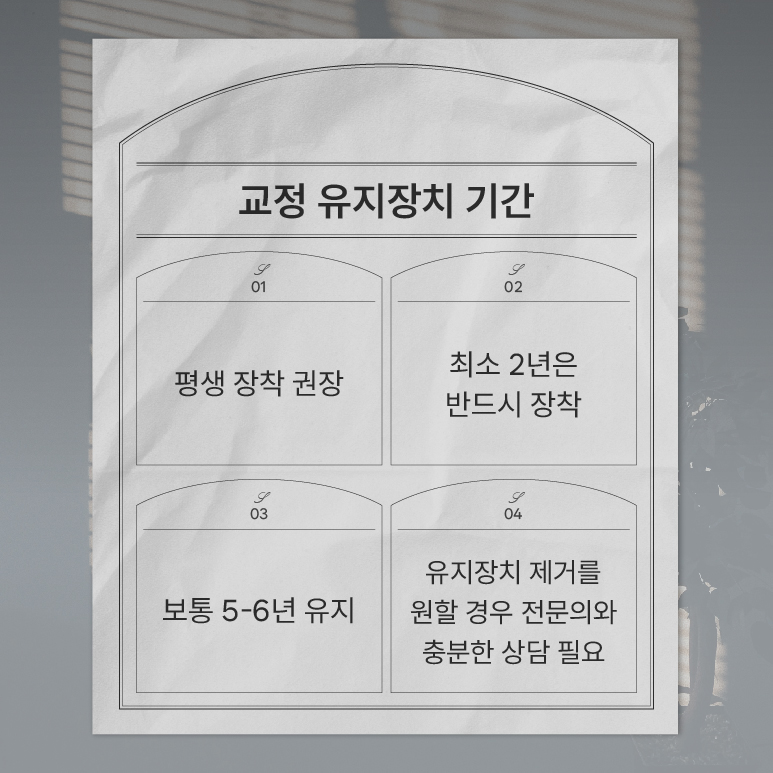
That is why a retainer is recommended as follows:
- 반드시 wear it for at least 6 months to 2 years after treatment
- Long-term use for 5 to 6 years or more is recommended
- If possible, maintain it for life
Also, when removing the retainer,
it should not be decided arbitrarily
and must be determined through consultation with the medical staff.
Types of retainers
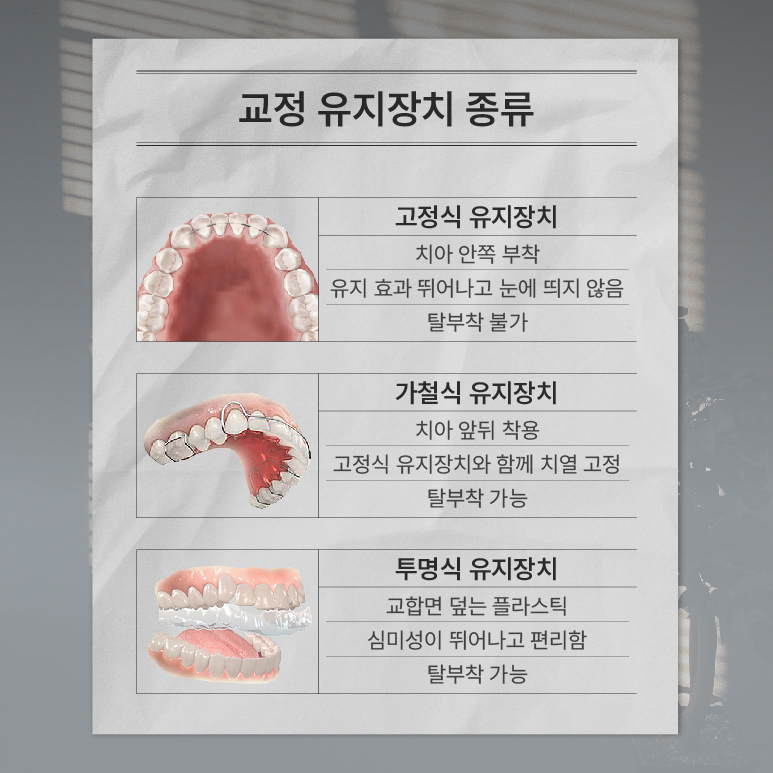
- Fixed retainer
A thin wire attached to the inside of the teeth.
It is not easily visible, so it is aesthetically pleasing,
and because it is fixed in place at all times, it provides excellent retention.
It causes almost no inconvenience in daily life
and does not greatly affect tongue or mouth movement.
- Removable retainer
A detachable type
made of wire and plastic.
In the beginning, it must be worn for more than 20 hours a day,
and later it is mainly worn while sleeping.
It is often used together with a fixed retainer,
and serves to further strengthen retention.
- Clear retainer
A form similar to clear aligners
that covers the entire teeth.
It is barely visible, so it offers excellent aesthetics,
and has the advantage of being convenient to wear and manage.
How to choose a retainer
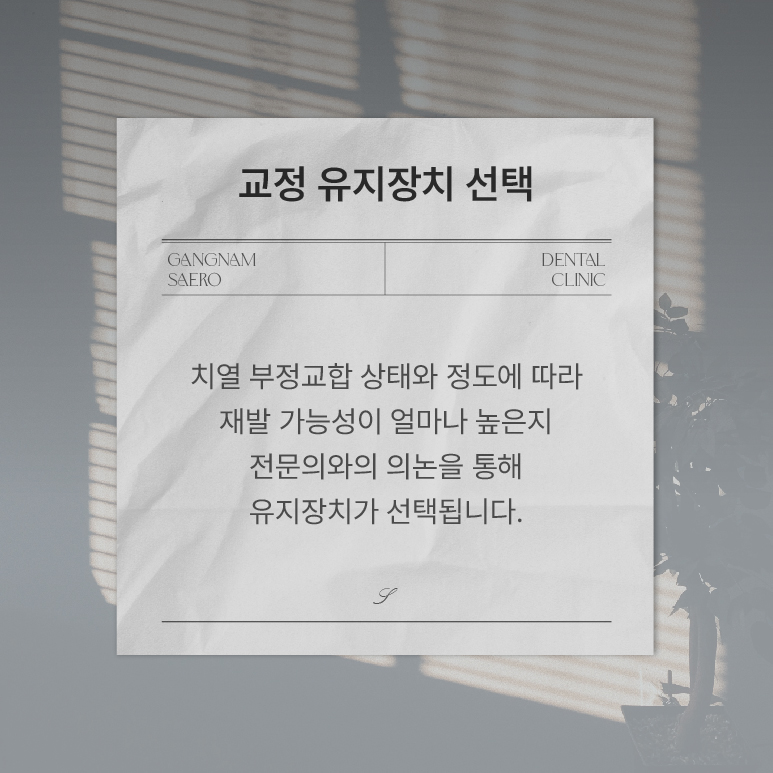
A retainer is not a device chosen simply according to the patient’s preference.
The dental team must determine the appropriate method by comprehensively considering
factors such as the state of the dentition, occlusion structure,
the amount of change before and after orthodontic treatment,
and the likelihood of relapse.
That is why orthodontic treatment must have
- initial diagnosis
- treatment plan
- orthodontic process
- post-treatment maintenance
All of these steps must be organically connected
in order to achieve a truly high-quality result.
From the start of orthodontics to maintenance, at Gangnam Saero Dental Clinic
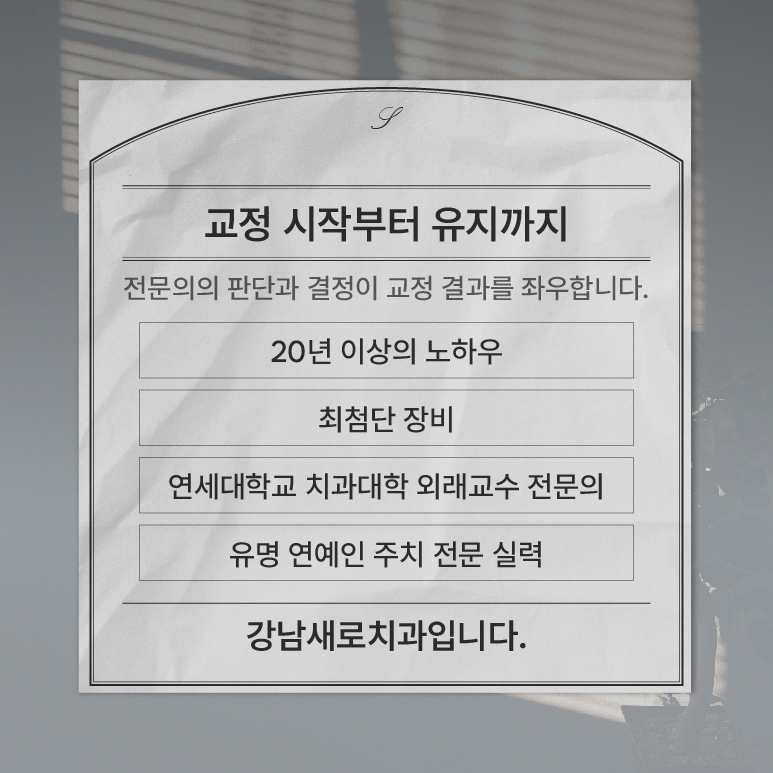
Specialist in celebrity orthodontics
NanoLiner advisory committee member
Specialist in jaw surgery orthodontics
With Director Jeon Jae-min,
Experience an orthodontic process that is on another level,
from start to maintenance!
New smile
New beginning
- This post is an article provided by a medical institution due to a third-party contractual relationship regarding medical information and other related matters.