
What are the symptoms and prevention methods of diabetes?
Implants possible even for patients with diabetes
Diabetes implants, PRF implants
Sweet foods are no longer something we eat only on special days.
Sugar is hidden in more foods than you might think,
and we consume it very naturally in our daily lives.
That is why diabetes is
no longer an unfamiliar disease.
The statement that one in three adults over the age of 30 in Korea
has diabetes or
is in the prediabetes stage
no longer sounds strange.
The problem is that diabetes
does not simply end with high blood sugar.
That is because it lowers the body’s ability to recover,
affects blood vessels and nerves, gums and bones,
and can eventually lead to various complications.
So if you are planning an implant,
you should not take diabetes lightly.
In this post,
we will go over what diabetes is, what its warning signs are,
and how patients with diabetes can safely receive implants
step by step!
What is diabetes

Simply put, diabetes is
a disease in which sugar is excreted in the urine.
To explain more accurately,
the food we eat is broken down into glucose,
and this glucose must enter cells through the action of insulin
to be used as energy or stored.
But if insulin is lacking
or insulin does not work properly,
glucose cannot enter the cells
and continues to remain in the blood.
When this state repeats,
blood sugar rises,
and eventually sugar is excreted in the urine.
Diabetes is broadly divided into the following four types.
Type 1 diabetes
Type 2 diabetes
Diabetes due to other causes
Gestational diabetes
Among these, the most common in Korea is
Type 2 diabetes.
This is influenced not only by genetic factors
but also by environmental factors such as
diet, lack of exercise, obesity, and lifestyle patterns.
In particular, if you consume a lot of high-sugar foods
and remain overweight for a long time,
the risk of developing the disease can increase even more.
Warning signs of diabetes

One of the reasons diabetes is frightening
is that there is no clear pain in the early stages.
Because the body does not feel seriously ill,
many people only find out after it has progressed quite far,
so it is important to stay alert to small changes in everyday life.
Common warning signs of diabetes include the following.
Frequent urination,
increased thirst,
easily feeling hungry and eating more while losing weight,
and easily becoming tired and lethargic
are the most common symptoms.
If these symptoms repeat,
it is better not to dismiss them as simple fatigue
and instead get an accurate examination and diagnosis.
Especially if you are considering an implant in the future,
you must first understand and manage your blood sugar status.
Only then
can diabetes implants, PRF implants
be performed more safely.
The relationship between diabetes and implants

Patients with diabetes generally
tend to heal more slowly and have weaker immunity.
This means that
recovery after surgery may be slower
and the risk of inflammation or infection may be relatively higher.
Because implant surgery
involves the gums and jawbone,
performing it when blood sugar is not well controlled
increases the likelihood of various problems.
For example,
gum inflammation,
delayed tissue healing,
increased risk of infection,
and delayed bonding between the jawbone and the implant
may occur.
Also, in cases of long-term diabetes,
jawbone loss may have progressed further,
which can make the implant procedure itself more difficult.
So diabetes implants should be understood not as a treatment that is absolutely impossible,
but as a treatment that requires more detailed preparation and management.
Implants for patients with diabetes
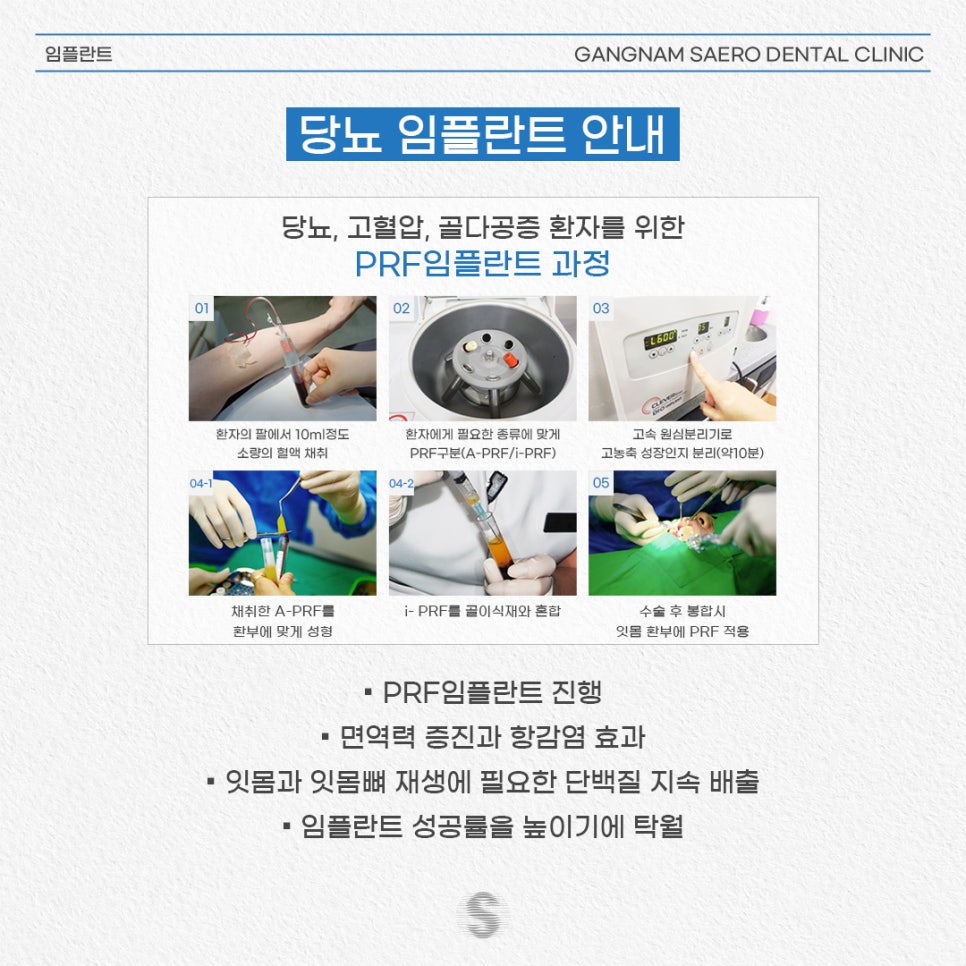
One of the methods that is especially important in implants for patients with diabetes is
diabetes implants, PRF implants.
PRF is a substance made by separating white blood cells and platelets
from the patient’s own blood
and concentrating growth factors.
When this component is applied to the surgical site,
it can help regenerate the gums and jawbone
and encourage the continuous release of proteins
needed for wound healing.
In other words,
for cases where recovery may be slow, such as in patients with diabetes,
it helps create a more stable surgical environment.
Diabetes implants, PRF implants
are not simply procedures with a special name,
but can be seen as a more careful implant approach
that takes the patient’s condition into account.
Precautions during implant surgery for patients with diabetes
Implants for patients with diabetes
require very important preoperative preparation and postoperative care.
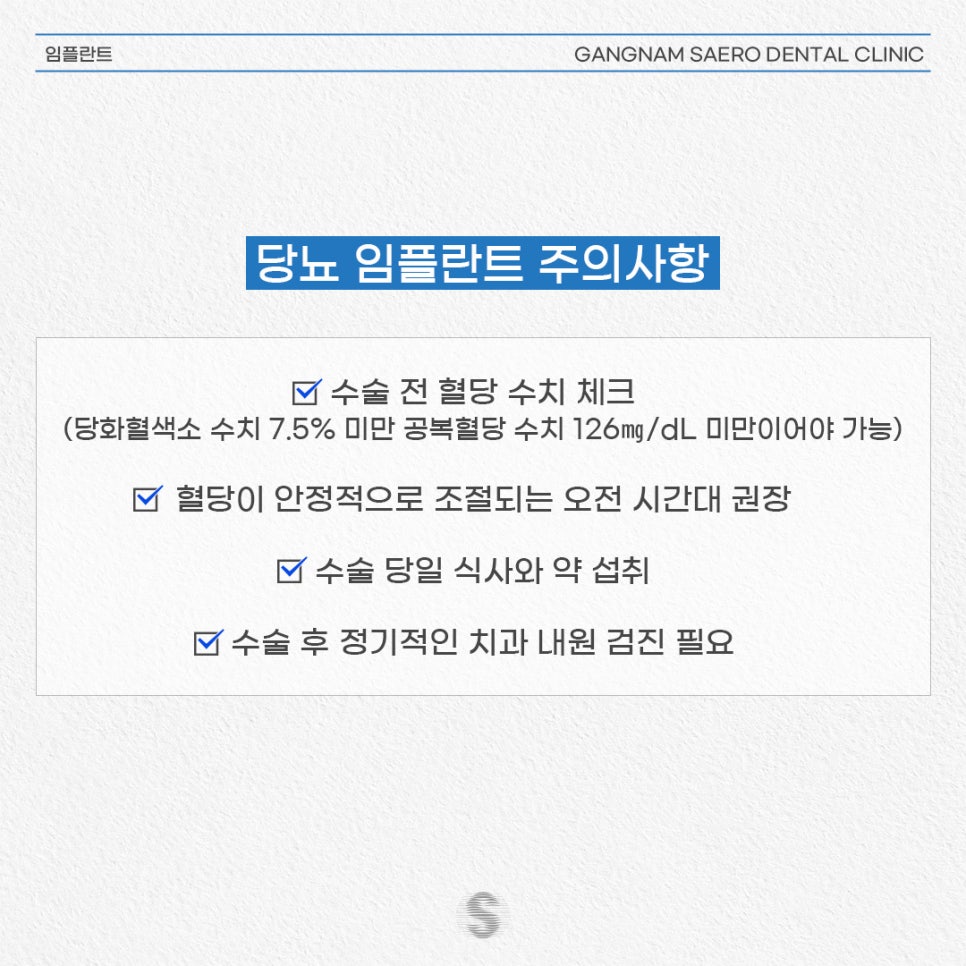
First, blood sugar control must be checked,
and glycated hemoglobin and fasting blood glucose levels
should be reviewed to see whether they are within a stable range.
Generally,
a glycated hemoglobin level below 7.5%
and a fasting blood glucose level below 126 mg/dL
are used as reference values.
In addition, it is more advantageous to perform surgery
in the morning, when blood sugar fluctuations are relatively smaller,
and on the day of surgery, it is necessary to plan according to the individual condition
so that meals and medication are not stopped unnecessarily.
Above all, the most important thing is
regular follow-up after surgery.
In patients with diabetes, even small inflammations
can last longer and become more severe,
so thorough aftercare
is necessary to increase the stability of diabetes implants, PRF implants.
Choosing a hospital for autologous blood implants
Implants for patients with diabetes
are not simply dental treatment.
They are a precise treatment that must also take overall health status into account.
So when choosing a hospital,
you should not look only at cost or accessibility,
but must check these three things:
whether there is extensive experience with implants for patients with diabetes,
whether precision diagnostic equipment is available,
and whether the pre- and postoperative care system is systematic.
Gangnam Saero Dental Clinic
provides a more stable treatment environment
based on clinical experience and a treatment system for full-mouth implants,
as well as implants for patients with diabetes, hypertension, and osteoporosis.
All it takes is slightly more detailed preparation
and slightly more careful management,
and patients with diabetes can also receive implant treatment 충분히 through
diabetes implants, PRF implants.
Rather than giving up because of health,
it is more important to approach treatment in a way that considers health.
That is the more important standard.
Diabetes is certainly not a disease to take lightly.
But that does not mean
you must give up implants entirely.
What matters is
understanding your body condition accurately,
choosing the treatment method that fits it,
and approaching it more carefully and systematically.
Oral health is
eventually connected to quality of life,
so for the sake of chewing comfortably, smiling naturally,
and spending daily life without discomfort,
I hope you start making the preparations you need now!
A choice for a new smile
and a healthy daily life,
begins with an accurate diagnosis.
- This post is an article provided by a medical institution due to a contractual relationship with a third party.