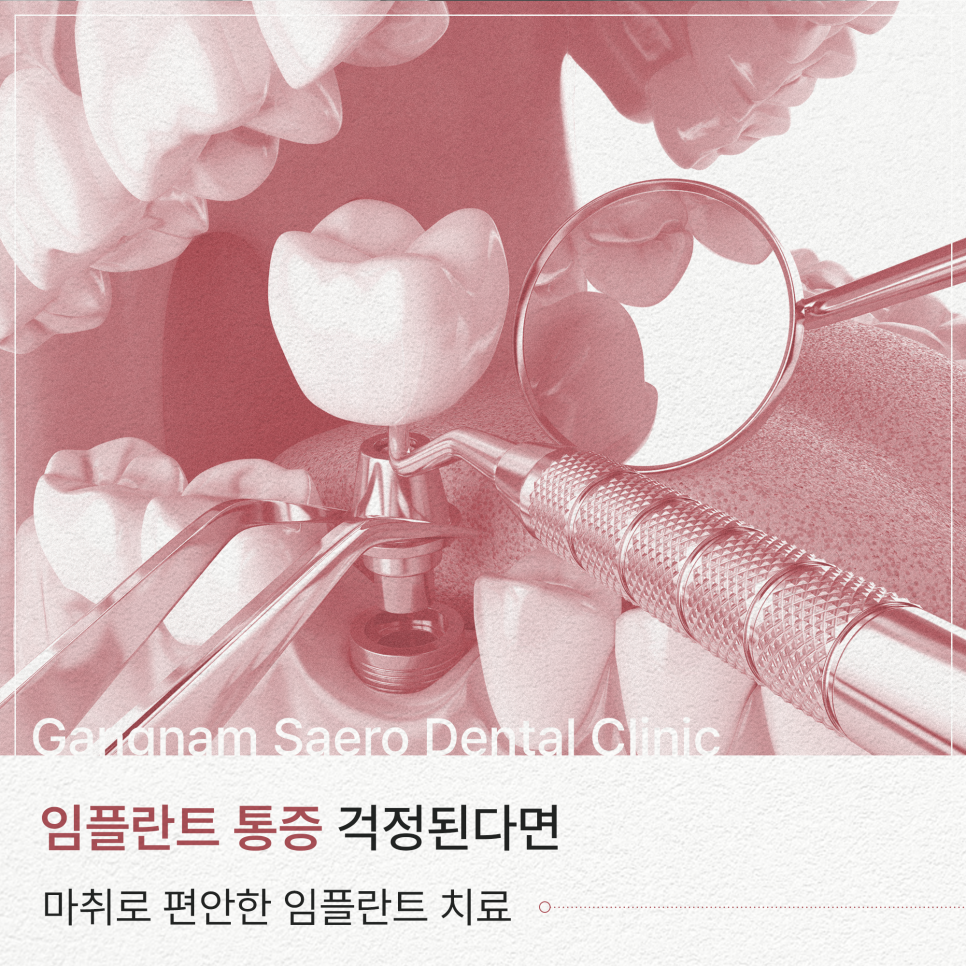
If you're worried about implant pain
Comfortable implant treatment with anesthesia
Implant pain
When you hear that you need an implant,
the first concern that usually comes to mind is not the cost,
but the worry, ‘Will it hurt?’
Just hearing that it involves making an incision in the gums
and placing an artificial tooth root can feel burdensome,
and many people also worry in advance
about pain and swelling after surgery.
That is why many people delay treatment
for a while even after losing a tooth,
but recently, with advances in precise diagnostic equipment,
minimally invasive surgical methods,
and a variety of anesthesia systems,
it has become possible to receive implant treatment
in a much more comfortable environment than before!
In other words, an implant is not necessarily a surgery
that is always painful and difficult;
depending on how it is diagnosed,
which surgical method is used,
and which anesthesia method is applied,
the burden felt by the patient can vary greatly.
Today, we will take a closer look at why implant pain occurs,
what methods can reduce the burden of pain,
and what should be checked for a more comfortable treatment!!!
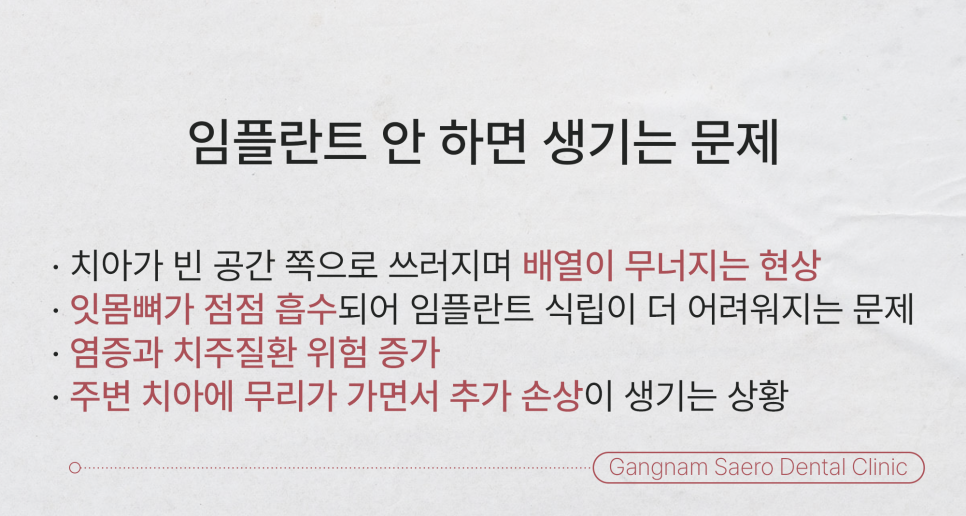
Problems that can occur if you do not get an implant
An implant is not simply a treatment to fill an empty space.
If a missing tooth is left untreated for a long time,
not only the surrounding teeth and gums,
but also the jawbone can be affected in a chain reaction,
so it can be said to be an important treatment
for restoring function and structure.
If a tooth is left missing for a long time,
the following problems can occur.
Teeth tilt toward the empty space, causing the dental alignment to collapse
The jawbone is gradually resorbed, making implant placement more difficult
Increased risk of inflammation and periodontal disease
Additional damage caused by strain on neighboring teeth
Eventually, because of a vague fear of implant pain,
if treatment is delayed,
the condition of the jawbone worsens over time
and the surgical area may become larger.
A treatment that could have ended simply at first
may later require bone grafting or additional surgery,
so it is important to receive treatment at the proper time.
Why does implant pain occur?
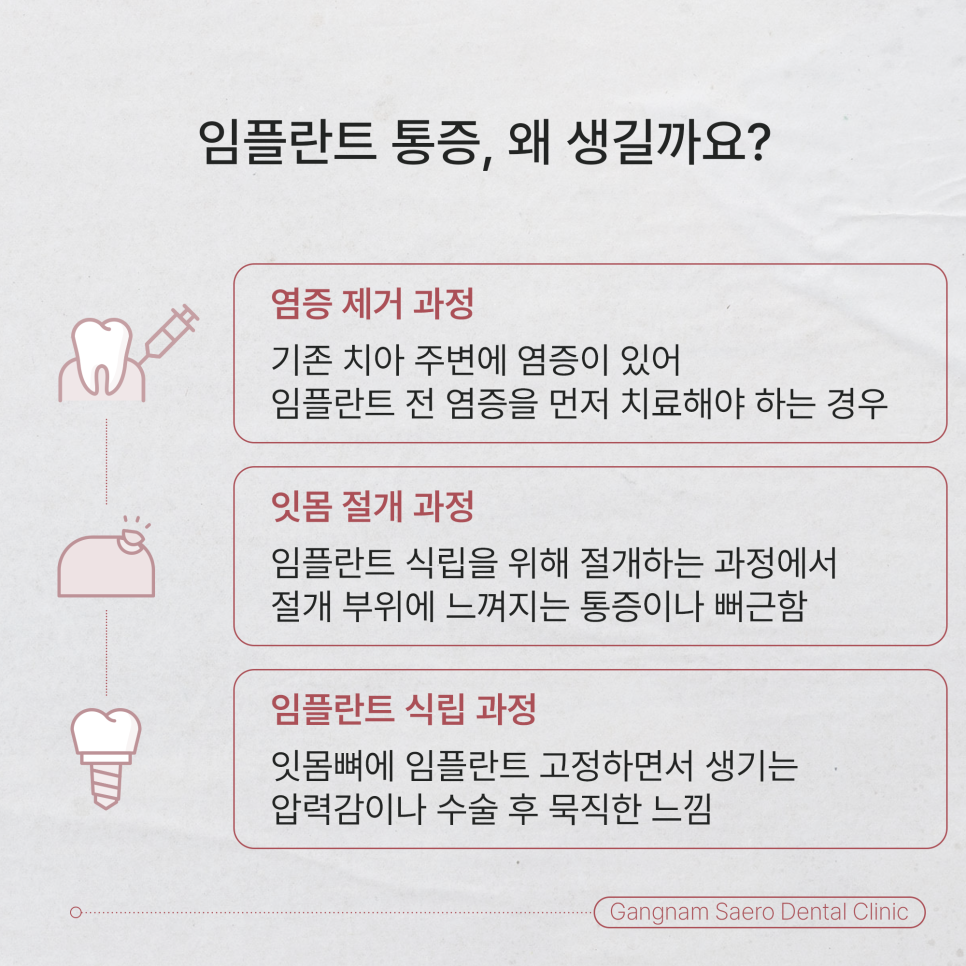
The implant pain felt after surgery
can occur mainly during several stages.
Inflammation removal process
If there is inflammation around the existing tooth
or if the tissue condition after extraction is not good,
the inflammation must be addressed first before proceeding with the implant.
Discomfort may occur during this process.
Gum incision process
When the gums are incised to place the implant,
pain or soreness may be felt at the incision site.
The wider the incision area,
the greater the recovery burden may be.
Implant placement process
During the process of securing the implant in the jawbone,
a feeling of pressure or a heavy sensation after surgery may occur.
Depending on the individual,
this may be felt as significant implant pain.
However, the important point is that
these processes do not necessarily lead to severe pain.
Depending on the surgical method, anesthesia method,
and the skill of the medical team,
the burden felt by the patient can vary greatly.
Recently, treatments have increasingly focused on minimizing implant pain
by reducing incisions and applying anesthesia more precisely.
Implant methods that reduce pain burden
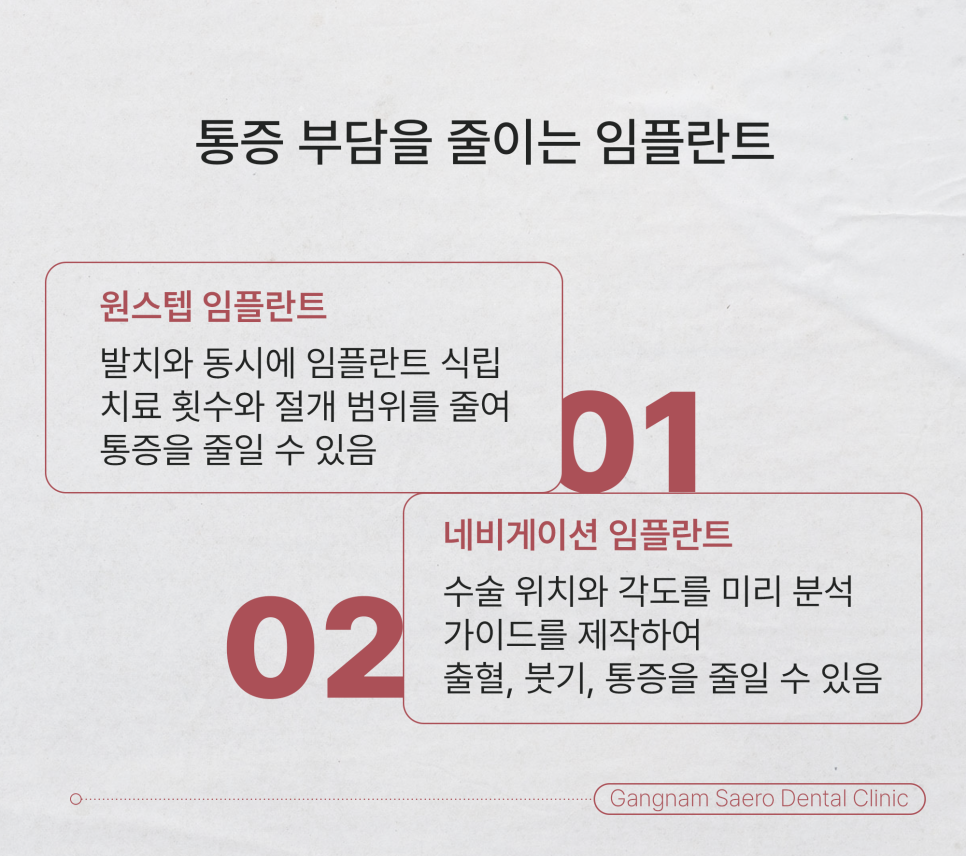
To reduce the burden of implant surgery,
it is important not just to endure it,
but to choose a treatment method
that considers pain and recovery from the beginning.
One-step implant
This is a method in which the implant is placed at the same time as extraction,
and in some cases, a temporary prosthesis is connected as well.
It can reduce the number of treatment visits and the incision area,
so the burden of coming to the clinic is lower,
and the recovery process may also be relatively simpler.
When appropriate conditions are met,
it can help reduce implant pain and recovery burden.
Navigation implant
Based on 3D CT data,
the surgical position and angle are analyzed in advance,
and then a precise guide is made for placement.
Because it minimizes incisions
and in some cases can be performed almost without incisions,
it is advantageous for reducing bleeding, swelling,
and post-surgical discomfort.
It may be suitable for those who want
more precise and stable treatment.
As such, recent implant surgery
is not focused only on placing a tooth,
but also considers how comfortably and precisely the surgery can be performed.
An anesthesia system for comfortable implants
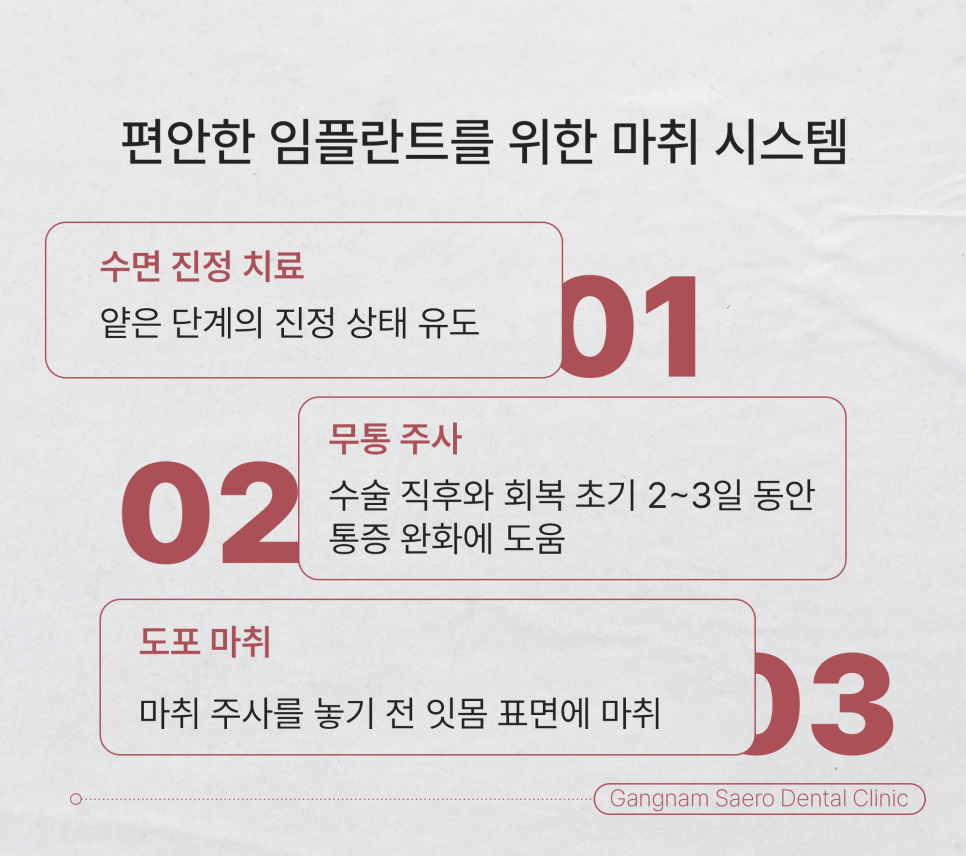
One of the most important factors in reducing implant pain
is anesthesia.
Even for the same treatment,
depending on how anesthesia is applied,
the patient’s sense of fear and the degree of pain
can vary greatly.
Sedation treatment
This method induces a light state of sedation
to reduce tension and fear.
For those with a strong fear of dental treatment
or those who are highly tense,
it can help them undergo surgery more comfortably.
Painless injection
This is a method applied to help ease pain
not only immediately after surgery,
but also during the first 2–3 days of recovery.
It can be considered a pain management method
that also takes into account the burden after surgery.
Topical anesthesia
Before the anesthetic injection is given,
the gum surface is first numbed
so that even the slight sting of the injection itself
is reduced.
It can be especially helpful
for those who are very afraid of needles.
Ultimately, the key to anesthesia implant treatment
is not simply administering anesthesia,
but applying it more carefully while considering the patient’s fear
and sensitivity to pain.
So when considering implant treatment,
it is a good idea to check not only the surgical method
but also what anesthesia system is in place.
A private treatment environment that considers recovery after surgery
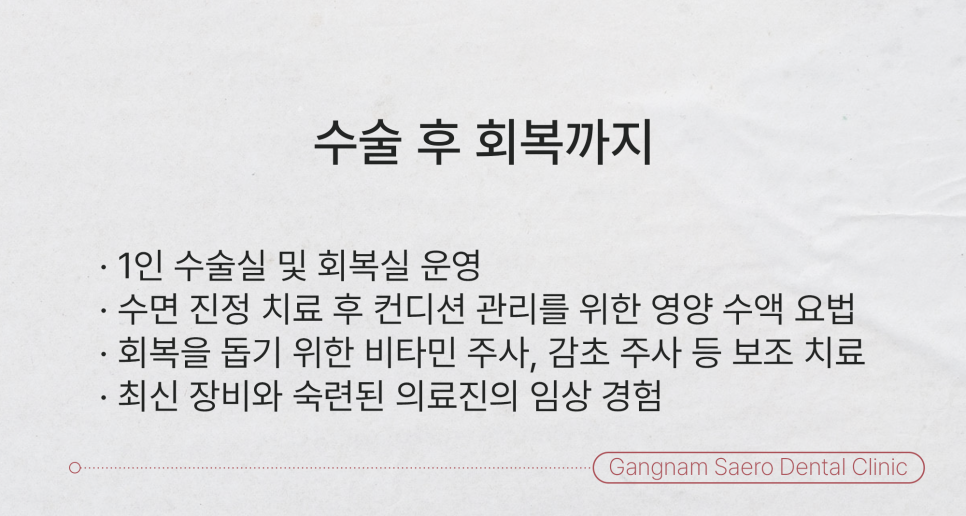
For implants, the surgery itself is important,
but how comfortably you can recover afterward
is also very important.
Especially for those who feel a lot of tension about dental treatment,
it is necessary to see whether the treatment environment itself
is stable and comfortable.
Gangnam Saero Dental Clinic
operates a treatment system that considers
not only the surgical technique but also the patient’s recovery process.
Operating one-person surgery rooms and recovery rooms
Nutritional IV therapy to manage condition after sedation treatment
Supportive treatments such as vitamin injections and licorice injections to aid recovery
Advanced equipment and the clinical experience of skilled medical staff
This system does not simply end with treatment,
but can be seen as part of integrated care
that also considers implant pain management, comfort during recovery,
and overall stability.
If you want implant surgery to be done comfortably
Before getting an implant,
the biggest concerns are, of course, pain and fear, right?
But in reality, it is not a treatment you simply have to endure;
today’s post explained in detail that the experience can vary greatly
depending on how it is done
and which medical team you work with.
When accurate diagnosis, precise surgical methods,
careful anesthesia application,
and a system that also considers recovery come together,
only then is a more comfortable implant treatment possible.
So if you are worried about implant pain,
instead of delaying it vaguely,
it is important to first have a thorough consultation
with a medical team experienced in pain management.
An implant treatment with a different kind of anesthesia,
comfortable and safe implant surgery,
less fear and more comfortable recovery.
A new departure, a new start, a new smile
This is Gangnam Saero Dental Clinic.
- This post was provided by a medical institution due to a third-party contractual relationship and contains medical information.