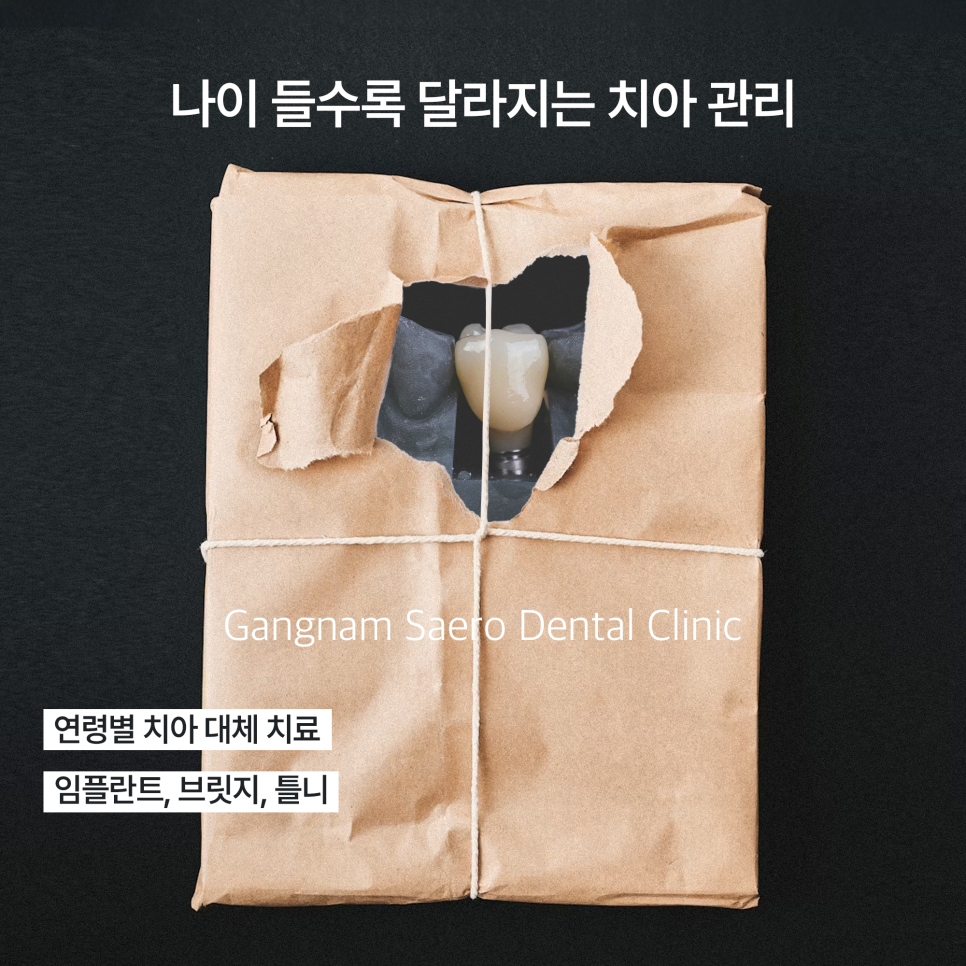
Dental care changes as you age
Tooth replacement treatment by age group
Implants, bridges, dentures
Even if your appearance stays much younger than before,
aging still appears little by little throughout the body.
Among these changes, the condition of the teeth and gums
has a particularly large impact on daily life.
This is not just a matter of appearance,
because it is deeply connected to chewing,
speech,
and overall health as well.
In particular, gum aging can lead to tooth loss,
and if tooth loss is left unaddressed for a long time,
it can cause not only inconvenience in eating
but also a decline in quality of life.
That is why it is important to know in advance
what kind of care is needed at each age,
and what treatment options can be considered
when teeth are lost.
Today, along with age-based tooth care methods,
we will organize implant surgery, bridges, and dentures
as replacement treatments for lost teeth by age group!
The beginning of tooth aging
Aging of the teeth and gums
does not begin all of a sudden one day,
but progresses gradually as it accumulates over time.
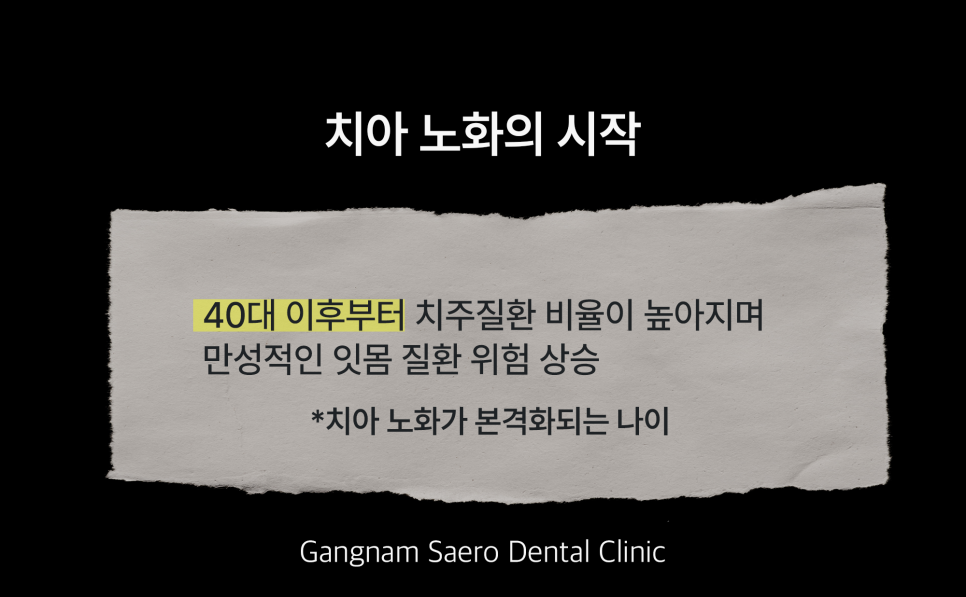
Statistically, from the 40s onward,
the proportion of people experiencing periodontal disease
starts to rise noticeably,
and from this point on,
the risk of chronic gum disease also increases.
In particular, after the 40s,
the gums gradually recede,
and the surrounding tissues that support the teeth can also weaken,
so more careful care than usual is needed.
Even if there is no major discomfort on the outside,
inside the mouth,
plaque, tartar, gum inflammation, and tooth wear may
be progressing slowly.
That is why, before tooth aging fully begins,
it is important to build habits centered on regular checkups
and prevention-focused care.
Dental care in your 40s is prevention
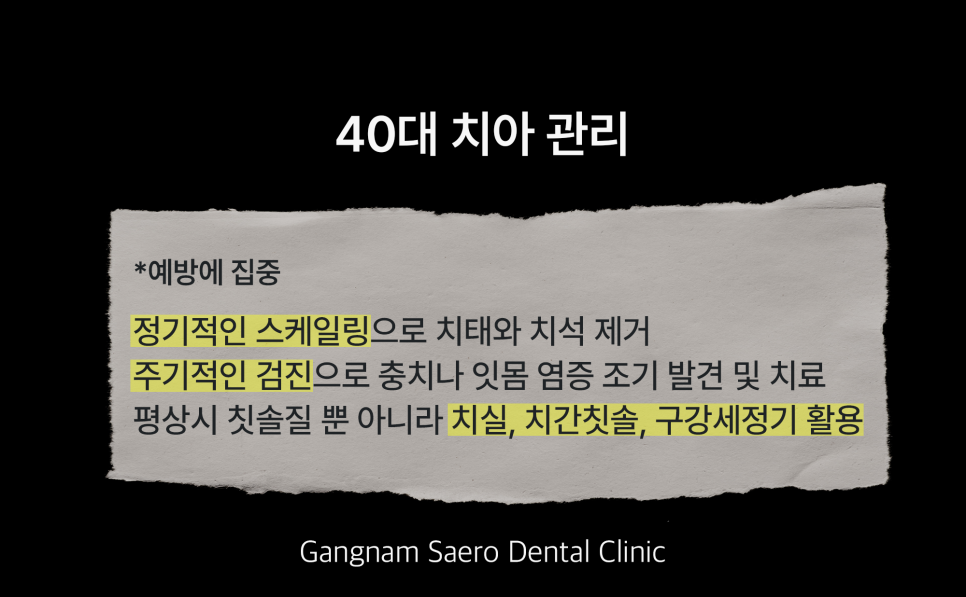
Your 40s are
not yet an age group where tooth loss is common,
but they can be seen as an important period
that determines future oral health.
At this stage, the key is to focus more on prevention
than on treatment.
It is important to remove plaque and tartar through regular scaling,
detect cavities and gum inflammation early,
and manage them so they do not lead to extraction.
Also, since brushing alone may not be enough,
it is necessary to build the habit of using floss,
interdental brushes, oral irrigators, and similar tools together
to carefully care for the spaces between teeth
and around the gums.
In other words, dental care in your 40s should
focus on keeping your natural teeth for as long as possible
so that replacement treatments such as implant surgery or dentures
will not be needed later.
The better the care starting at this stage,
the lower the treatment burden may be in later age groups!
Dental care in your 50s and 60s is single-tooth treatment
In your 50s and 60s,
gum recession and bone loss in the jaw
can become more pronounced.
At this stage,
the priority is to preserve natural teeth as much as possible,
but if there are already missing teeth
or extraction is unavoidable,
replacement treatment should also be considered.
The representative treatment options are as follows.
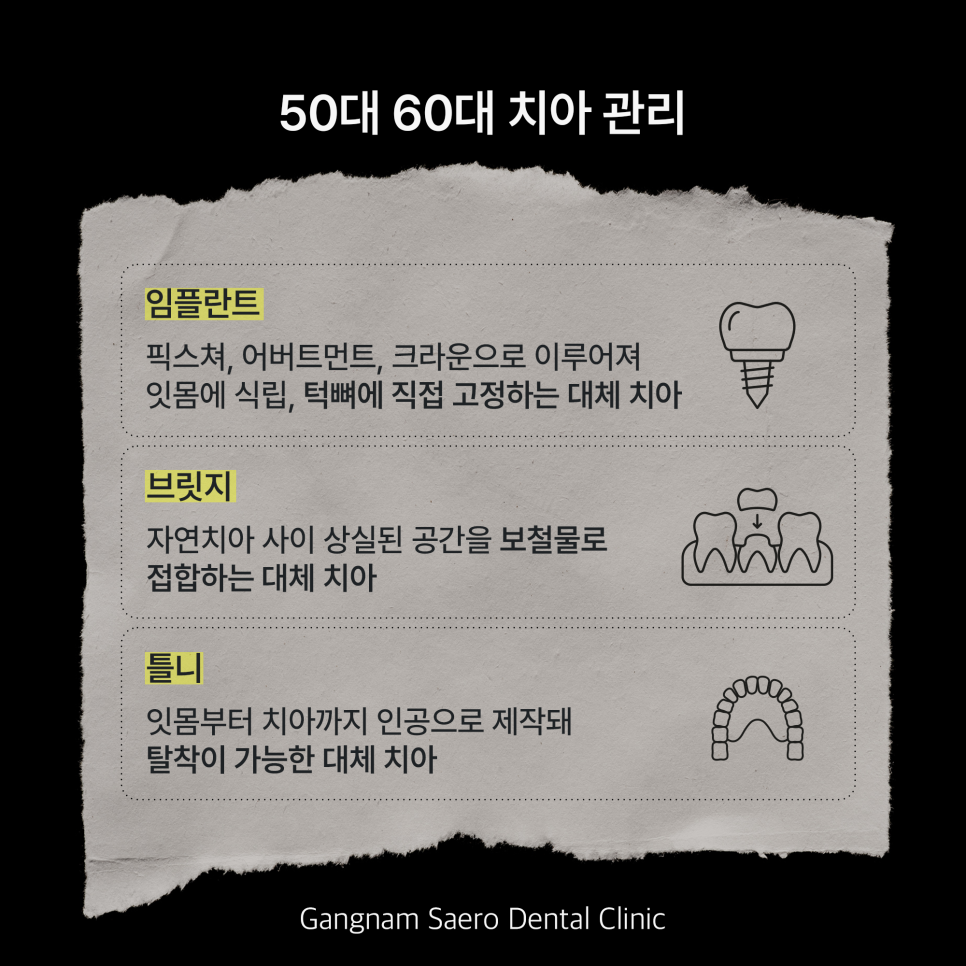
Implant surgery
An implant consists of a fixture, abutment, and crown,
and it is a treatment that is fixed directly into the jawbone
so that function similar to a natural tooth can be expected.
Because the chewing force is relatively stable
and the surrounding teeth are not significantly damaged,
many people consider this option.
Bridge
This is a method that connects a prosthetic tooth
using the teeth on both sides of the missing tooth.
It can be an alternative when implants are difficult,
but the fact that the adjacent teeth must be trimmed
also needs to be considered.
Dentures
This is a method of replacing the gums and teeth
with artificial prosthetics,
and it can be removed and reinserted.
It can be considered when the extent of tooth loss is wide
or when implants are difficult.
At this stage,
it is important to choose a customized treatment method
by comprehensively considering the condition of the natural teeth,
the health of the jawbone, the presence of systemic disease,
and cost burden.
Dental care in your 70s is about restoring function
In your 70s and beyond,
the number of missing teeth often increases,
and there are many cases where simple care alone is not enough.
So at this stage,
it is important to actively review how to restore missing teeth
in a stable way while also protecting the remaining teeth.
The following methods can be considered.
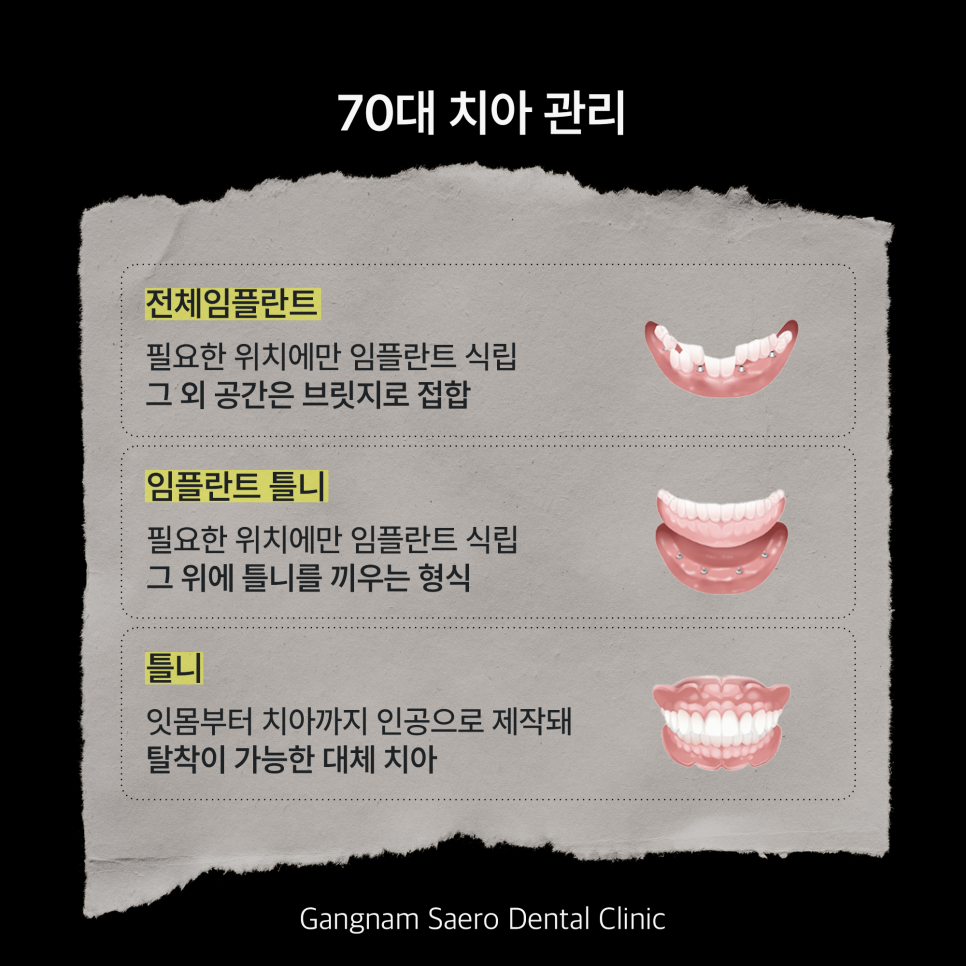
Full-mouth implants
This is a method of restoring full dental function
by placing implants in the necessary positions.
Because it offers excellent stability and, in terms of chewing function,
is the closest to natural teeth,
a more stable sense of use can be expected.
Implant-supported dentures
After implant fixtures are placed,
removable dentures are attached on top of them.
This is used as a way to improve stability compared with traditional dentures
while reducing the burden compared with full-mouth implants.
Dentures
This is a removable method in which the gums and teeth are artificially made.
It is a treatment that can be chosen when implant surgery is difficult
because of jawbone condition or general health.
If the jawbone and overall condition allow it,
full-mouth implants can be a more stable alternative,
but the same method is not applied to every patient.
Therefore, after the age of 70,
it is more important than anything else to establish a realistic treatment plan
that fits the current oral condition.
Systemic health connected to dental care
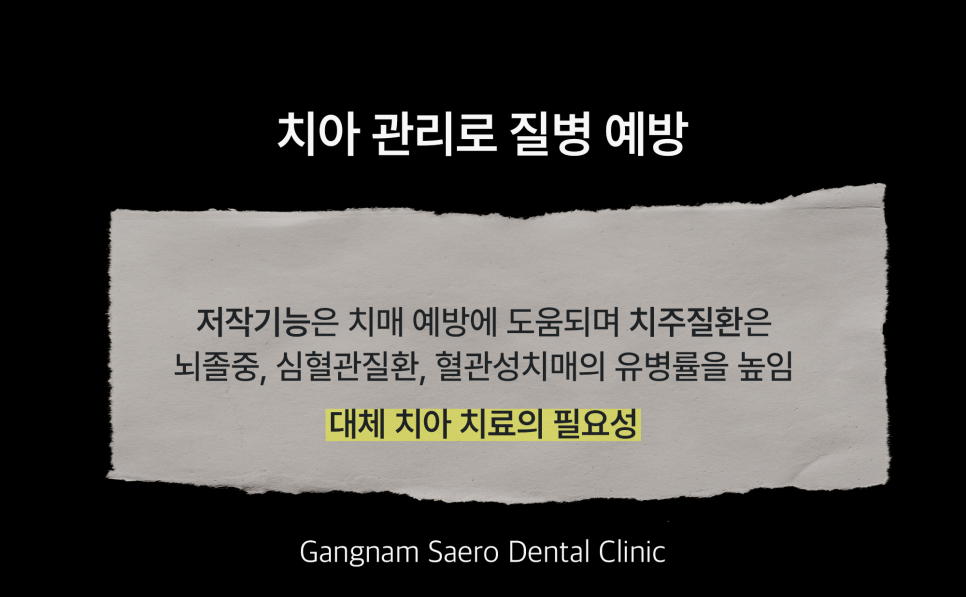
Dental health is not just a matter of being able to chew well.
Because oral health is closely connected to overall health,
tooth loss or gum disease should not be taken lightly.
When chewing function is smooth,
it not only helps you chew food well,
but is also known to help continuously stimulate the brain,
which is related to maintaining cognitive function.
Also, if periodontal disease continues,
the inflammatory response can affect the whole body,
and it may be associated with an increased risk of diseases such as cardiovascular disease and stroke.
That is why, rather than leaving missing teeth untreated for a long time,
it is important to restore function through replacement treatments such as implant surgery, bridges, and dentures when needed.
Dental treatment is not just about solving a dental problem;
it is also part of the care that protects daily life and overall health.
Key summary of dental care by age group
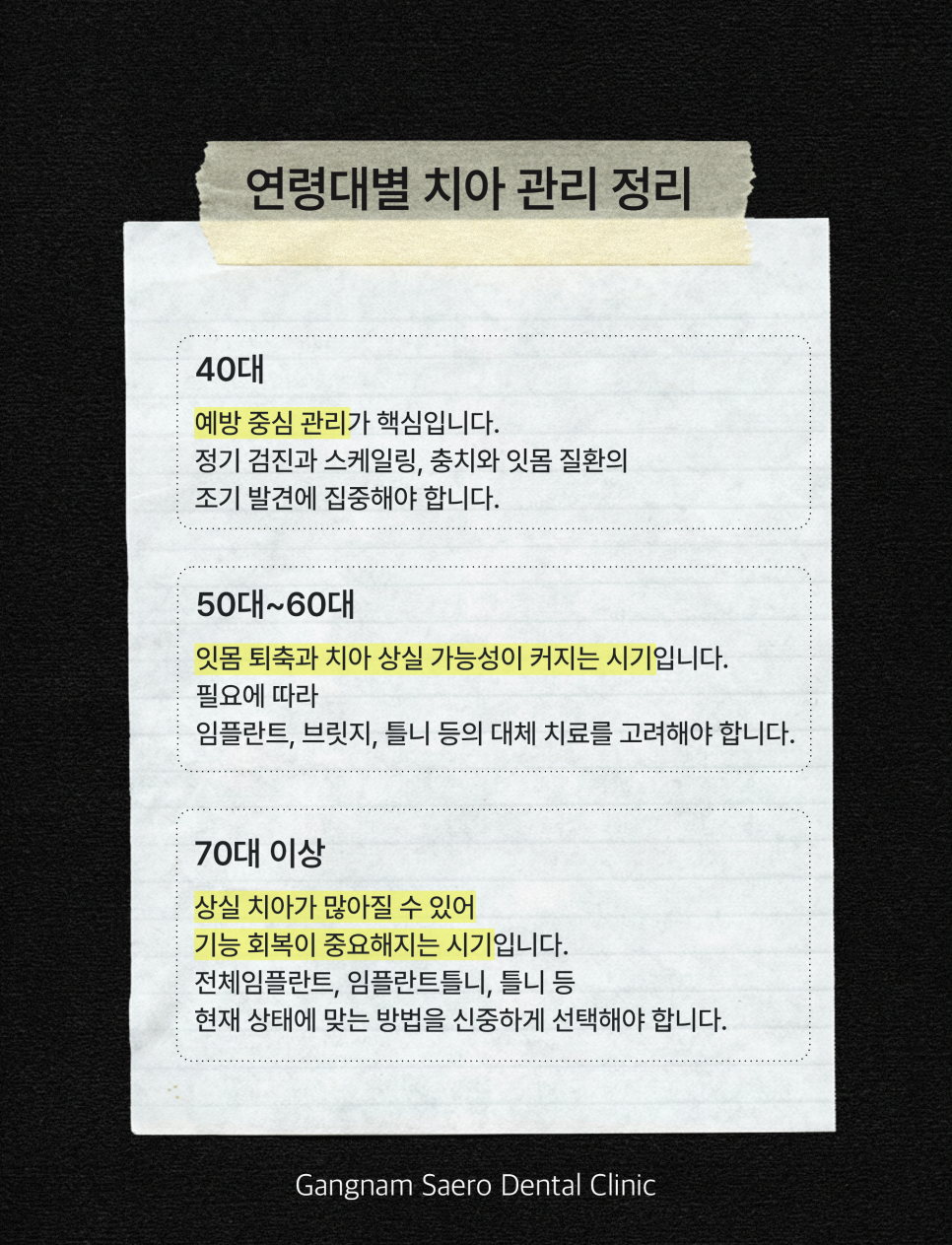
As age changes, the priorities of dental care also change.
40s
Prevention-focused care is key.
You should focus on regular checkups and scaling,
as well as early detection of cavities and gum disease.
50s to 60s
This is the period when gum recession and the possibility of tooth loss increase.
Depending on the need,
replacement treatments such as implant surgery, bridges, and dentures should be considered.
70s and older
This is the time when the number of missing teeth can increase,
making functional restoration more important.
Full-mouth implants, implant-supported dentures, dentures, and other options
should be carefully selected to fit the current condition.
Health insurance coverage for implants for people aged 65 and older
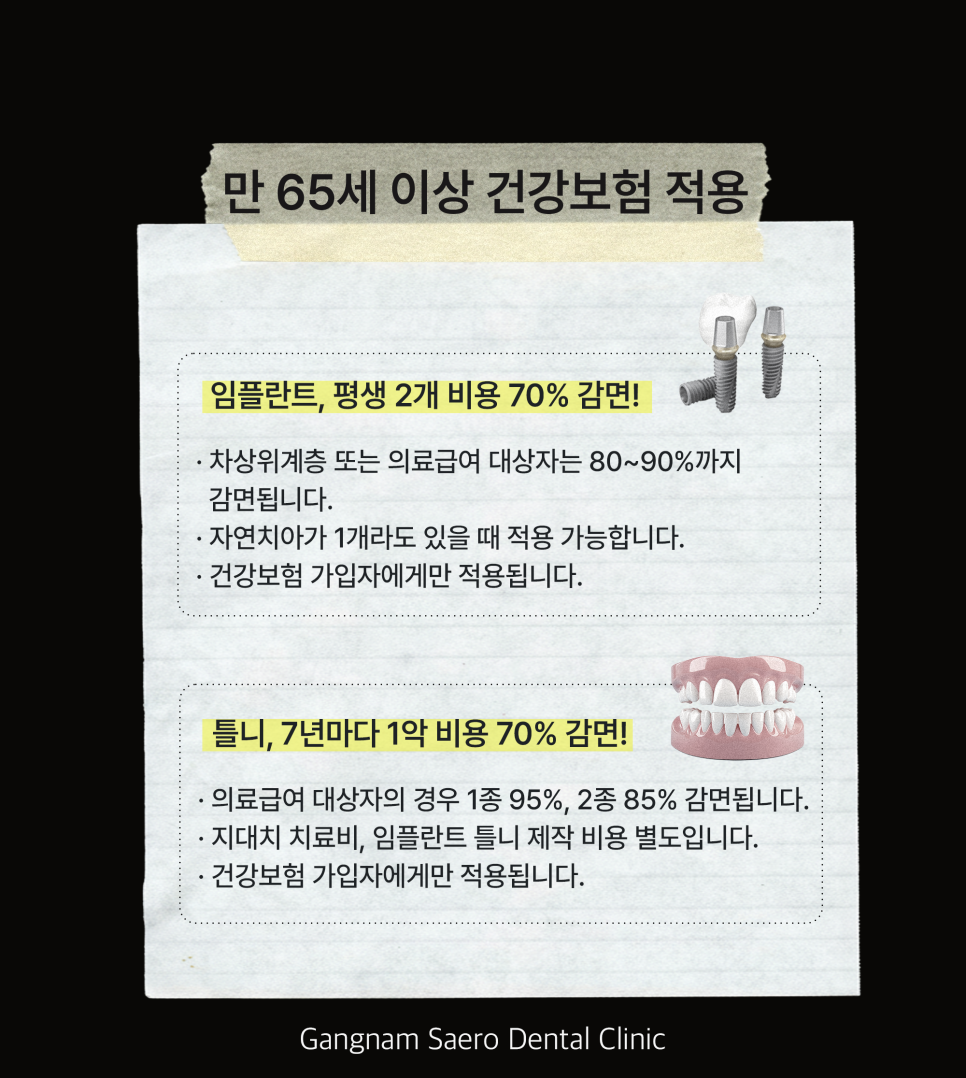
Even when people know tooth loss treatment is necessary,
they often delay it because of cost concerns.
However, if you are 65 or older,
there are cases where health insurance coverage applies
to implants and dentures,
so it is a good idea to check this when planning treatment.
If tooth loss is left untreated for a long time,
chewing function declines,
and it can negatively affect not only oral health
but also overall health.
So rather than delaying because of cost concerns,
it is important to first get counseling on the currently available treatment options,
including whether insurance coverage applies.
Specialized implant treatment, Gangnam Saero Dental Clinic
Gangnam Saero Dental Clinic
provides treatment tailored to each patient’s condition
based on extensive experience with implant surgery.
They treat various cases such as
full-mouth implants,
implant-supported dentures,
and implant reoperation,
and establish treatment plans by comprehensively considering
the patient’s age and oral condition,
jawbone conditions,
and overall health.
It is also conveniently located just a 5-minute walk from the subway station,
making access easy,
and counseling related to health insurance coverage for implants for those aged 65 and older is also available.
In your 40s,
care to preserve natural teeth for as long as possible is important.
In your 50s and 60s,
appropriate replacement treatment for missing teeth should be considered.
After your 70s,
treatment that looks at functional restoration and comfortable use
at the same time is needed.
Please check the optimal treatment method for your age and condition
at Gangnam Saero Dental Clinic.
A new beginning, a new smile
- This post is an article provided by a medical institution due to a third-party contractual relationship.