Comfortable scaling with gargle anesthesia
Painless scaling
How to prevent periodontal disease
Scaling is
a representative dental treatment that is essential
for protecting the health of your teeth and gums, right?
However, many people put off treatment because of stories about
scaling sensitivity, scaling pain, and teeth feeling spaced after scaling.
When this is combined with a vague fear of the dentist,
it is not easy to come in for treatment, even when it is truly necessary.
In fact, scaling is a relatively simple procedure,
but its effect on oral health is very significant.
Recently, there is also a painless scaling method
that reduces pain and discomfort,
making it possible to receive treatment more comfortably.
Even people who are afraid of dental treatment can start with much less burden.
Today, we will take a detailed look at why scaling is necessary,
how the procedure is performed,
and for whom painless scaling can be helpful.
Reasons why scaling is necessary
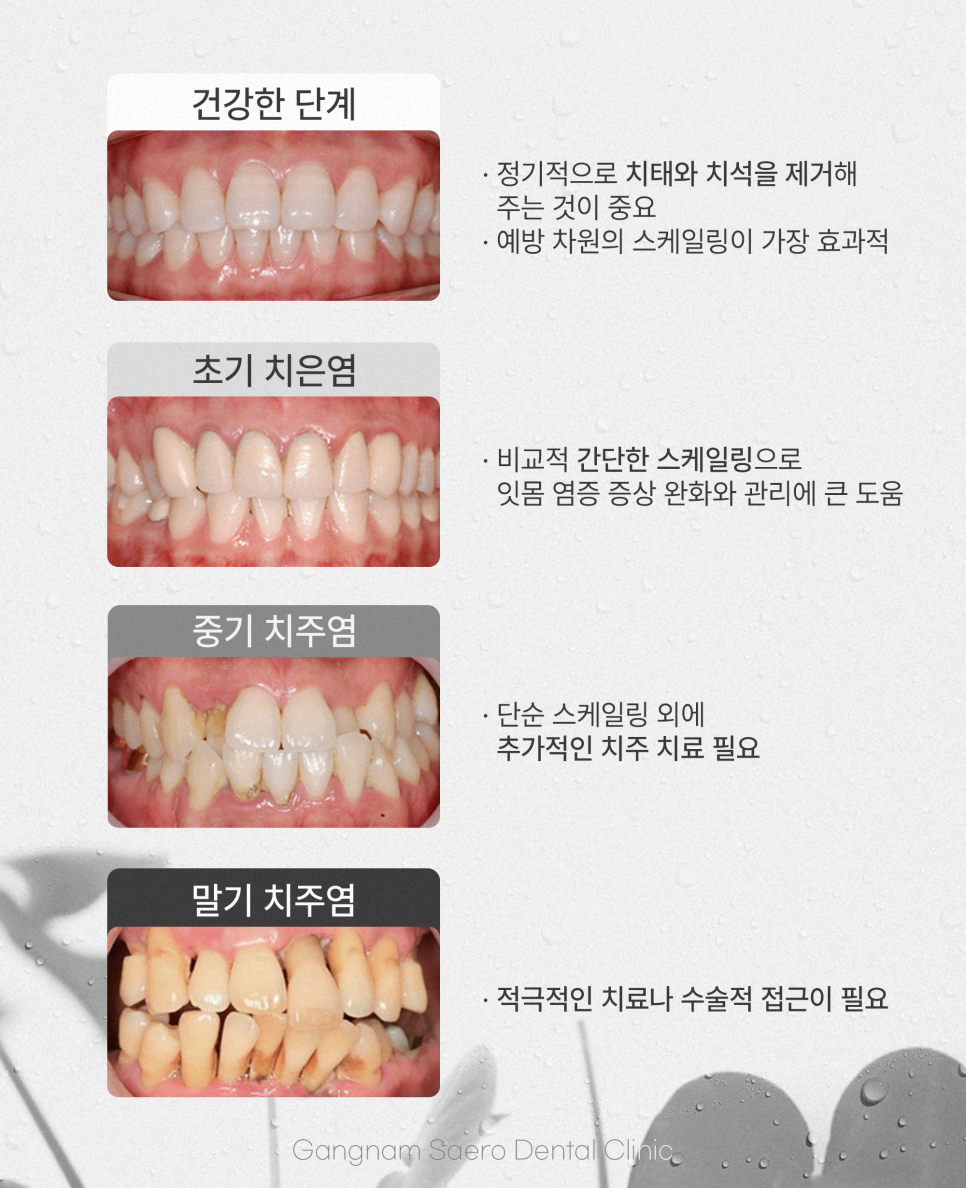
The need for scaling becomes easier to understand
by looking at the stages of gum disease progression.
Healthy stage
Healthy gums are bright pink and elastic,
and there is almost no bleeding when brushing.
To maintain this condition for a long time,
it is important to regularly remove plaque and tartar.
This is also the most effective time for preventive scaling.
Early gingivitis
If your gums start to swell or bleed when brushing,
it may be a sign that inflammation has begun in the gums.
At this stage,
even relatively simple scaling
can greatly help relieve symptoms and manage the condition.
Moderate periodontitis
As plaque and tartar build up over a long period of time,
inflammation becomes more severe,
the gums weaken,
and you may feel that your teeth are loose.
At this stage,
additional periodontal treatment may be needed
in addition to simple scaling.
Advanced periodontitis
If the bone supporting the gums is severely damaged,
the force holding the teeth in place weakens,
and eventually you may lose teeth.
At this stage, more active treatment or
surgical intervention is likely to be needed.
In other words, scaling is
not so much a treatment you receive after a problem appears,
but a treatment that matters most when it is done in advance
to prevent oral disease
and keep your teeth healthy for a long time.
The scaling procedure and method
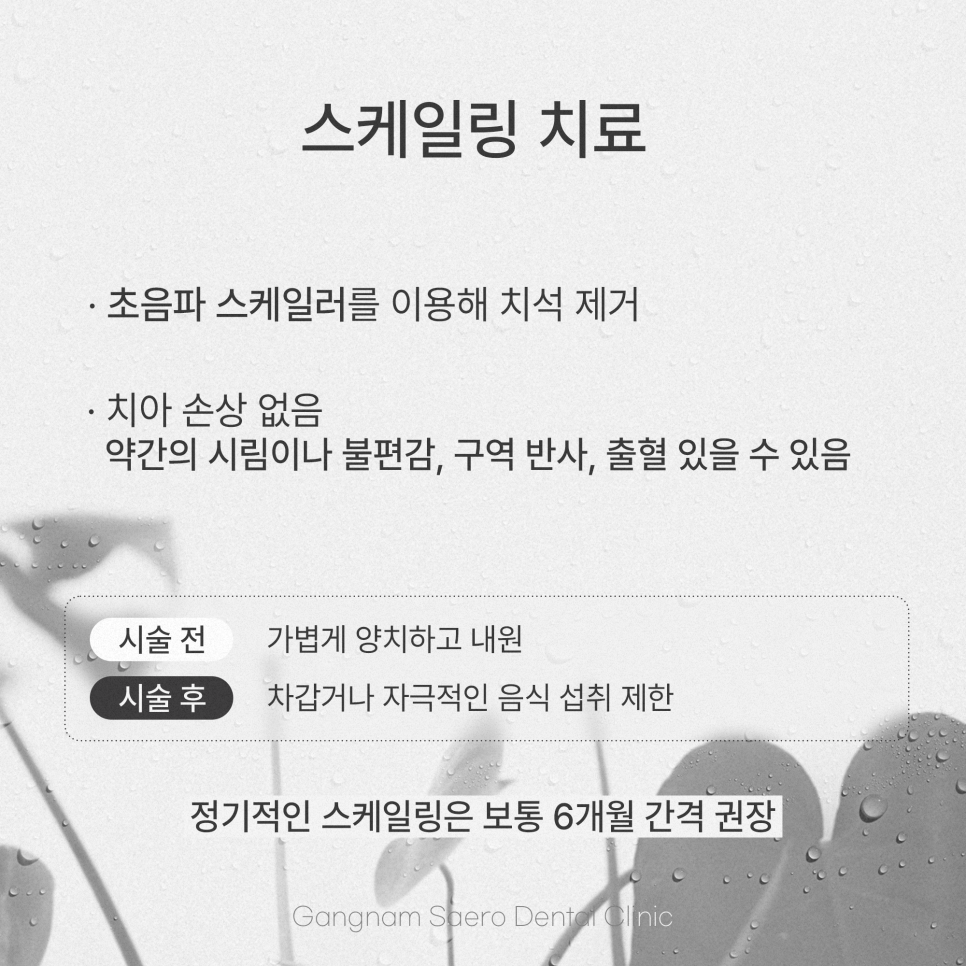
When tartar is mainly accumulated above the gums,
it is generally removed using an ultrasonic scaler.
The instrument may look sharp,
but it is not a tool that grinds down the tooth,
so the tooth itself is not damaged.
Many people worry before scaling
that the pain might be severe.
Depending on the individual, during the procedure
there may be a little sensitivity, discomfort,
or a gag reflex.
However, these are mostly temporary reactions,
and they vary depending on the amount and location of tartar and the condition of the gums.
Some people also experience scaling sensitivity,
because the tooth surface that had been hidden beneath tartar
is exposed and may feel temporarily sensitive.
In many cases, this gradually improves over time,
so there is no need to worry too much.
Some people also worry that scaling will make their teeth feel spaced.
However, scaling does not make teeth separate;
in most cases, the feeling of an open space happens because the tartar
that had been packed between the teeth is removed.
In fact, the longer tartar is left untreated,
the more negatively it can affect gum health.
Before the procedure, it is a good idea to brush lightly and come in,
and after the procedure,
it is helpful to avoid cold foods or foods that are too刺激적인 for about a day.
There may be slight bleeding,
but it is generally a normal response,
and in most cases it subsides within a day or two.
Regular scaling is
usually recommended every 6 months,
but depending on the condition of your gums and the amount of tartar that forms,
more frequent care may be needed,
so it is best to follow the guidance of the medical staff.
Painless scaling for added comfort
For people who are very afraid of dental treatment
or are sensitive to pain,
the available option is
painless scaling.
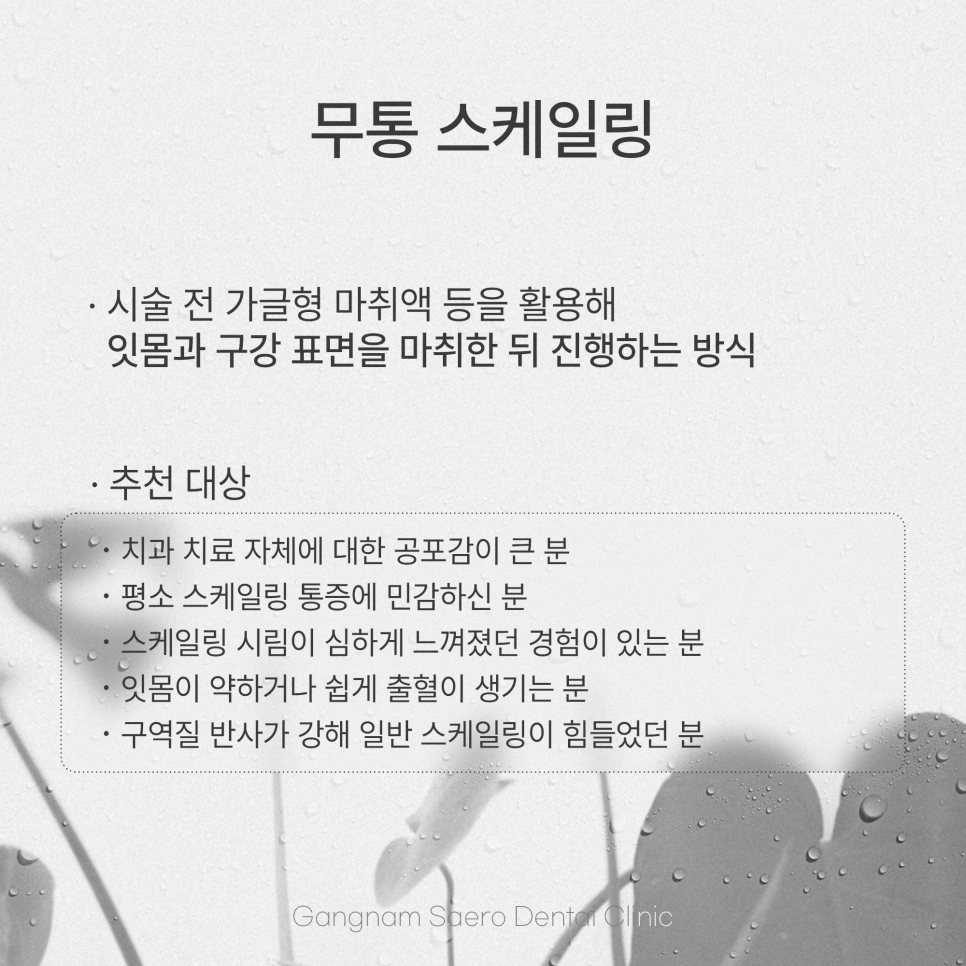
Painless scaling is
a method in which the gums and oral surface are anesthetized first
using a gargle-type anesthetic solution before the procedure,
and then the scaling is performed.
Compared with regular scaling,
it can help reduce pain and discomfort.
Because of this, even people who feel a heavy burden about scaling
can receive treatment in a more comfortable state.
In particular, painless scaling may be helpful for the following people.
People who have a strong fear of dental treatment itself
People who are usually sensitive to scaling pain
People who have previously experienced severe scaling sensitivity
People with weak gums or gums that bleed easily
People who have a strong gag reflex and found regular scaling difficult
If you know that scaling is necessary
but have been putting it off because of discomfort,
starting treatment more easily through painless scaling
can be a good option.
If you are looking for a nearby dental clinic for painless scaling
Scaling is
known as a relatively basic dental treatment,
but depending on the patient's level of tension, gum condition,
and sensitivity to pain,
the actual experience can vary greatly.
So if you are considering painless scaling,
it is important to check not only how close the clinic is to your home,
but also the medical staff's expertise and the system in place.
If you are looking for a nearby dental clinic where you can receive
comfortable and quick painless scaling,
you can receive treatment at Gangnam Saero Dental Clinic.
Gangnam Saero Dental Clinic
provides stable care from basic treatments such as scaling
to more precise treatments,
based on the latest equipment and a systematic treatment system!
Even people with dental phobias
or those who had an uncomfortable experience with scaling
are provided with a careful treatment environment
so they can visit more comfortably.
Comfortable, fast, and safe painless scaling
We hope you will start without 부담 at Gangnam Saero Dental Clinic.
- This post is an article presented by a medical institution due to a third-party contractual relationship.