Wisdom Tooth Extraction
Things to Check to Reduce
Pain and Side Effects
Wisdom teeth are the teeth that many people
first think of as a
“guaranteed painful and difficult extraction.”
But in reality, not all wisdom teeth
grow in the same way,
and depending on their position, direction, degree of impaction, and distance from the nerve,
the difficulty of extraction, pain, and recovery process can vary.
In particular, when a wisdom tooth grows in an abnormal direction or
is buried under the gums,
it can cause more than just discomfort;
it may lead to various problems such as
cavities, inflammation, pain, and cysts,
which is why extraction may be recommended.
So wisdom tooth extraction is not simply
“getting it removed because it hurts,”
but rather,
it is important to accurately diagnose the current condition
and proceed safely only when necessary.
Today, we will take a closer look at when wisdom tooth extraction is needed,
what to be careful about,
and what should be checked to reduce
wisdom tooth side effects.
Wisdom Tooth Types
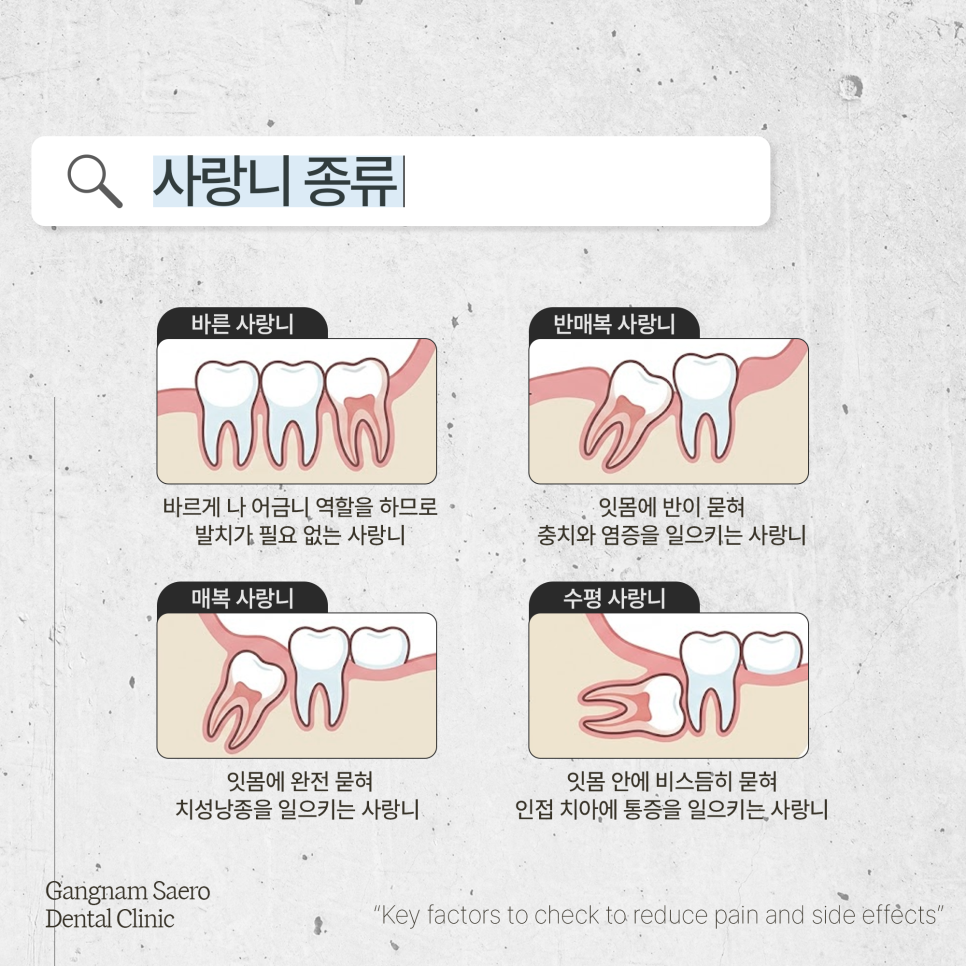
Depending on how they grow,
the treatment approach for wisdom teeth differs.
Not all wisdom teeth must necessarily be removed,
but if there is a high chance of problems or
if symptoms have already appeared,
extraction is considered.
Properly aligned wisdom teeth
If they erupt in a normal direction and can be used functionally,
and do not cause problems for neighboring teeth or gums,
there are cases where extraction is not necessary.
Partially impacted wisdom teeth
These are wisdom teeth that grow with only part of the tooth visible through the gums.
Because a toothbrush cannot easily reach them, food can get trapped easily,
and the likelihood of inflammation and cavities is high,
so wisdom tooth extraction is often recommended.
Fully impacted wisdom teeth
These are wisdom teeth completely buried under the gums,
and even if they are not visible from the outside,
they can still cause problems internally.
In particular, there is also a possibility that they can lead to lesions such as odontogenic cysts,
so regular checkups are necessary.
Horizontal wisdom teeth
These lie at an angle and push against or compress the adjacent tooth.
In such cases, they may cause pain in nearby teeth or
cause damage,
so extraction is often needed.
In other words, except for wisdom teeth that grow properly,
most abnormal wisdom teeth are likely to cause problems over time,
so it is important to check their condition early
and determine the appropriate timing.
Side Effects and Precautions to Know Before Wisdom Tooth Extraction
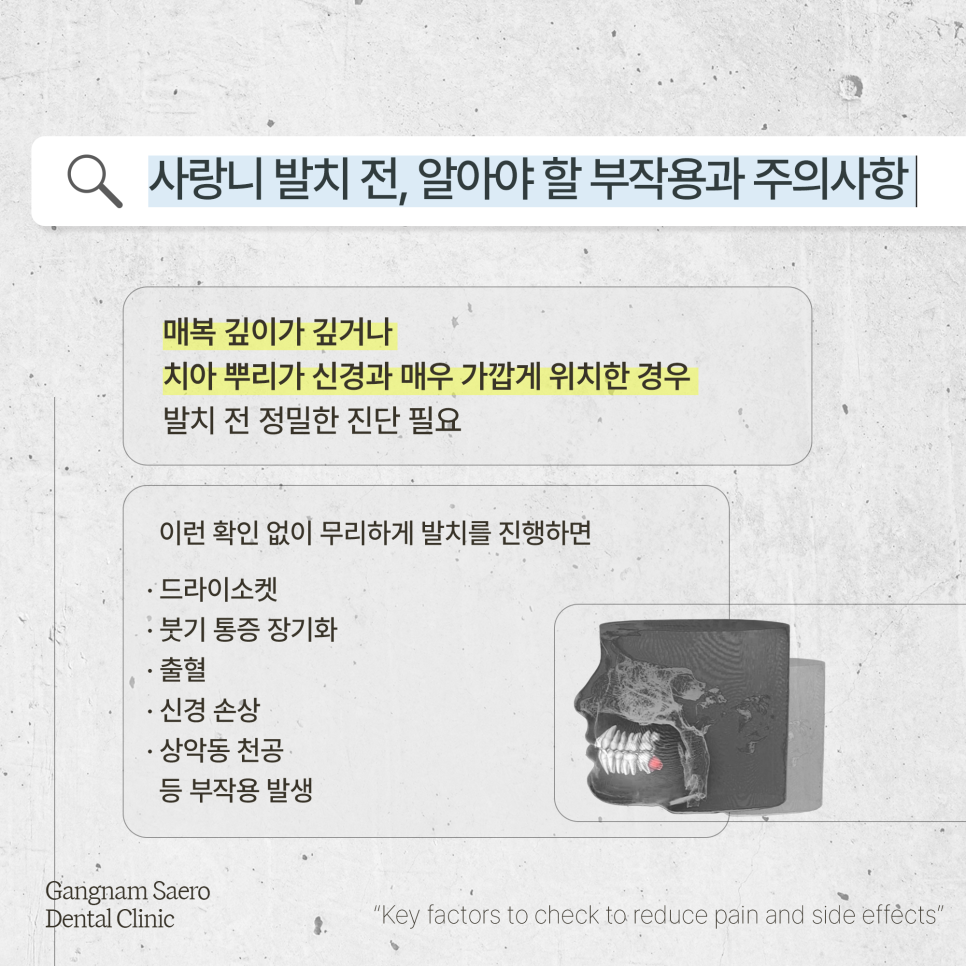
Wisdom tooth extraction is a relatively common procedure,
but not every case is simple.
In particular, when the impaction is deep
or the tooth root is located very close to a nerve,
detailed diagnosis before extraction is essential.
If extraction is forced without such checks,
the following wisdom tooth side effects may occur.
Dry socket
Prolonged swelling and pain
Bleeding
Nerve damage
Maxillary sinus perforation
Of course, these wisdom tooth side effects
do not occur in every patient,
but the more difficult the wisdom tooth is,
the more important preoperative diagnosis and the clinician’s experience become.
That is why, for wisdom tooth extraction,
it is more important than simply finding a nearby dental clinic
to accurately identify the position through precision equipment
and to have an experienced medical professional perform the procedure directly.
In fact, depending on the position or difficulty of the wisdom tooth,
some dental clinics focused on general care do not perform the extraction,
and instead refer the patient to a place where more specialized treatment is available.
Problems That Can Occur If Wisdom Teeth Are Left Untreated
Just because a wisdom tooth does not hurt much
does not mean it can always be left alone.
In particular, impacted wisdom teeth or wisdom teeth that grow at an angle
can create bigger problems over time.
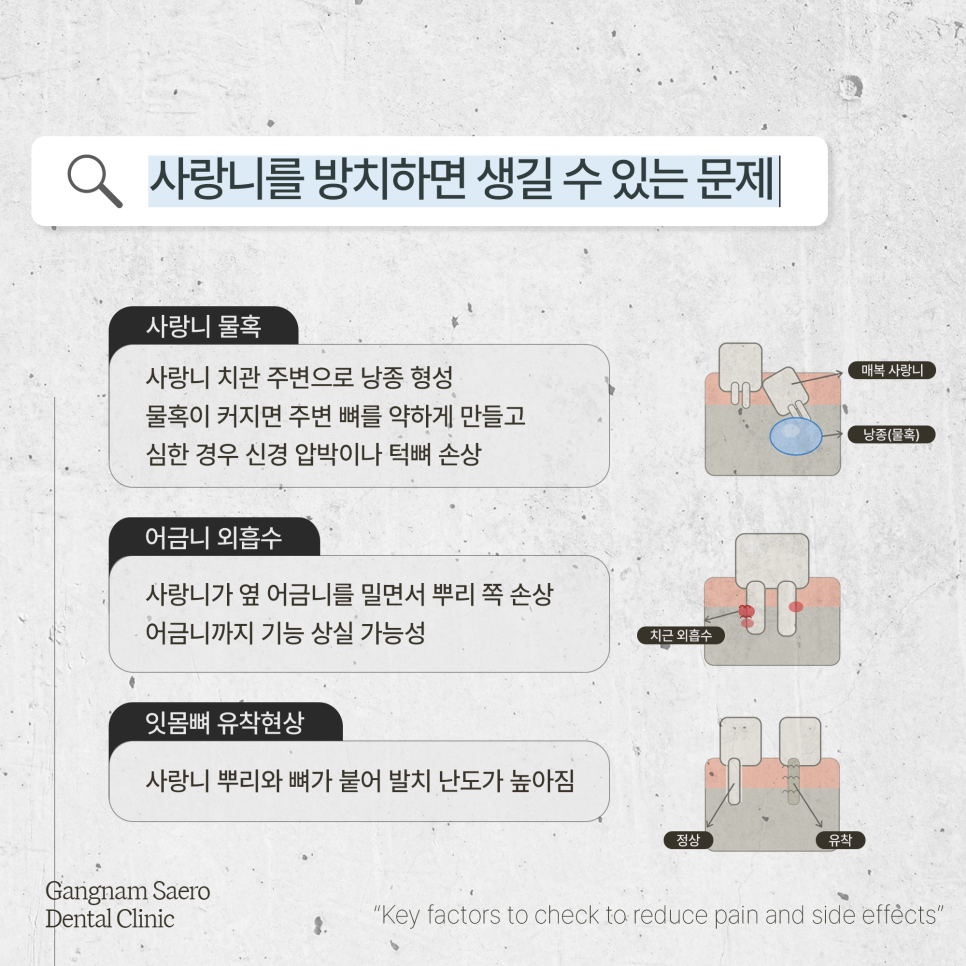
Wisdom tooth cyst
A cyst may form around the crown of the wisdom tooth.
If this cyst gradually grows larger, it can weaken the surrounding bone,
and in severe cases it may even lead to nerve compression or
jawbone damage.
External root resorption of the molar
This occurs when the wisdom tooth pushes the adjacent molar
and damages the root area.
In this case, even the molar that was originally supposed to be used normally
may be affected and become difficult to use.
Ankylosis of the gum bone
As time passes,
if the wisdom tooth root and bone become fused,
the difficulty of extraction later on
can increase.
An extraction that might have ended relatively simply at first
can turn into a much more complicated procedure.
In other words, rather than feeling reassured because there is no pain,
it is important to first check whether the current condition of the wisdom tooth
is likely to cause problems in the long term.
If necessary, performing wisdom tooth extraction at the right time
may actually be the safer choice.
Choosing a Hospital for Safe Wisdom Tooth Extraction
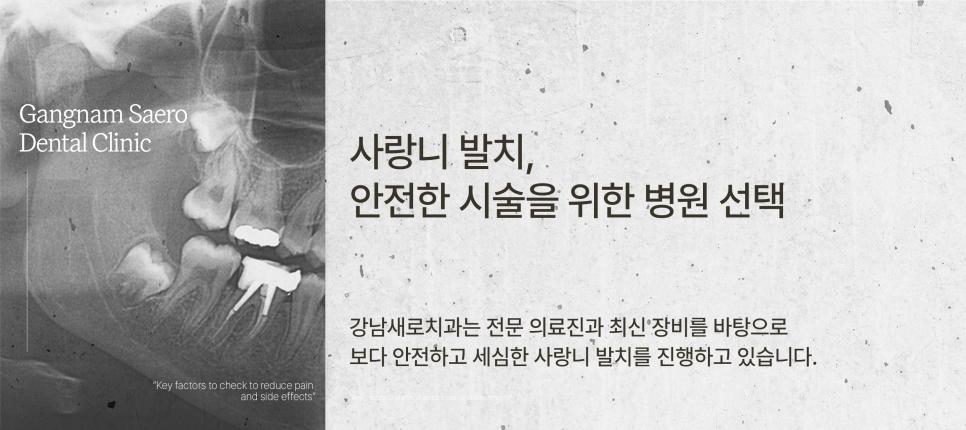
If you are preparing for wisdom tooth extraction,
the first thing to check is
how precisely the position of the tooth and its relationship to the nerve can be identified.
In particular, for difficult cases such as impacted wisdom teeth or horizontal wisdom teeth,
a simple visual diagnosis has limitations,
so analysis using precision equipment is important.
In addition, the experience of the medical team
actually performing the extraction is also very important.
Because every wisdom tooth differs in shape and position,
the judgment of how to approach the extraction process
has a major impact on the outcome.
If you are considering wisdom tooth extraction,
it is a good idea to check whether the dental clinic can precisely identify the nerve position
and provide oral and maxillofacial surgery care.
Gangnam Saro Dental Clinic
provides safer and more careful
wisdom tooth extraction based on specialized medical staff and the latest equipment.
By fully considering the position and difficulty of the wisdom tooth,
the clinic sets up a treatment plan in a way that reduces pain and burden,
so you can prepare for extraction with greater peace of mind.
- This post is a post presenting medical information, etc. by a medical institution due to a third-party contractual relationship.