
After root canal treatment, is a crown really necessary?
Dental crown
A quick look at the reasons, types, and treatment process
When decay becomes deep enough to require root canal treatment,
most people hear after the treatment is finished,
“Now you need to get a crown.”
At first, you may wonder why additional treatment is needed
after the cavity has already been treated.
Many people also think that partial restoration treatments,
such as resin or inlays,
might be enough.
However, a tooth that has undergone root canal treatment
is often in a state where the inside has become much weaker,
even if it looks fine from the outside.
In other words, it is not enough to simply remove the decay and stop there;
it is essential to protect the weakened tooth
so it can be used for a long time.
The treatment needed at this stage is the dental crown.
Today, we will simply organize why crown treatment is necessary,
what materials are used,
and what order the treatment follows.
�
�
Why a dental crown is needed after root canal treatment
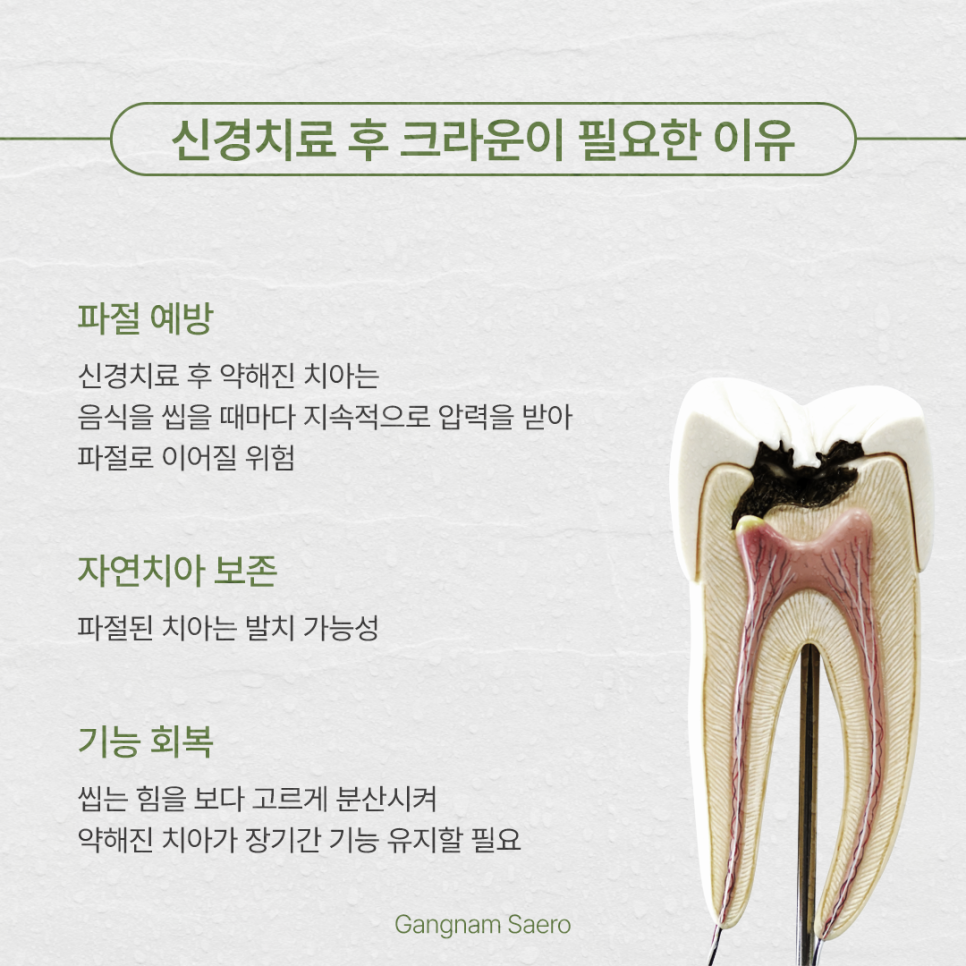
If a tooth needs root canal treatment,
it is often because the cavity has already progressed deep inside the tooth.
When the decay is removed
and the root canal treatment is completed,
the inside of the tooth can become much weaker than before.
To put it simply, a tooth that has finished root canal treatment
can be similar to a container
with only the outer wall left
and the inside hollowed out.
Because of that, even the force from everyday chewing
can make it more likely to crack or break.
Preventing fracture
Teeth are continuously subjected to pressure
every time we chew food.
A tooth weakened after root canal treatment
may have reduced ability to withstand this force,
so if it is used without protection,
there is a risk that it will fracture.
Preserving the natural tooth
If it is not covered and protected with a crown,
eventually the tooth may break or suffer greater damage,
which can even lead to extraction.
In other words, crown treatment is also a treatment
for preserving the remaining natural tooth as long as possible.
Restoring function
A crown that covers the entire tooth
distributes chewing force more evenly,
helping the weakened tooth maintain function over a long period.
In the end, crown treatment is not simply the process of placing a prosthesis;
it can be seen as the final step in protecting
a tooth weakened after root canal treatment.
How are dental crown types different?
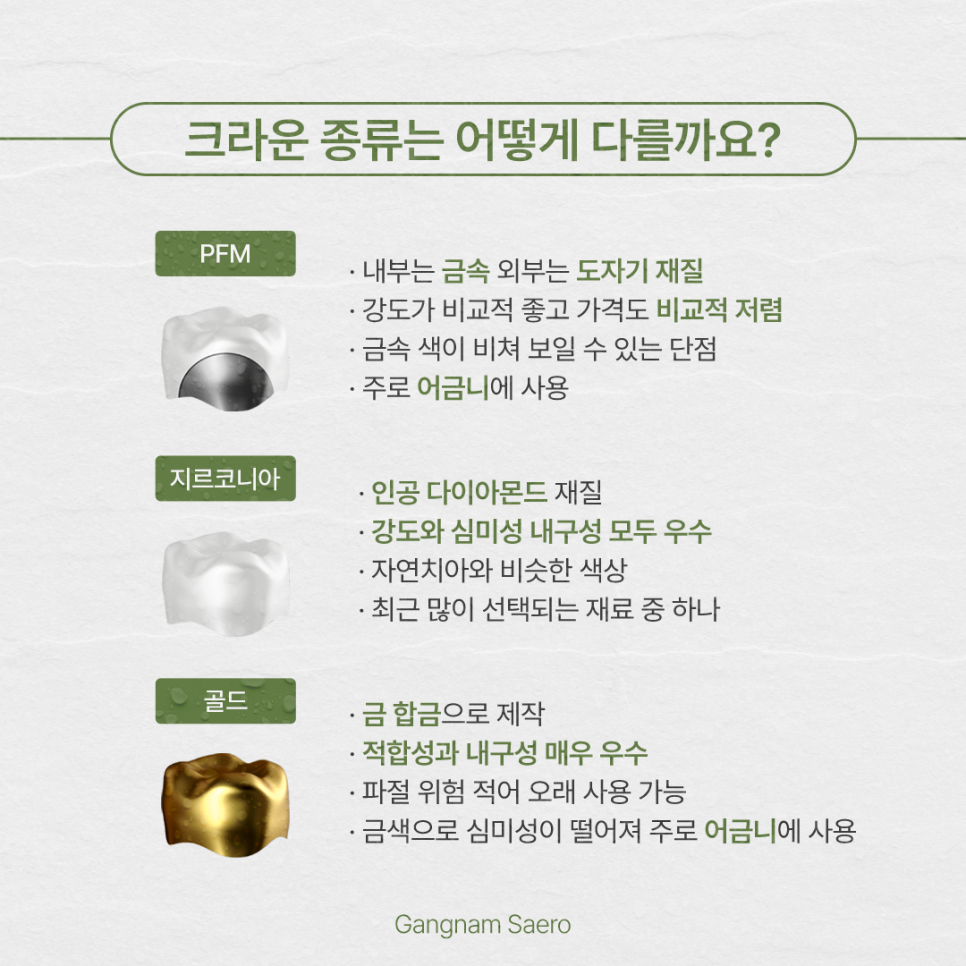
Crown characteristics vary depending on the material used.
The materials commonly chosen include the following:
PFM crown
PFM is a type made with metal on the inside and porcelain on the outside.
It has relatively good strength
and is fairly reasonably priced,
so it has been widely used.
However, over time,
the metal color may show through near the gum line,
so it is used more often for molars
than for areas where aesthetics are important.
Zirconia crown
Zirconia is widely used as a material that considers both strength and aesthetics.
It can achieve a tooth-like color,
making it relatively suitable for visible areas,
and it also has excellent durability.
For that reason, it is one of the materials
frequently chosen in crown treatment today.
Gold crown
A crown made from a gold alloy,
with excellent fit and durability.
It has the advantage of being less likely to fracture
and can be used for a long time,
but because the gold color remains visible,
it is mainly used for molars
rather than areas where aesthetics are important.
In other words, dental crown types are not just different in price;
the selection criteria can vary depending on aesthetics, strength, the area of use, and the patient’s preference.
So rather than asking which material is the best,
it is more important to choose a material
that matches the current tooth location and condition.
Dental crown treatment process and duration
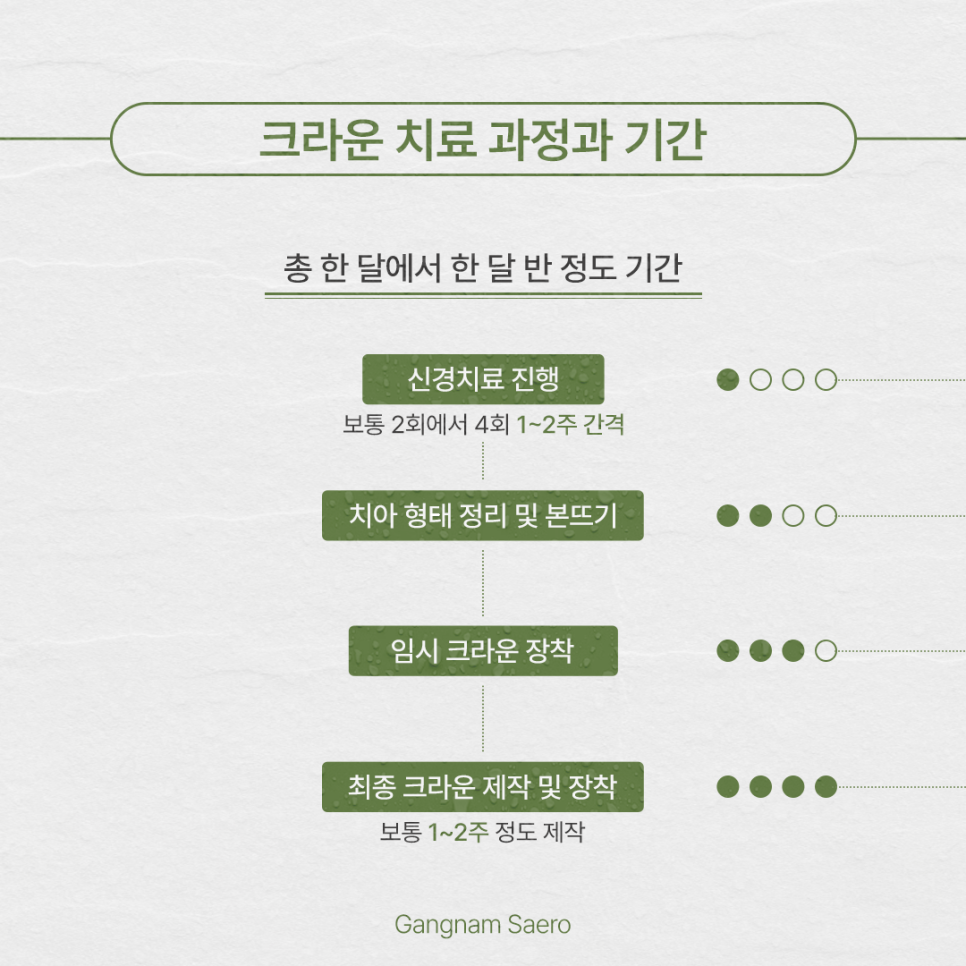
The process from root canal treatment to a crown
often does not end in one visit,
but proceeds through several steps.
In general,
it may take about one month to one and a half months,
and the exact duration can vary depending on the condition of the tooth.
It usually proceeds in the following order.
- Root canal treatment
Usually carried out over about 2 to 4 visits,
and depending on the condition of the tooth,
treatment may be done at 1- to 2-week intervals.
- Shaping the tooth and taking an impression
Once the root canal treatment is finished,
the tooth is shaped so that the crown fits properly,
and an impression is taken.
- Temporary crown placement
Before the final prosthesis is completed,
a temporary crown is placed to protect the tooth.
During this period, it is best to avoid very hard or chewy foods.
- Final crown fabrication and placement
Making the prosthesis
usually takes about 1 to 2 weeks,
and once it is completed, it is finally placed
to check the bite and fit.
As such, crown treatment may look like a simple covering procedure,
but it is carefully carried out through several necessary steps
to help the tooth be used for a long time.
Care is still important even after getting a crown
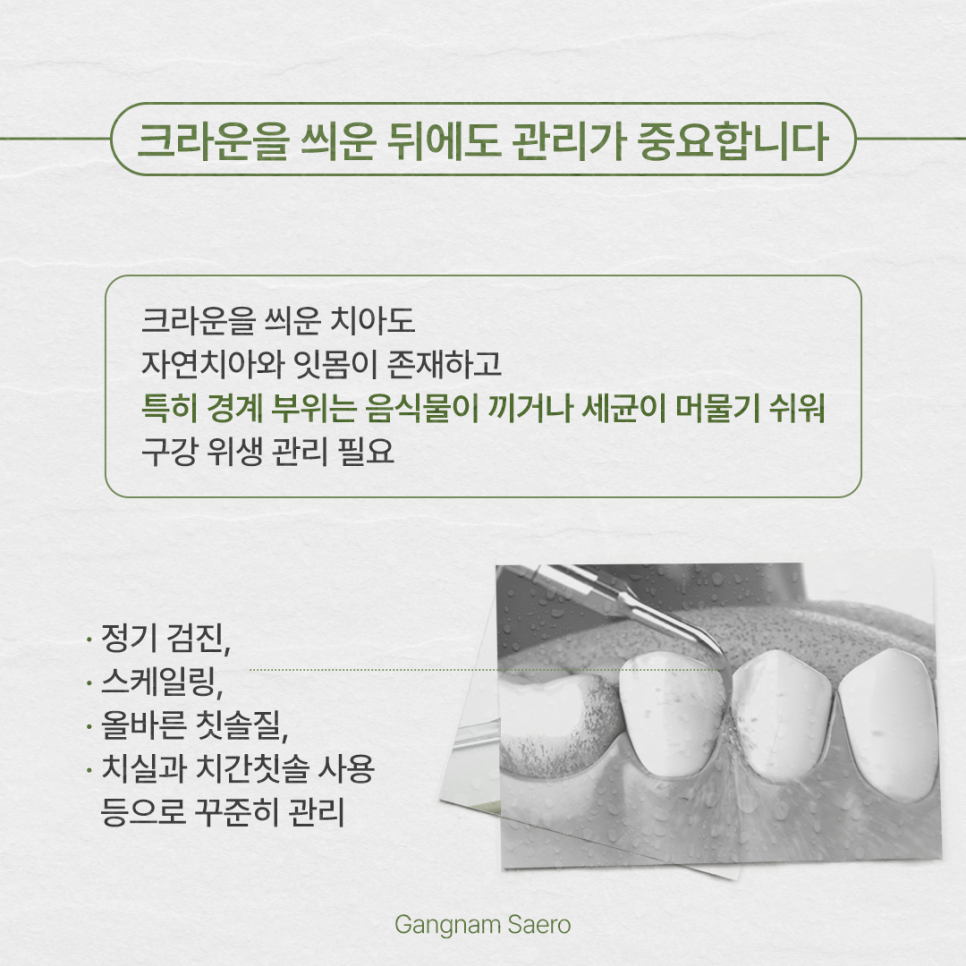
Many people think that once a crown is placed,
the tooth can no longer develop cavities.
But in reality, that is not the case.
A crown itself is a prosthesis,
but underneath and around it,
there is still natural tooth structure and gum tissue,
so if oral hygiene is neglected,
problems can arise again.
In particular, the crown margin is an area
where food can get trapped
or bacteria can remain easily, so care is important.
Therefore, even after dental crown treatment,
it is necessary to continue with regular checkups,
tartar removal,
proper brushing,
and using dental floss and interdental brushes.
In other words, a crown is not the end of treatment;
to use the natural tooth for as long as possible,
you need to continue care even after the protective device has been placed
in order to achieve satisfying results.
Where is a good place to get crown treatment?

For office workers or students,
who may have difficulty adjusting their schedules,
treatment planning and visit convenience are also important factors.
Root canal treatment and crown treatment
often require multiple visits rather than being completed in one go,
so it is helpful to choose a dental clinic
with a well-organized treatment system.
Gangnam Saero Dental Clinic
operates a treatment system that allows patients
to receive care more conveniently despite busy schedules
through evening and weekend appointments.
In addition, by working together with specialists in prosthodontics,
as well as orthodontics, conservative dentistry,
and oral and maxillofacial surgery,
the clinic can create a customized treatment plan
that fits each patient’s condition.
Beyond cavity treatment,
it also allows comprehensive review of various dental services
such as implants, orthodontics, and wisdom tooth extraction,
so when treatments need to be connected,
a more systematic approach is possible.
A tooth that has finished root canal treatment
may look fine on the outside
but often has become weak internally.
So rather than thinking that cavity treatment is simply over,
you should also consider the step of protecting the tooth
so it can be used for a long time in the future.
A dental crown after root canal treatment
covers and protects the weakened tooth, helps prevent fracture,
and is an important treatment that helps preserve the natural tooth
for as long as possible.
Also, because strength, aesthetics,
and appropriate usage areas differ depending on the material,
it is necessary to choose one that fits the current condition of the tooth.
If you were wondering why a crown is needed after root canal treatment,
it may be helpful to understand it now not as a simple additional procedure,
but as an essential protective process
for preserving the natural tooth.
A new smile, a new beginning
Check it out at Gangnam Saero Dental Clinic!
- This post is an article provided by a medical institution due to a third-party contractual relationship regarding medical information, etc.


�