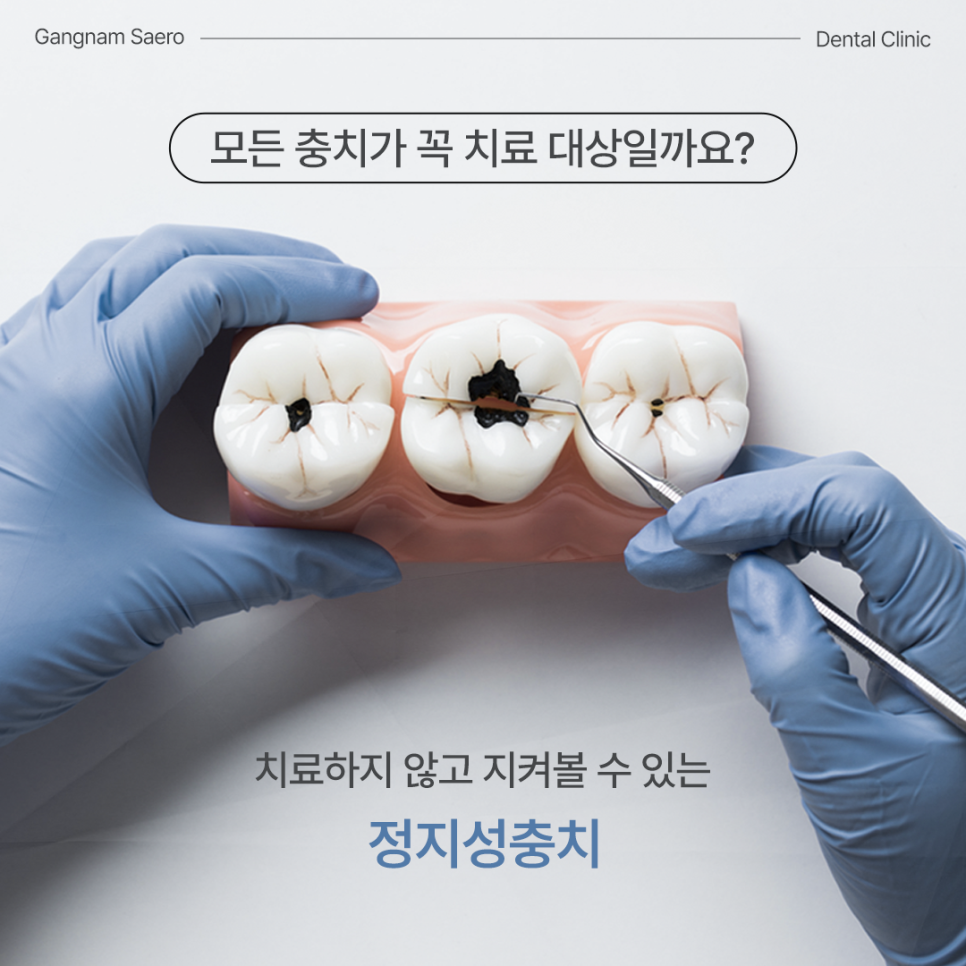
Do all cavities necessarily need treatment?
An arrested cavity that can be watched without treatment
When receiving dental care,
there are surprisingly moments that feel the most confusing.
That is when different dental clinics give slightly different explanations about the same tooth.
If one place says, “It needs treatment now,”
while another says, “We can still watch it for now,”
it is only natural for patients to wonder whose explanation to trust.
This difference is not simply due to each doctor’s style,
but because the decision can change depending on whether the cavity is still progressing
or has already stopped.
In other words, not all cavities are in the same condition,
and it is not true that every cavity must be drilled and treated right away.
Today, let’s take a simple look at what an arrested cavity is,
how it differs from a typical progressing cavity,
and what criteria are used to decide whether treatment is needed without overtreatment!
What is a cavity?
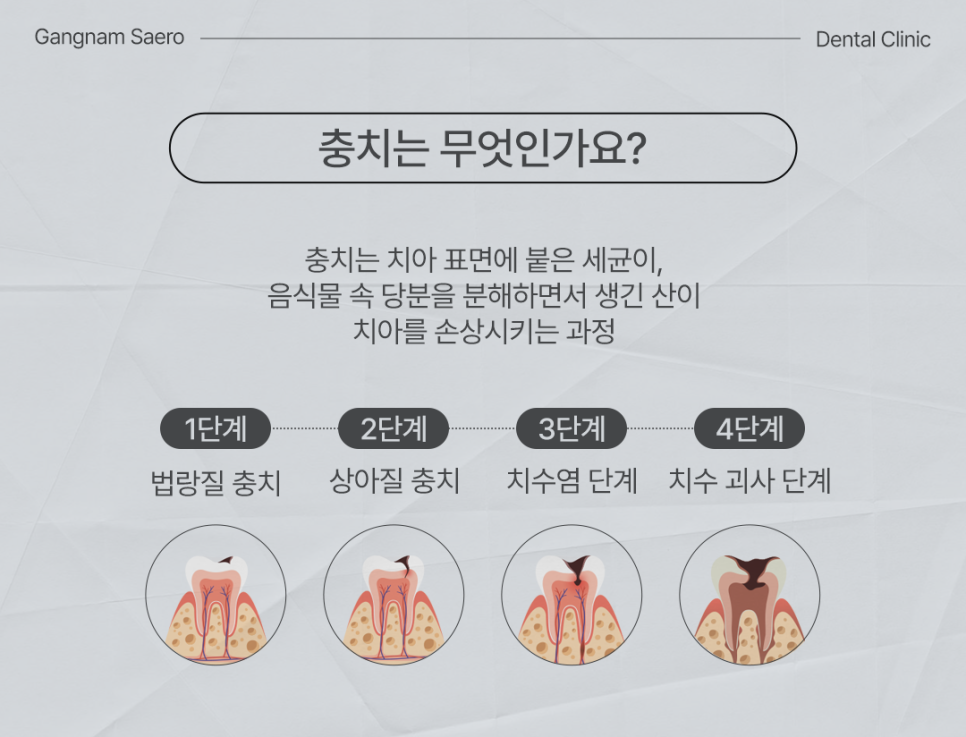
A cavity is the process in which acids produced when bacteria attached to the tooth surface break down sugars in food
slowly damage the tooth.
As this process repeats,
damage gradually progresses from the outermost layer of the tooth inward,
and depending on the condition, it can lead to pain, inflammation, or infection.
In general, cavities can be divided according to the degree of progression as follows.
Stage 1, enamel caries
This is an early stage in which only the enamel, the outermost layer of the tooth, is damaged.
There is usually no pain,
but if not managed, it can progress deeper.
Stage 2, dentin caries
The cavity has passed through the enamel and progressed into the dentin inside.
You may start to feel sensitivity or discomfort
to cold or sweet foods.
Stage 3, pulpitis stage
The cavity has progressed close to the nerve of the tooth or into the nerve itself,
causing inflammation.
At this stage, tooth pain may become severe,
and root canal treatment may be needed.
Stage 4, pulp necrosis stage
The nerve is damaged or necrotic,
and in some cases it may be difficult to save the tooth.
If the condition is severe, extraction may need to be considered.
Although cavities are generally known as a disease that progresses over time,
not all cavities continue to worsen until the end.
Some no longer progress
and remain in a stopped state,
and this is what is called an arrested cavity.
What is an arrested cavity?
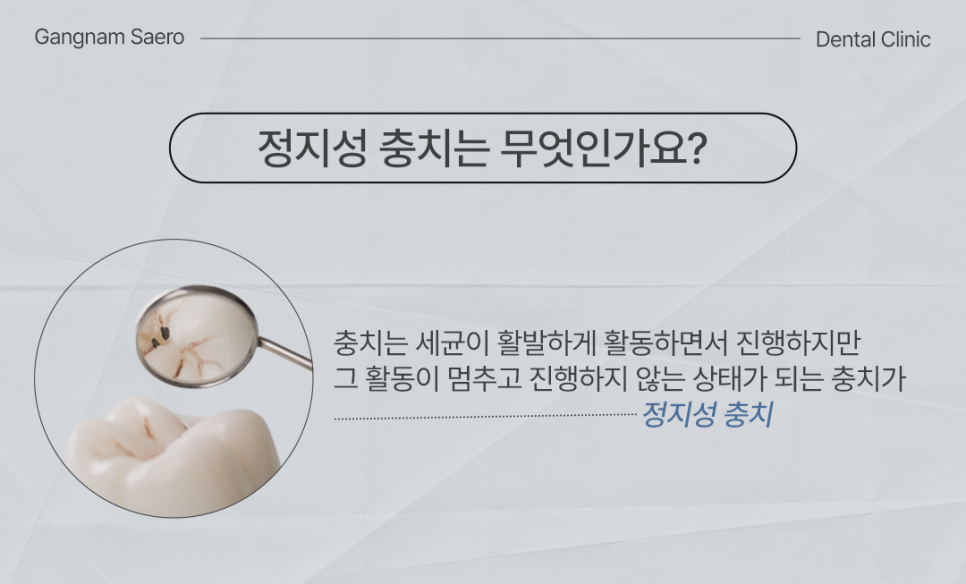
Cavities progress while bacteria are actively working,
but in some cases that activity stops
and the condition no longer progresses.
Such cavities are called arrested cavities, or inactive cavities.
They are usually seen in early cavities that have damaged only the enamel,
and in cases where the tooth shows a defensive reaction on its own
or the oral environment improves,
so the cavity no longer progresses.
In other words, even if it looks slightly dark or seems like a trace on the surface,
if bacterial activity is not currently active,
immediate removal treatment may not be necessary.
The features of an arrested cavity are usually as follows.
The surface color may look dark brown or black
The outside may feel hard and smooth, or glossy
There is often no pain or sensitivity
Even after time passes, the size or depth does not change clearly
In such cases, rather than always removing tooth structure and filling it,
regular observation and management may be more appropriate.
How is an arrested cavity different from a progressing cavity?
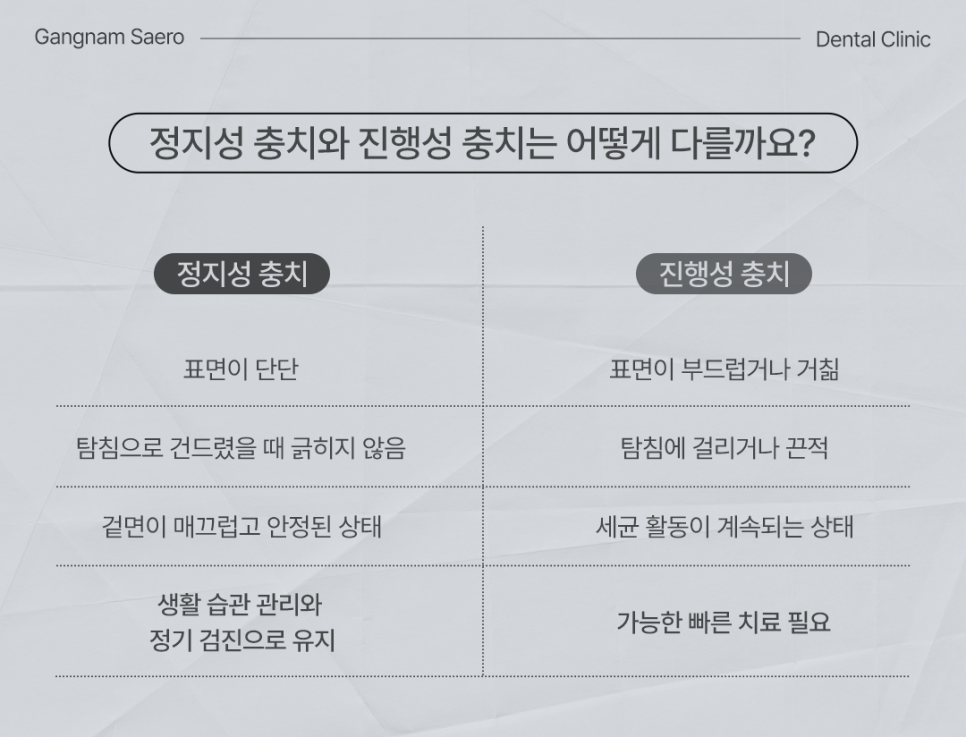
At a glance, an arrested cavity and a progressing cavity
may look similar.
That is why an accurate distinction must be made through a dental examination.
Dentists usually use an instrument called an explorer
to check the surface condition.
Arrested cavity
The surface is hard,
and when lightly touched with an explorer, it does not easily scratch.
The outer surface is relatively smooth,
and it often appears to be in a stable state.
Progressing cavity
The surface is soft or rough,
and it may catch on the explorer or feel sticky.
In other words, bacterial activity is still ongoing,
so the cavity is likely still progressing.
Because progressing cavities can deepen over time,
they need treatment as quickly as possible.
On the other hand, if an arrested cavity is currently stable,
it can often be maintained with lifestyle management and regular checkups alone.
The problem is that this boundary is not always very clear.
Depending on the patient’s oral hygiene, cavity location, eating habits, saliva characteristics, and visit intervals,
the decision about whether treatment is needed can vary slightly.
That is why, even for the same tooth,
the explanation may feel different from one clinic to another.
Criteria for deciding on cavity treatment without overtreatment

Cavities should be found and treated quickly,
but that does not mean every cavity should always be treated immediately.
To avoid overtreatment
while not missing necessary care,
it is a good idea to look at several criteria together.
Is the degree of cavity progression clearly checked?
It is important to confirm whether the dentist explains not only by visual inspection,
but also through X-rays or explorer examinations,
how far the cavity has progressed.
Is observation over time offered as an option?
Rather than rushing into treatment,
if the explanation is that changes will be monitored first through regular checkups,
that can help reduce the possibility of overtreatment.
This is especially important in many cases of arrested cavities.
Are the patient’s lifestyle habits and oral environment considered as well?
Even the same cavity
may require different management depending on the patient’s brushing habits, eating habits, tooth position, and oral hygiene status.
It is important not to judge only the lesion itself,
but to provide care that also considers overall oral health.
An arrested cavity may require management more than treatment

If a cavity is judged to be arrested,
it may be more important to keep the current condition stable
than to remove tooth structure without cause.
In other words, not treating it
does not mean neglecting it,
but rather providing care by actively managing it and keeping an eye on it.
What matters in such cases is the following.
Regularly check for changes through routine exams
Maintain oral hygiene with proper brushing and flossing
Reduce the frequency of sugar intake and manage eating habits
If needed, combine preventive care such as fluoride application
In the end, an arrested cavity is not so much “a cavity that does not need treatment,” as it is
“a cavity for which management and observation are more important than immediate removal treatment.”
Reliable dental care begins with
the judgment to stop when needed
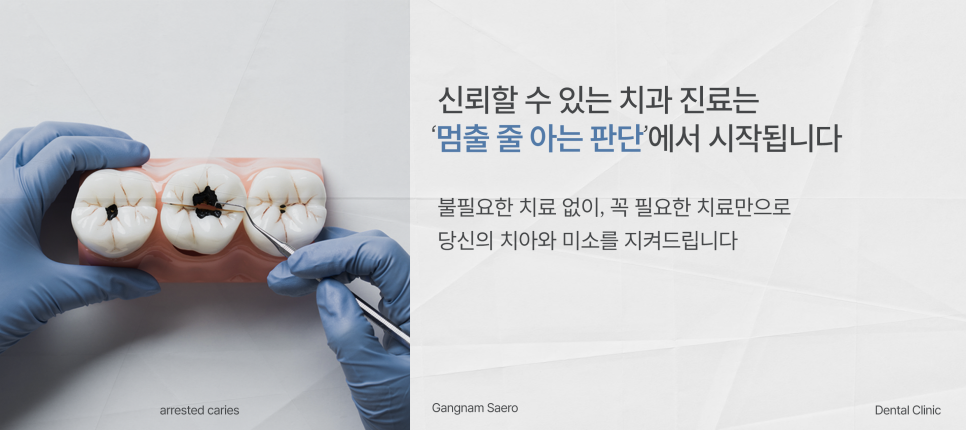
Trust in dental care
does not come simply from recommending a lot of treatment.
Rather, trust is built when treatment is explained accurately when it is truly needed,
and when unnecessary procedures can be stopped
in situations where treatment is not necessary.
Gangnam Saero Dental Clinic
also places importance on carefully distinguishing
between arrested cavities and progressing cavities in cavity care,
and suggesting a direction tailored to each patient’s condition.
In other words, rather than treating as quickly as possible no matter what,
the essence of care is to provide only the treatment that is truly needed.
Not all cavities are necessarily immediate candidates for treatment.
Sometimes management may be a better choice than treatment,
and that judgment begins with an accurate diagnosis and an honest explanation.
We protect your teeth and smile
with only the necessary treatment, without unnecessary procedures.
- This post is provided with medical information from a medical institution due to a contractual relationship with a third party.