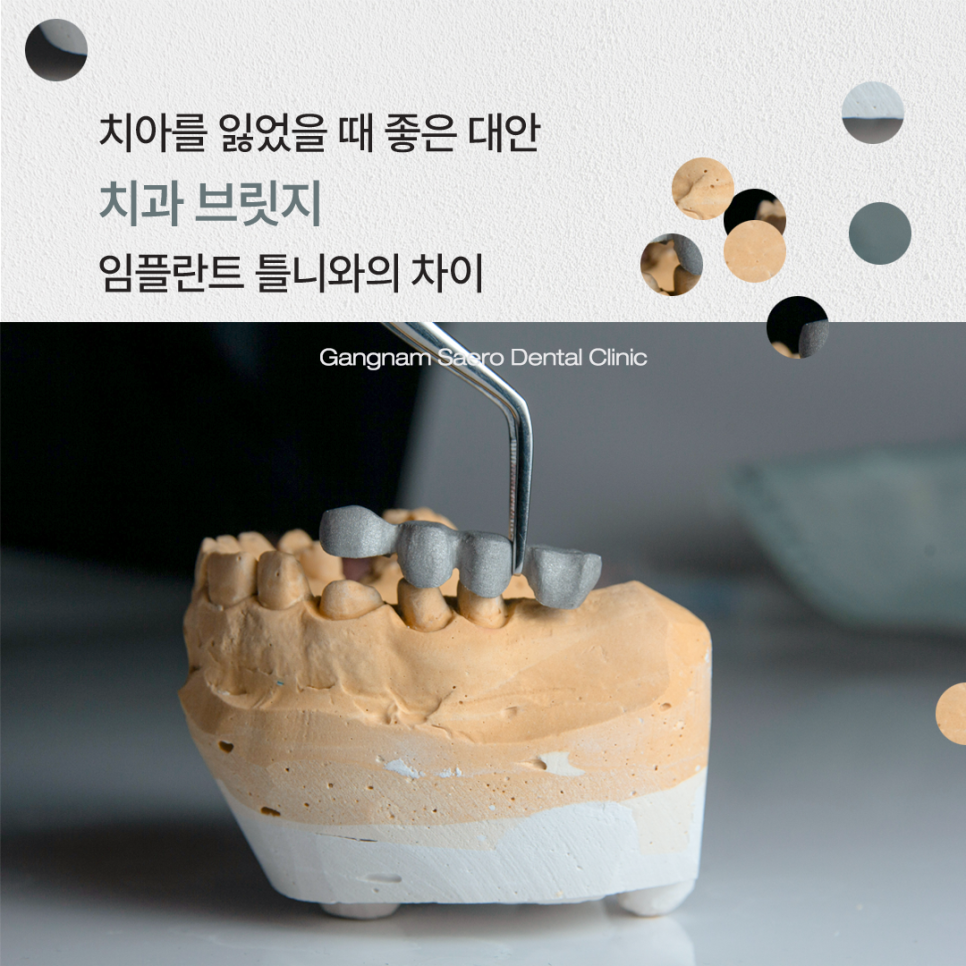
A Good Alternative When You Lose a Tooth
Dental Bridge
Differences from Implants and Dentures
We chew food, speak, and smile dozens of times a day.
Because these everyday actions feel so natural, we often do not fully realize the role of a single tooth.
But once you actually lose a tooth,
the inconvenience can feel bigger than expected!
Chewing strength changes, pronunciation feels awkward, and even smiling starts to feel like something to be conscious of.
When a tooth falls out, many people first think of treatments such as
implants or dentures.
But there is another important alternative in between.
That is the bridge.
A bridge uses the remaining teeth
to connect the missing space,
and depending on the case, it can be a balanced choice
in terms of function, aesthetics, and cost.
Today, we will go over what a bridge is,
how to understand terms like dental bridge, dental clinic bridge, and implant bridge,
and what differences there are
when compared with implants or dentures, step by step!
What is a bridge?
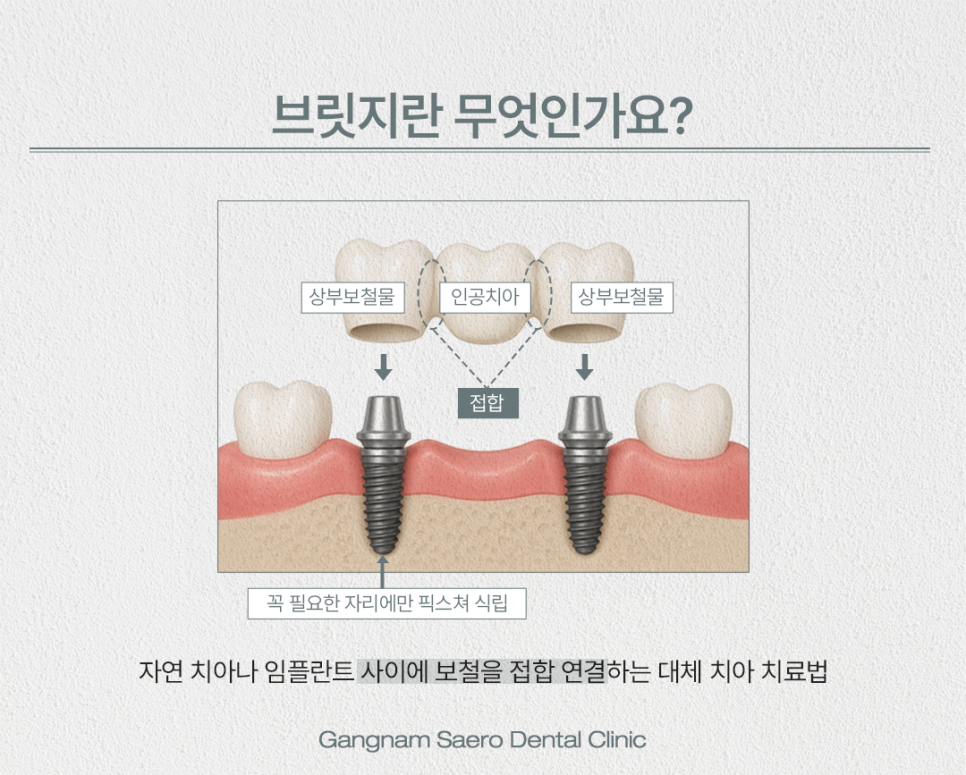
A bridge is a type of prosthetic treatment
that connects like a bridge, as the name suggests.
It uses the natural teeth on both sides of the missing tooth space,
or in some cases uses implants as supports,
to connect the space with artificial teeth.
In other words, instead of filling only the missing tooth area by itself,
it is a concept of linking the structures on both sides like a bridge.
What are commonly called dental bridge, dental clinic bridge, and implant bridge
are all treatment methods based on this kind of connecting structure.
The key point is to restore the function and shape of the missing area
by using the remaining teeth or implants as supports.
The biggest advantage of a bridge is that
it can restore a relatively natural shape
and stable chewing function.
However, when natural teeth are used as supports,
some reduction of the adjacent teeth may be necessary,
so an accurate diagnosis of the current tooth condition is very important.
How are bridges different from dentures and implants?
When a tooth is lost,
the main treatments that can be considered
are broadly bridges, dentures, and implants.
All three share the common goal of replacing missing teeth,
but they differ in structure, feel during use, and treatment method.
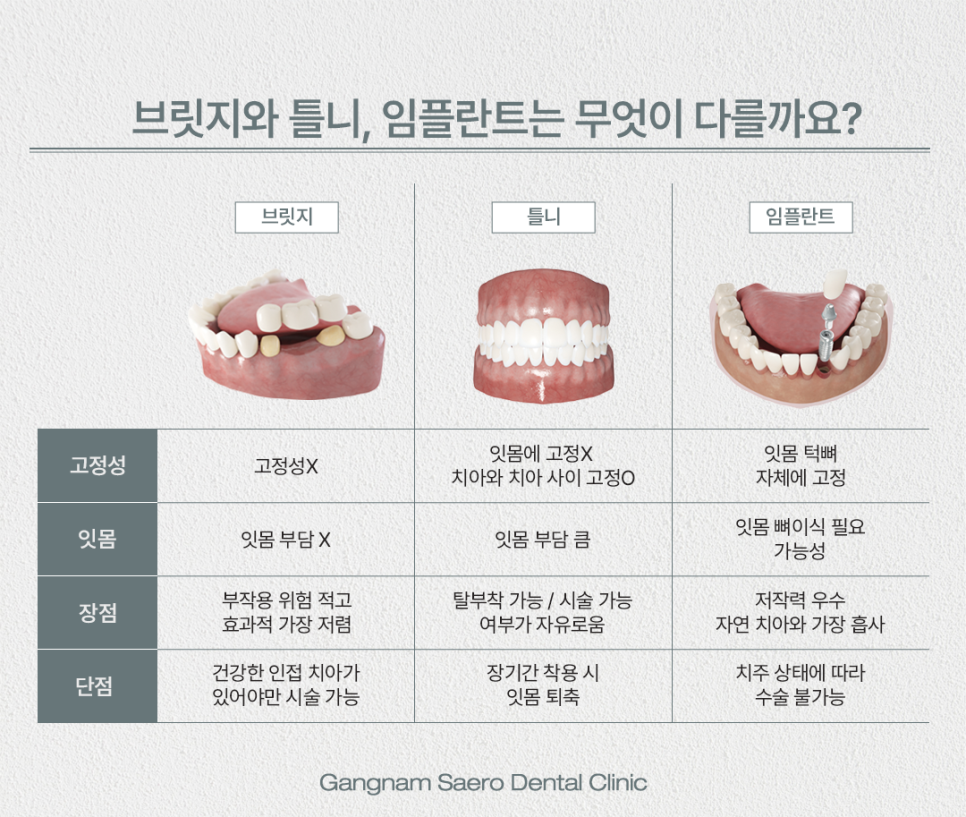
Difference in fixation
A bridge can be used relatively stably
because the prosthesis is connected to adjacent teeth or implants.
Dentures are removable,
so you may feel movement while using them,
and an adjustment period is often needed.
Implants are placed directly into the jawbone,
so among the three, they offer the strongest fixation.
Burden on the gums
A bridge is not a structure that sits directly on the gums,
so it tends to irritate the gums less than dentures.
On the other hand, dentures continuously place force on the gums,
which can lead to gum recession and discomfort over time.
Implants require surgery to be placed directly into the jawbone,
and in some cases additional procedures such as bone grafting may be needed.
Differences in advantages and disadvantages
A bridge can be relatively economical and can also be made to look natural aesthetically,
and it has the advantage of requiring less surgical burden.
Dentures are removable, which makes them easier to care for,
but they may be less satisfactory in terms of stability and chewing strength.
Implants can create the most solid and independent structure,
but the cost and surgical burden are relatively greater.
The drawback of a bridge is that
the adjacent teeth must be healthy,
and those teeth may need to be partially reduced.
However, overall,
when considering the balance of function, aesthetics, and cost,
a bridge can be a sufficiently attractive treatment option.
When is bridge treatment suitable?
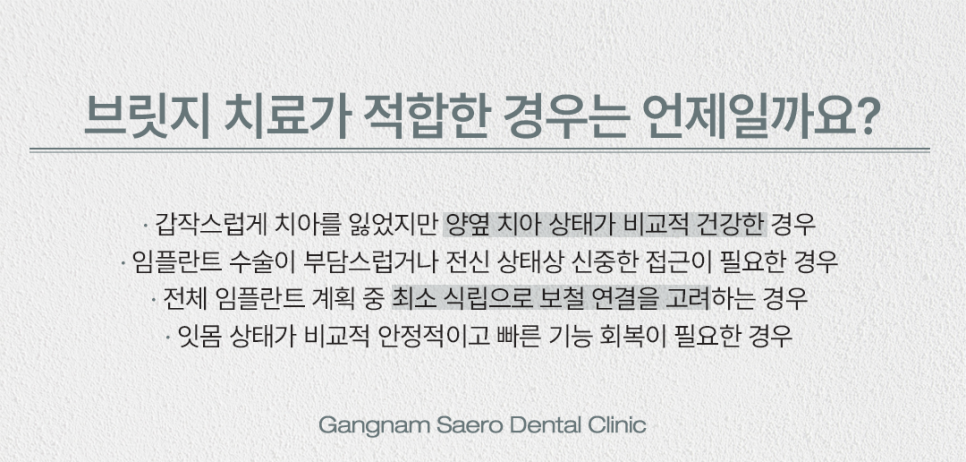
A bridge is not the right choice for every case of tooth loss,
but in certain situations it can be a very appropriate option.
When a tooth is lost suddenly but the teeth on both sides are relatively healthy
When implant surgery feels burdensome or requires a cautious approach due to overall health conditions
When considering prosthetic connection with minimal placement in an overall implant plan
When the gum condition is relatively stable and quick functional recovery is needed
In other words, a dental bridge or dental clinic bridge can be a good treatment option
when the surrounding teeth and gums are in good condition,
and when you want to restore aesthetics and function relatively quickly.
Also, because it is not a method that always requires surgery,
it can become a practical alternative for patients who feel burdened by implants.
Why is aftercare important after bridge treatment?

Even after treatment, a bridge requires consistent care.
Because the prosthesis is closely fitted to the adjacent teeth and gums,
if food debris and plaque buildup are not managed well,
problems can develop in the surrounding teeth and gums.
So when you use a bridge,
you need regular scaling,
floss or bridge-specific floss,
interdental brush care,
and periodic checkups.
In particular, in the case of an implant bridge,
not only the prosthesis but also the health of the jawbone around the supporting implant
must be maintained,
so regular X-ray exams and condition checks are important.
In the end, a bridge is not a treatment that ends with the procedure itself;
it is a treatment that can be used stably for a long time only when follow-up care continues as well.
Why is choosing the right clinic important for bridge treatment?
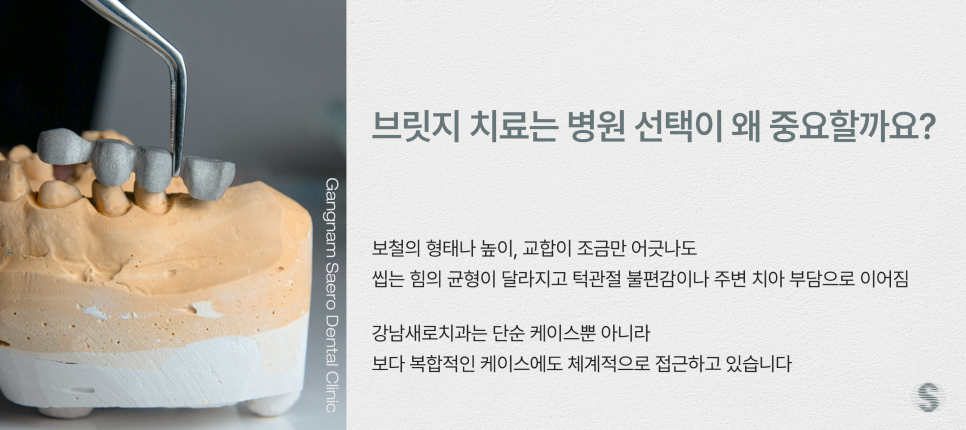
A bridge may seem like a simple treatment
that just fills the missing tooth space,
but in reality it is a precise prosthetic treatment
that must consider both aesthetics and function.
If the shape or height of the prosthesis,
or the bite,
is even slightly off,
the balance of chewing force can change,
and it may lead to jaw joint discomfort or added strain on the surrounding teeth.
So with bridge treatment,
the level of satisfaction can vary depending on
how accurately the current oral structure is diagnosed,
how precisely the prosthesis is designed,
and whether the treatment also considers the bite.
Gangnam Saero Dental Clinic
is led by Director Jae-wook Jeong, a prosthodontics specialist,
and plans and carries out various prosthetic treatments, including bridges,
with greater precision.
Based on experience in implant-focused treatment,
we also take a systematic approach not only to simple cases
but also to more complex cases.
In particular,
full-mouth implants
diabetes implants
hypertension implants
osteoporosis implants
PRF implants
autologous blood implants
alveolar ridge preservation, bone grafting, and sinus lift procedures, etc.
Because we have a wide range of treatment experience,
you can also receive broad counseling on which choice is more appropriate between bridges and implants.
Losing a tooth is not simply a matter of having an empty space.
It can affect chewing function, pronunciation, aesthetics, and even confidence in daily life.
But that does not mean every case must necessarily lead to surgery.
A way to restore function and aesthetics while making the most of the remaining natural teeth,
one answer is the bridge.
Dental bridge, dental clinic bridge, and implant bridge
are still being used as important alternative tooth replacement treatments
even now, as dental technology has advanced.
What matters is not which treatment is more famous,
but which method fits your current oral condition and lifestyle best.
If you are wondering what choice is right after losing a tooth,
it is best to consult with a specialist medical team
based on an accurate diagnosis.
New smile, new beginning
Gangnam Saero Dental Clinic.
- This post is medical information provided by a medical institution due to a contractual relationship with a third party.